
Requisites
Make Everybody Happy ~ MJT + 3 | By Eddie Carter
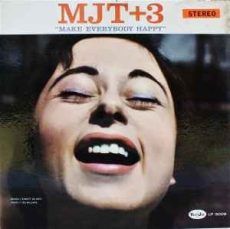
Submitted for your approval from my library this morning is one of the tightest, most underrated hard bop groups to emerge out of Chicago, Illinois, at the beginning of the sixties. MJT+3 (short for Modern Jazz Two + Three) was co-founded by drummer Walter Perkins and bassist Bob Cranshaw, who solidified the lineup by recruiting three young Memphis musicians: trumpeter Willie Thomas, alto saxophonist Frank Strozier and pianist Harold Mabern. “Make Everybody Happy” (Vee-Jay VJLP 3008/VJSR 3008) was the second of four albums the quintet made together and captures the ensemble delivering a distinct Midwestern brand of hard bop and firing on all cylinders. I own the 1960 U.S. Stereo misprint reissue (a stereo label on both sides listing the mono catalog number).
The title track, Make Everybody Happy by Harold Mabern, opens the album with sanctified blues and gospel overtones in a marching melody by the quintet. Frank enters first with a biting tone and imaginative ideas. Willie follows with a superbly constructed reading, and Harold cooks consistently into the theme’s reprise and close. The Trolley Song by Hugh Martin and Ralph Blane was introduced by Judy Garland in the 1944 film “Meet Me in St. Louis.” Perkins and the rhythm section mimic a train coming down the track toward the ensemble’s theme. On this twelve-minute trip, Willie, Frank, and Harold each take turns at the controls ahead of the quintet’s closing melody and Perkins’s fade-out.
Sweet Silver by Booker Little is a bluesy tribute to pianist Horace Silver, and the group’s opening chorus gets into a good groove right out the gate. Frank’s opening solo will have the listener popping their fingers, then Willie impresses on the following statement with solid assurance. Harold delivers a final, concise reading that swings comfortably before leading the quintet into the reprise. Don’t Get Around Much Anymore by Duke Ellington and Bob Russell opens Side Two, with the ensemble’s melody giving this old favorite fresh clothes. Willie and Frank both take short solos, with Walter and Bob offering a concise comment before the closing chorus.
Up next is My Buddy by Walter Donaldson and Gus Kahn. After the front line’s introduction, Frank takes the lead on the melody, and Willie switches to a mute to join him. Frank shapes the first solo with a touch of the blues. Willie follows with an exquisite reading, smooth as glass. Harold then delivers an impressive statement before the climax. Harold Mabern’s original, Richie’s Dilemma, kicks the energy level up for the quintet’s medium melody. Willie goes first with a laid-back solo, then Bob takes a short walk in the following interpretation. Frank works his magic next, followed by Harold, who provides a delightfully constructed reading. Willie and Frank share an impressive offering with Walter, leading to the group’s climax.
The quintet eases back on the throttle one final time for Love Letters by Edward Heyman and Victor Young. The opening ensemble begins with Willie’s elegant mid-tempo bounce. Frank’s opening statement is warm and compassionate. Then Walter has his say next and gives a short, deeply satisfying moment. Willie puts an exclamation point on the song with a mellow performance, before the group reconvenes for the closing chorus. The session was supervised by Sid McCoy, but the recording engineer is not known. The album’s sound quality is excellent, with a soundstage that’s warm, engaging and musical.
Make Everybody Happy by MJT + 3 is an overlooked gem with a well-balanced lineup and thoughtful repertoire. Willie Thomas and Frank Strozier create a compelling two-horn conversation, while Harold Mabern adds harmonic richness and rhythmic drive. Bob Cranshaw and Walter Perkins anchor the ensemble with steady, assured support. Together, MJT + 3 offers the listener a prime example of soulful, bluesy jazz that, as the title suggests, is sure to Make Everybody Happy every time it’s on the turntable. I highly recommend it for your library, and I hope you’ll check it out the next time you visit your favorite record store!
~ Don’t Get Around Much Anymore – Source: JazzStandards.com ~ Love Letters, The Trolley Song – Source: Wikipedia.org © 2026 by Edward Thomas Carter