

On The Bookshelf
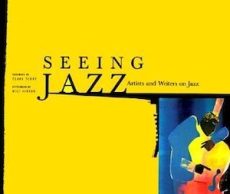
Seeing Jazz: Artists & Writers On Jazz
Within these 144 pages, Seeing Jazz is a showcase of 77 paintings, sculptures, drawings, collages, and photographs, accompanied by literary selections, that express the many moods of jazz. This is jazz, art, and literature in concert.
In this museum of artists are, but not limited to, include Romare Bearden, Sam Gilliam, James Phillips, Miles Davis, Gjon Mili, Jacob Lawrence, Stuart Davis, Ann Tanksley, Archibald Motley, Ed Love, Gordon Parks, JeanMichel Basquiat, Henri Matisse, William Claxton, Stuart Davis, Ed Love, and Man Ray,
A representation of authors include Julio Cortazar, Ntozake Shange, Ralph Ellison, and Toni Morrison. The Foreword was written by trumpeter Calrk Terry, the Afterword by bassist Milt Hinton. The introduction is by Columbia University jazz scholar Robert O’Meally.
Whether it is improvisation, spontaneity, fusion, freedom or innovation, jazz has always been about more than music, and the ideas and moods of jazz have ruffled the minds of creatives throughout every category of the arts.
Seeing Jazz: 1997 | Marquette Folley-Cooper, Deborah Macanic, Janice McNeil
Chronicle Books | Smithsonian Institution Traveling Exhibition Service

On The Bookshelf
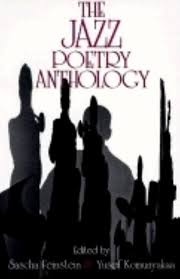
The Jazz Poetry Anthology
Since the turn of the century, poets have responded to jazz in all its musical and cultural overtones. The poems here cover the range of jazz itself: from early blues to free jazz and experimental music. Among the 132 poets included are James Baldwin, Lawrence Ferlinghetti, Langston Hughes, Jack Kerouac, Mina Loy, Ishmael Reed, Sonia Sanchez, Amiri Baraka, Carol Bergé, Sterling A. Brown, Alice Fulton, and Carl Sandburg.
The poems give the reader a sense of jazz imagery through the history of the music, yet have been lost to so many jazz enthusiasts and aficionados of the 20th century. Many of the names in this publication will be familiar but most one will discover anew.
Each poet has heard, felt the emotion of and experienced the music from a different perspective, writing in that voice. This makes for a pleasurable journey through time for the reader, especially those familiar with the music and the musicians.
This anthology represents the broad appreciation for jazz as poetic inspiration, not only from the Beat movement but from writers across the decades and around the world.
The Jazz Poetry Anthology: 1991 | Sasha Feinstein & Yusef Komunyakaa
Indiana University Press
On The Bookshelf
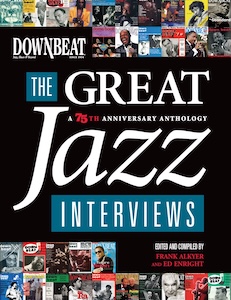
Downbeat: The Great Jazz Interiews: 2009 | Frank Alkyer & Ed Enright
In honor of its 75th anniversary, publisher Frank Alkyer, with the assistance of the magazine’s editors past and present, has combed through the vast DownBeat archives and assembled a compendium of the magazine’s most celebrated, historical, and groundbreaking features, in-depth interviews, insights, classic photographs and magazine covers from the illustrious history of the world’s top jazz magazine, DownBeat.
This anthology includes the greatest of DownBeat‘s Jazz Hall of Famers: from early legends like Jelly Roll Morton, Louis Armstrong, Count Basie, Duke Ellington, and Benny Goodman; to bebop heroes like Charlie Parker, Dizzy Gillespie, John Coltrane, Sonny Rollins, and Miles Davis; to truly unique voices like Ornette Coleman, Cecil Taylor, Thelonious Monk, and Rahsaan Roland Kirk; to the pioneers of the electric scene like Chick Corea, Herbie Hancock, Pat Metheny, and Joe Zawinul.
The Great Jazz Interviews delivers the legends of jazz, talking about America’s music and America itself, in their own words. At times this collection reads less like a book and more like a conversation about jazz among the artists themselves.
On The Bookshelf
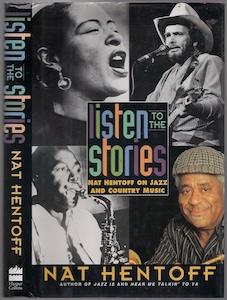
Listen To The Stories
Nat Hentoff has been listening to jazz, blues, country, and gospel since he was eight years old and tuned in (under the bedsheets) to Fats Waller broadcasting from Chicago’s Hotel Sherman during the Depression – and he has been writing about it nearly ever since, with ever-increasing passion.
This new book is the fruit of long nights of listening to, watching, traveling and talking with, and knowing firsthand jazz musicians and country and gospel singers from all over the nation – a book of truly American originals.
In this 220 page collection of stories he writes poignant descriptions of the early days of Roy Eldridge, the last years of Billie Holiday and Bird. He chronicles accounts of Duke, the Count, and Dizzy. Listen to the Stories covers new recordings and old legends, remarkable lives and unforgettable music.
On The Bookshelf
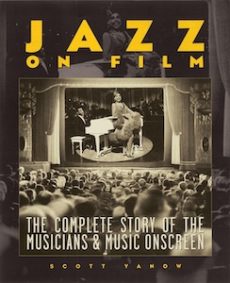
Jazz On Film: The Complete Story Of The Musicians & Music Onscreen is a compendium of reviews, analyzes, and rates virtually every appearance of a jazz musician or singer on film. After presenting a detailed essay on the history of jazz on film and television.
Reading this book one gets a brief history of jazz on film between 1917 to 1960, accounting for Soundies, Snader telescriptions, jazz on television and movies. from 1960 to the present day, Ruth Etting, the film careers of Hoagy Carmichael, Harris Barris, Cliff Edwards, Kay Kyser, and Svend Asmussen. It includes three jazz film collectors: Mark Cantor, Ken Poston, John Altman.
Yanow reviews and rates 1,300 movies, documentaries, shorts, videos, and DVDs. This book lets readers know how to view the jazz legends and the greats of today, and what DVDs and videos are worth acquiring. Each film is given a 1 to 10 rating and a concise description of its contents and value.