

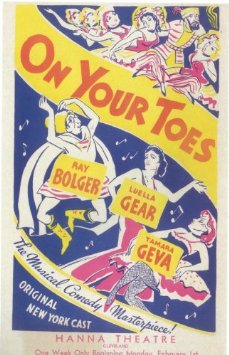
From Broadway To 52nd Street
On Your Toes opened at the Imperial Theater on April 11, 1936. The show ran three hundred and fifteen performances and the music and lyrics were once again composed by Richard Rodgers and Lorenz Hart. The production starred Ray Bolger, Tamara Geva and Doris Carson.
the Story: Junior Dolan, son of an old vaudevillian, becomes a music professor. He takes on the task of helping a struggling Russian ballet company. When complications arise, Junior is forced to take the place of the lead dancer and perform opposite Vera Barnova. Gangsters try to shoot him during the ballet but they are apprehended in time for a happy ending that included his proposal of marriage to sweet Frankie Frayne. From this musical came two songs that have endured as jazz classics – Glad To Be Unhappy and There’s A Small Hotel.
Broadway History: Broadway and 39th Street became the site where Aronson built The Casino with the procurement of financing from some of the wealthiest finance wizards of the day – the Goulds, Roosevelts, Vanderbilts and Morgans. When it opened I n 1882, The Casino was considered the finest example of Moorish architecture outside of Spain.
While Aronson was building his theatre, Charles Frohman had begun his separate career as the manager of theatrical professionals and in 1893 opened his own theatre. The Empire was one block up from The Casino. In November of that year Abbey’s Theatre opened next door to The Casino and the uptown migration of the theatre district continued. The Casino led the way for a number of entrepreneurs to build in the vicinity of Longacre Square, a long open promenade where Broadway crossed 7th Avenue. Following Aronson’s lead, the likes of Charles Frohman, Henry Abbey, Oscar Hammerstein and the Shuberts were among the investors and creators of the new theatre district.
Sponsored By

www.whatissuitetabu.com
More Posts: broadway

Daily Dose Of Jazz…
Pete Christlieb was born on February 16, 1945 in Los Angeles, California to bassoonist Don Christlieb. He began his musical career playing the violin at seven, adding the tenor sax by thirteen. After high school he played with diverse L.A. bands in the early 60’s including those led by Chet Baker, Woody Herman and Sy Zenter. He joined Louis Bellson in 1967 and stayed into the eighties.
He recorded his first leader session for the Jazz City label in 1971 and by the early 80’s he started his own label, Bosco Records that would issue small group albums as well as records by Bellson and Bob Florence.
Christlieb has long been in demand as a studio player and the saxophonist has played with innumerable artists including Count Basie, Benny Goodman, Quincy Jones and Sarah Vaughan while also knocking out legendary solos on Steely Dan’s Deacon Blues, Natalie Cole’s Unforgettable and the extended solo on the movie theme FM. He held a longtime seat in Doc Severinsen’s band on The Tonight Show with Johnny Carson.
Pete Christlieb, a bebop, hard bop and West coast tenor saxophonist currently plays with his group the Tall and Small Band, the Bill Holman Orchestra and his own quartet.
More Posts: saxophone
Daily Dose Of Jazz…
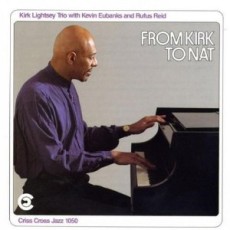
Kirkland “Kirk” Lightsey was born on February 15, 1937 in Detroit, Michigan and started his piano instruction at the age of five, adding clarinet through high school. After his Army service he worked accompanying singers around Detroit and in California, gaining some attention when he recorded with Sonny Stitt in 1965 and on five Prestige dates with Chet Baker. He would work with Yusef Lateef, Betty Carter, Bobby Hutcherson, Kenny Burrell, Pharaoh Sanders and many others.
From 1979 to 1983 he toured with Dexter Gordon and was a member of the Leaders. Through out the 80’s he led sessions including duets with Harold Danko, performed with Jim Raney, Clifford Jordan, Woody Shaw, David Murray and Harold Land.
Rooted in the hard-bop genre, Kirk has developed his own style and sound that is marked by a certain openness and playfulness. An accomplished flautist, he occasionally doubles in live performances.
In 2004 he released a duo album with Rufus Reid titled Nights At Bradley’s and recorded a quintet project Lightsey To Gladden in 2008, dedicated to the late great drummer, Eddie Gladden. Over the course of his career he has amassed some three-dozen albums as a leader and sideman and pianist Kirk Lightsey continues to create music and perform worldwide.

More Posts: piano
Daily Dose Of Jazz…
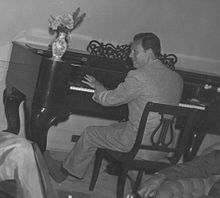
Irving Gordon was born in Brooklyn, New York on February 14, 1915 and as a child, studied violin. After attending public schools in New York City, he went to work in the Catskill Mountains at some of the resort hotels in the area. While working the resorts, he took to writing parody lyrics to some of the popular songs of the day. He has been credited with writing “Who’s On First” made famous by Abbott and Costello, according to his son William.
In the 1930s, he took a job with the music-publishing firm headed by talent agent Irving Mills, at first writing only lyrics but subsequently writing music as well. Together they wrote two songs for Duke Ellington, Please Forgive Me and Prelude To A Kiss and co-wrote Blue Prelude with Ellington.
After writing Mister and Mississippi, a Patti Page hit, Irving decided he enjoyed puns on state names, and some years later wrote Delaware, a Perry Como hit. He also went on to write for Bing Crosby, Eddy Arnold and Billie Holiday. But he is perhaps best known for his song, “Unforgettable” recorded by Nat King Cole in 1951 and then three Grammys in 1992 by his daughter Natalie Cole, in which Gordon himself received a Grammy. Nat’s version was inducted into the Grammy Hall of Fame in 2000.
In the 1940’s he moved to Los Angeles where he spent the rest of his life continually writing and composing and is noted for his contribution in music and lyrics of the Americana genre. Songwriter Irving Gordon passed away in his home of cancer on December 1, 1996.
More Posts: songwriter
Daily Dose Of Jazz…
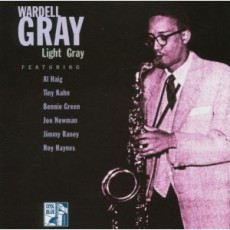
Wardell Gray was born the youngest of four children on February 13, 1921 in Oklahoma City, Oklahoma. Though his early years were spent there, in 1929 his family moved to Detroit. By 1935 he attended Northeastern High but soon transferred to Cass Technical High, whose noted alumni were Donald Byrd, Lucky Thompson and Al McKibbon. After year and before graduating Wardell dropped out and began playing the clarinet, but it was hearing Lester Young that drove him to pick up the tenor.
He played around Michigan in various bands led by pianist Dorothy Patton, Jimmy Raschel and Benny Carew and by 1941 a short-lived marriage produced a daughter. Gray got his big break when he joined the Earl Hines Orchestra in 1943, not only nationally known but had nurtured the careers of Dizzy Gillespie and Charlie Parker. For the young tenor he toured all over the country for the next three years becoming a featured soloist and subsequent recordings showed a relaxed, fluent stylist.
After leaving Hines, Wardell settled in Los Angeles and started recording under his own name for the Sunset label. He also worked with Benny Carter, Billy Eckstine and blues singer Ivory Joe Hunter. But it was Central Avenue that he found his greatest pleasure playing after-hours sessions, attracting the owner of Dial Records to hire him to play showcases for Charlie Parker, showing no signs of intimidation. On the avenue Gray held tenor battles with Dexter Gordon and his light sound and swift delivery was a match for Dexter’s big sound. The tenor jousts soon became a symbol for the Central Avenue scene.
With his career moves progressing he joined Benny Goodman’s small groups in 1947 and although musically successful, it was not financially. In ’48-‘50 he moved between Count Basie and Benny Goodman, recorded with Tadd Dameron, ended his second marriage and formed a septet that included Clark Terry and Buddy DeFranco bringing to audiences a very relaxed swinging band. Over the next few years he got married for the third time, did a few recording dates with Art Farmer, Hampton Hawes, Dexter Gordon and Teddy Charles, and performing most notably with Gerald Wilson’s Orchestra trading choruses with Zoot Sims and Stan Getz.
One of the top tenors to emerge during the bop era, Wardell Gray passed away under mysterious circumstances, found on a stretch of desert outside Las Vegas with a broken neck, on May 25, 1955.

More Posts: saxophone