

Daily Dose Of Jazz…
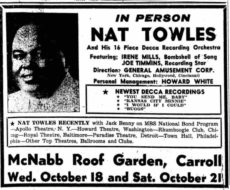
Nat Towles was born on August 10, 1905 in New Orleans, Louisiana the son of string bassist Phil “Charlie” Towles. Starting his musical career as a guitarist and violinist at the age of 11, he switched to the bass at the age of 13. Performing in New Orleans through his teenage years with Gus Metcalf’s Melody Jazz Band, he eventually played with a number of bands, including those of Buddie Petit, Henry “Red” Allen, Jack Carey, and the Original Tuxedo Jazz Orchestra.
In 1923 he formed The Nat Towles’ Creole Harmony Kings and this jazz band became one of the prominent territory bands in Texas, Oklahoma, Kansas, and Nebraska. By 1925 he was playing bass for Fate Marable, and the following year reformed his own band. 1934 saw him organizing a band of young musicians studying music at Wiley College in Austin, Texas.
Nat worked a club circuit in Dallas during this period, reportedly for a gangster who owned 26 nightclubs throughout the city. During this period T-Bone Walker and Buddy Tate worked for him. During the 1930s he transformed his band into The Nat Towles Dance Orchestra, signed with the National Orchestra Service, and focused on swing music through the 1930s and 1940s.
In 1934 Towles took up residence in North Omaha, Nebraska, where his band was stationed for the next 25 years. With this outfit he dueled with Lloyd Hunter for dominance over the much-contested Near North Side in North Omaha, where he was held over at the Dreamland Ballroom for several weeks. In 1936 and 1937 his band held residence at Omaha’s Krug Park.
In 1943 he also held a three-month stint at the Rhumboogie Club in Chicago, and later that year took up residency again with Billy Mitchell in tow in Omaha’s Dreamland Ballroom. He went on to play extensively throughout New York City, playing with trombonist Buster Cooper, saxophonists Red Holloway, Buster Bennett and Preston Love.
As their bandleader, Towles is credited with influencing a variety of musicians including Sir Charles Thompson and Neal Hefti, as well as superior saxophonists Jimmy Heath, Oliver Nelson and Paul Quinichette. As an educator he influenced many younger musicians such as pianist Duke Groner and trombonist Buddy McLewis, aka Joe McLewis.
Continuing to lead bands throughout the 1950s, in 1959 he retired to California and opened a bar. Bassist, guitarist and violinist Nat Towles, who feared the limelight would steal away his best players thus never sought national recognition and leaving no known recordings, passed away in January of 1963 in Berkeley, California of a heart attack.

Give A Gift Of Jazz – Share

More Posts: guitar,string bass,violin
Daily Dose Of Jazz…
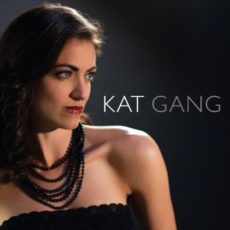
Kat Gang was born on August 9, 1980 in Boston, Massachusetts. She developed a passion for jazz at Berklee School of Music in her hometown and while matriculating received the Berklee College of Music Judges’ Choice Award and the Outstanding Vocalist Award. Honing her skills further at New York University, she earned a Bachelor’s degree while majoring in drama and voice.
A singer/songwriter, Kat takes on the traditional standards but is no stranger to interpretations of Joni Mitchell, Rickie Lee Jones, Arctic Monkeys or Oasis as she works as a duo with jazz guitar or piano. She is also known to work with many of Europe’s leading musicians in big bands, nonets, or as part of an eight piece Ella Fitzgerald tribute.
Currently with her own trio and quartet, vocalist Kat Gang stays in constant demand to perform in theaters, clubs, restaurants and even bateaux on London’s River Thames.
Inspire A Young Mind
More Posts: vocal
Daily Dose Of Jazz…
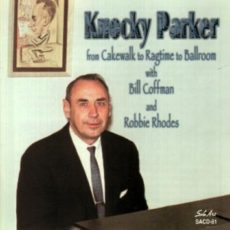
Knocky Parker was born John William Parker, II on August 8, 1918 in Palmer, Ellis County, Texas. By the Thirties he was playing in Western Swing bands such as The Wanderers and the Light Crust Doughboys through the end of the decade before serving in the military during World War II.
After the war Parker worked with Zutty Singleton and Albert Nicholas, then earned a Ph.D in English and taught at Kentucky Wesleyan College and the University of South Florida. While fulfilling his teaching responsibilities he worked with Doc Evans, Omer Simeon, and Tony Parenti, among others, as well as working as a solo artist.
In the early 1960s he recorded every Scott Joplin rag, one of the first to do so. In addition, he recorded the complete works of Jelly Roll Morton. Knocky recorded extensively, for the labels Texstar, Paradox, GHB, London, Audiophile, Jazzology, and Euphonic.
Pianist Knocky Parker, who played primarily ragtime and Dixieland jazz passed away on September 3, 1986 in Los Angeles, California.
Sponsored By

www.whatissuitetabu.com
More Posts: piano
Daily Dose Of Jazz…
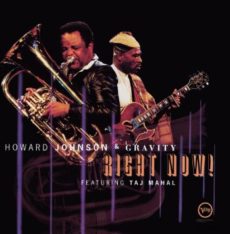
Howard Lewis Johnson was born August 7, 1941 in Montgomery, Alabama. In the 1960s he worked with Charles Mingus, Hank Crawford, Rahsaan Roland Kirk, Archie Shepp, and Hank Mobley on the album A Slice of the Top.
He began a long association with Gil Evans in 1966, arranger of a horn section that backed Taj Mahal on Mahal’s 1971 live album, The Real Thing, which featured three other tubists/multi-instrumentalists, Bob Stewart, Joseph Daley and Earl McIntyre. Howard played with The Band on their Rock of Ages live album, The Last Waltz and into the late 2000s with The Band drummer, Levon Helm’s Band. During the 1970s, he was the band conductor of the Saturday Night Live Band; he can be seen in several musical numbers, including playing bass saxophone in the King Tut sketch.
He has also led three tuba bands, collaborated with Tomasz Stanko, Substructure, Tuba Libre and GRAVITY, perhaps his best-known band. In 1981 he performed at the Woodstock Jazz Festival, held in celebration of the tenth anniversary of the Creative Music Studio.
He had a minor role in the 1983 film, Eddie and the Cruisers as Wendell’s replacement and also appeared in episodes of Matlock and Hill Street Blues. Johnson famously accompanied James Taylor in a performance of Jelly Man Kelly on Sesame Street in 1983, and also on tin whistle when Taylor sings to Oscar The Grouch.
Tubist, baritone saxophonist, arranger, conductor and bandleader Howard Johnson, who also plays bass clarinet, trumpet and other reed instruments, continues to perform, record and tour.
Dose A Day-Blues Away
Daily Dose Of Jazz…
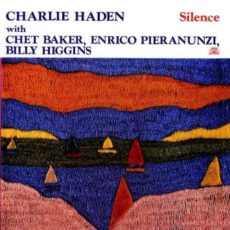
Charles Edward Haden was born on August 6, 1937 in Shenandoah, Iowa into a musical family who performed on the Haden Family radio show. He made his professional debut as a singer on the radio show when he was just two years old. He continued singing with his family until he was 15 but a bulbar form of polio affecting his throat and facial muscles sidelined him but a year earlier he had become interested in jazz after hearing Charlie Parker and Stan Kenton in concert.
Recovering from his bout with polio, Charlie began concentrating on the bass and soon set his sights on moving to Los Angeles, California to pursue his dream of becoming a jazz musician and in 1957 he realized his dream turning down a full scholarship at Oberlin College, which had no established jazz program at the time and attended Westlake College of Music.] His first recordings were made that year with Paul Bley, with whom he worked until 1959. He also played with Art Pepper for four weeks in 1957, and from 1958 to 1959, with Hampton Hawes whom he met through his friendship with bassist Red Mitchell and for a time shared an apartment with the bassist Scott LaFaro.
In May 1959, he recorded his first album with the Ornette Coleman Quartet, the seminal The Shape of Jazz to Come. Later that year, the Ornette Coleman Quartet moved to New York City, secured a six-week residency at the Five Spot Café that would represent the beginnings of free or avant-garde jazz.
By 1960, Haden’s narcotics addiction forced him to leave Coleman’s band, go into rehabilitation in 1963 in California, met his first wife and moved to the Upper West Side of New York City. He resumed his career in 1964, working with John Handy, Denny Zeitlin’s trio, performed with Archie Shepp in California and Europe and freelanced with Henry “Red” Allen, Pee Wee Russell, Attila Zoller, Bobby Timmons, Tony Scott, the Thad Jones/Mel Lewis Orchestra, Roswell Rudd, and returned to Ornette Coleman’s group in 1967.
Charlie went on to work with Keith Jarrett’s trio and his American Quartet, organized the collective Old and New Dreams, which consisted of Don Cherry, Dewey Redman, and Ed Blackwell from Coleman’s band. He founded his first band, the Liberation Music Orchestra at the height of the Vietnam War, working with arranger Carla Bley, exploring free jazz and political music. The original lineup consisted of Haden and Bley and Gato Barbieri, Dewey Redman, Paul Motian, Don Cherry, Andrew Cyrille, Mike Mantler, Roswell Rudd, Bob Northern, Howard Johnson and Sam Brown.
Over the course of his half-century career he established the Jazz Studies Program at California Institute of the Arts in Valencia, been honored as Jazz Educator of the Year and as a leader has won several Grammy Awards, recorded forty-six albums as well as 134 albums as a sideman with Geri Allen, Ray Anderson, Ginger Baker, Bill Frisell, Kenny Barron, Beck, Paul Bley, Jane Ira Bloom, Michael Brecker, Henry Butler, Alice Coltrane, John Coltrane, Robert Downey Jr., Dizzy Gillespie, Jim Hall, Tom Harrell, Joe Henderson, Fred Hersch, Laurence Hobgood, Rickie Lee Jones, Lee Konitz, Brad Mehldau, David Liebman, Abbey Lincoln, Helen Merrill, Pat Metheny, Bheki Mseleku, Yoko Ono, Joe Pass, Enrico Pieranunzi, Joshua Redman, Gonzalo Rubalcaba, John Scofield, Wadada Leo Smith, Ringo Starr and Masahiko Togashi.
Double bassist, bandleader, composer, educator and NEA Jazz Master Charlie Haden, who revolutionized the harmonic concept of bass playing in jazz passed away in Los Angeles, California on July 11, 2014, at the age of 76 after suffering from effects of post-polio syndrome and complications from liver disease.
Take A Dose On The Road
More Posts: bass