

Daily Dose Of Jazz…
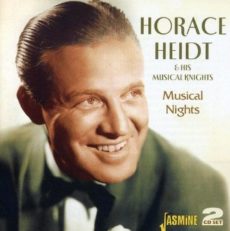
Horace Heidt was born on May 21, 1901 in Alameda, California, He went on to attend the University of California Berkeley as a guard on the football team. But a broken back dashed those dreams and he turned his attention to music, forming The Californians with some classmates.
From 1932 to 1953, he became one of the more popular radio bandleaders beginning on NBC’s Blue Network with Shell Oil’s Ship of Joy and Answers by the Dancers and Horace Heidt’s Alemite Brigadiers. He broadcasted from CBS from 1937-1939.
Horace would employ singer Matt Dennis and singing comedian Art Carney. His recordings were highly successful with Gone With The Wind and Ti-Pi-Tin going to No. 1 and The Man With The Mandolin hitting No. 2 on the charts. His 1941 song, The Hut-Sut Song is heard in the movie A Christmas Story.
He returned to NBC to perform on Pot o’ Gold radio show from 1939-194, portraying himself in the film of the same name starring James Stewart and Paulette Goddard. From 1940 to 1944 he did Tums Treasure Chest, followed by 1943–45 shows on the Blue Network. Lucky Strike sponsored The American Way on CBS in 1953.
On December 7, 1947, NBC launched The Horace Heidt Youth Opportunity Program and accordionist Dick Cortino the first winner of the $5,000 prize, soon had his own show. Heidt’s talent search catapulted a number of performers such as Carney, Frankie Carle, the King Sisters, Alvino Rey, Gordon McRae, Frank DeVol, Johnny Standley and Al Hirt. When the program expanded from radio to television in 1950, it was one of the first talent shows.
Pianist and bandleader Horace Heidt passed away on December 1, 1986 in Los Angeles, California. For his contribution to radio and television he has two stars on the Hollywood Walk of Fame and a Golden Palm Star on the Palm Springs Walk of Stars.

Uplift Someone’s World

More Posts: piano

Daily Dose Of Jazz…
Carmen Souza was born in Lisbon, Spain on May 20, 1981 of Cape Verdean heritage speaking Creole, the Cape Verde dialect and Portuguese. In her teens she sang professionally in a Lusophone Gospel Choir. Musicians like Luis Morais, Ella Fitzgerald, Joe Zawinul, Herbie Hancock, Keith Jarrett and Diana Krall were some of her inspirations. Theo Pas’cal, her producer and mentor and one of the best bass players in Portugal, discovered her talent and introduced her to jazz, fusion and other contemporary sounds that markedly influenced her musical development.
Working with Theo in 2003, two years later Carmen released to critical acclaim her debut album Ess ê nha Cabo Verde that combined Creole, African and Cape Verde rhythms like Batuke, Morna, and Cola djon with her jazz contemporary influences. The album led to her international breakthrough performance at the WOMAD at Reading Festival of the same year.
Her sophomore album Verdade she co-produced and is featured on Wurlitzer and guitar. She returned in 2010 with the impressive Protegid (Protected) that continued to push the limits of what constitutes the Cape Verdean music, world music and jazz. The expressive voice, versatile style of vocalist Carmen Souza continues to perform, record and tour.
Jazz Is Global – Share
More Posts: vocal
Daily Dose Of Jazz…
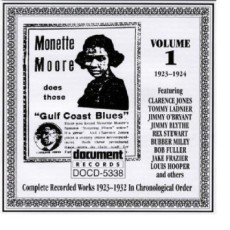
Monette Moore was born May 19, 1902 in Gainesville, Texas but was raised in Kansas City, Missouri. She taught herself piano in her teens and worked as a theater pianist in Kansas City in the early Twenties. In 1923–24 she recorded for Paramount Records in New York City and Chicago, in addition working Dallas and Oklahoma City and eventually settling in New York City.
Monette played with Charlie Johnson’s ensemble at Smalls Paradise and recorded with him in 1927–28. Her output from 1923–27 amounts to 44 tunes, some recorded under the name Susie Smith. Her sidemen included Tommy Ladnier, Jimmy O’Bryan, Jimmy Blythe, Bob Fuller, Rex Stewart, Bubber Miley, Lou Hooper and Elmer Snowden.
In the 1930s, Moore recorded with Fats Waller, filled in for Ethel Waters as an understudy, and in 1937 sang with Zinky Cohn in Chicago. She would perform at her own club, Monette’s Place, in New York City in 1933. Around 1940 she sang in New York with Sidney Bechet and Sammy Price, then moved to Los Angeles in 1942, performing often in nightclubs. She appeared in James P. Johnson’s revue Sugar Hill in 1949 and in numerous films in minor roles.
Monette recorded again from 1945-47, performed with the Young Men of New Orleans at Disneyland in 1961–62. Vocalist and pianist Monette Moore passed away of a heart attack on October 21, 1962 in Garden Grove, California.
More Posts: vocal
Daily Dose Of Jazz…
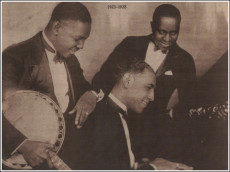
Louis Stanley Hooper was born on May 18, 1894 in North Buxton, Ontario, Canada but was raised in Ypsilanti, Michigan and studied piano at the Detroit Conservatory, playing locally in dance orchestras in the 1910s. Around 1920 he moved to New York City and recorded frequently with Elmer Snowden and Bob Fuller in the middle of the decade. He was known to perform with both of them in Harlem as well as with other ensembles.
Lou served for some time as the house pianist for Ajax Records, accompanying many blues singers on record, including Martha Copeland, Rosa Henderson, Lizzie Miles, Monette Moore and Ethel Waters. He was a participant in the Blackbirds revue of 1928.
In 1932 Hooper returned to Canada, where he played in Mynie Sutton’s dance band, the Canadian Ambassadors. Working locally as a soloist and in ensembles for the next two decades, he was brought back into the limelight by the Montreal Vintage Music Society in 1962.
Lou recorded a two-LP set with Bill Coleman titled UK LIve:Satin Doll, Vol. 1 & 2 in 1967 and released an album as a leader of ragtime piano tunes in 1973 titled Lou Hooper, Piano.
Wearing the educator hat, he taught at the University of Prince Edward Island late in his life and appeared regularly on CBC television in Halifax. Pianist Lou Hooper passed away on September 17, 1977 in Charlestown, Prince Edward Island. His papers, which include unpublished compositions and an autobiography, are now held at the National Library of Canada in Ottawa.
Give A Gift Of Jazz – Share
More Posts: piano
Daily Dose Of Jazz…
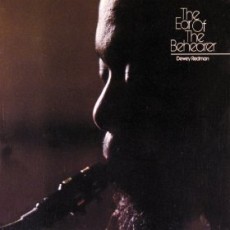
Walter Dewey Redman was born May 17, 1931 in Fort Worth, Texas. He attended I.M. Terrell High School and played saxophone in the school band with Ornette Coleman, Prince Lasha and Charles Moffett. After high school he briefly enrolled in the electrical engineering program at Tuskegee Institute in Alabama but became disillusioned with the program and returned home to Texas. In 1953, he earned a bachelor’s degree in Industrial Arts from Prairie View Agricultural and Mechanical University and while attending switched from clarinet to alto saxophone, eventually to tenor.
Following his degree, Redman served for two years in the Army and upon his discharge he began working on a master’s degree in education at the University of North Texas. While there he taught music to fifth graders in Bastrop, Texas and worked as a freelance saxophonist at night and on weekends around Austin, Texas. By 1957 he graduated in Education with a minor in Industrial Arts.
1959 saw him moving to San Francisco, California as result of an early collaboration with clarinetist Donald Rafael Garrett. He would go on to perform with Ornette Coleman, from 1968 to 1972 and recording New York Is Now!, among others. Dewey was also a part of Keith Jarrett’s American Quartet from 1971 – 1976, whose album The Survivors’ Suite was voted Jazz Album of the Year by Melody Maker in 1978.
In the mid-70s Redman formed the quartet Old And New Dreams with Coleman alumni Don Cherry, Charlie Haden and Ed Blackwell. They recorded four albums in the period to 1987. He performed and recorded as an accompanying musician with jazz musicians who performed in varying styles within the post-1950s jazz idiom, including drummer Paul Motian, Pat Metheny, Jane Bunnett, Anthony Cox, Cameron Brown, Billy Hart, Matt Wilson, Roswell Rudd, Randy Weston, Clifford Thornton, Jon Ballantyne, Michael Boclan, David Bond, Leroy Jenkins, Dane Belany and Michel Benita.
As a leader with more than a dozen recordings, Dewey established himself as one of the more prolific tenor players of his generation. Though generally associated with free jazz, he would also play standards and ballads reminiscent of the blues and post-bop mainstream and would sometimes hum into his sax while performing.
Tenor saxophonist Dewey Redman, who occasionally played alto saxophone, the Chinese suona and clarinet mainly in the free jazz genre, passed away from liver failure in Brooklyn, New York, on September 2, 2006. He was the subject of an award-winning documentary film Dewey Time and recorded two albums with his son Joshua.
Inspire A Young Mind