

Daily Dose Of Jazz…
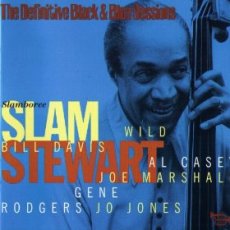
Slam Stewart was born Leroy Eliot Stewart on September 21, 1914 in Englewood, New Jersey. He originally played violin before switching to bass at the age of 20. While attending the Boston Conservancy he heard Ray Perry singing along with his violin giving him the inspiration to follow suit with his bass.
In 1937 Stewart teamed with Slim Gaillard forming the novelty jazz act Slim and Slam. The duo’s biggest hit was in 1938 with Flat Foot Floogie (With A Floy Floy).
Stewart found regular session work throughout the 1940s with Lester Young, Fats Waller, Coleman Hawkins, Erroll Garner, Art Tatum, Johnny Guarnieri, Red Norvo, Don Byas, Benny Goodman Sextet and Beryl Booker among others.
One of the most famous sessions he played on took place in 1945, when Stewart played with Dizzy Gillespie’s group during Charlie Parker’s tenure. Out of those sessions came some of the classic bebop tunes such as “Groovin’ High” and “Dizzy Atmosphere”.
Throughout the rest of his career, Stewart worked regularly and employed his unique and enjoyable bass-playing style trademark of bowing the bass (arco) while simultaneously humming or singing an octave higher until his death on December 10, 1987 in Binghamton, New York.

Inspire A Young Mind
More Posts: bass
Daily Dose Of Jazz…
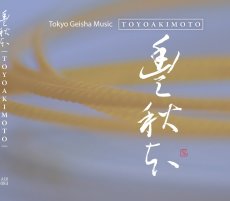
Tatsu Aoki was born on September 19, 1957 in Tokyo, Japan into an artisan family that was a booking and training agent for Geisha ladies. He received at age 4 the important essence of traditional Tokyo Geisha cultural training and studies and became a part of the performing crew in early childhood. After his grandmother died, he had kept the Tokyo music training until early teen, and shifted his musical focus to American pop music and experimental music.
With his movie producer father he began working in small gage films and started to produce experimental films, was active performer during the early 70’s in the mist of Tokyo Underground Arts movement, became a member of Japanese Experimental Music ensemble, Gintenaki, presenting mixture of traditional music and new western music.
After coming to U.S. in 1977, Aoki studied experimental filmmaking at the School of the Art Institute of Chicago. During the late 80’s, Aoki has become a leading advocate for Chicago’s Asian American community and one of Chicago’s most in-demand musicians on contrabass, taiko (Japanese drums) and shamisen (Japanese lute) and working in both film and music.
An active musician in the field of Asian American jazz, he is the founder and artistic director of Asian Improv ARTS Midwest, The Annual Chicago Asian American Jazz Festival and The JASC Tsukasa Taiko Legacy arts residency program. Double bassist Tatsu Aoki currently teaches at the School of the Art Institute in Chicago.
Jazz Is Global – Share
Daily Dose Of Jazz…
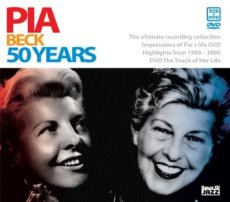
Pia Beck was born Pieternella Beck on September 18, 1925 in Den Haag, Netherlands. She was a natural on the piano without significant musical training. In 1945 she joined the Miller Sextet taking the piano chair and vocalist slot touring Belgium, Germany, Sweden and the Dutch East Indies.
By 1949 she started her own combo and her first composition, Pia’s Boogie, became an instant hit, though she never learned to read sheet music. 1952 saw her first visit the United States, toured the jazz club circuit – an annual event until 1964, was nicknamed “The Flying Dutchess” by Time Magazine who also gave her the cover, and was bestowed honorary citizenship of New Orleans and Atlanta.
In 1965 Beck emigrated to Costa de Sol with her life partner and three children, opened a piano bar and when it went bankrupt she opened a real estate firm and wrote travel guides. By 1975 she was on the comeback trail in Scheveningen, Netherlands and once again enjoyed a successful career, albeit, openly exposing her homosexuality during her U.S. tours by resisting against the anti-gay activist Anita Bryant during the late Seventies.
Pia Beck said goodbye to the general public in 2003. The pianist who Oscar Peterson called the best jazz pianist in the world, died at age 84 of heart failure on November 26, 2009 in Malaga, Spain.
Daily Dose Of Jazz…
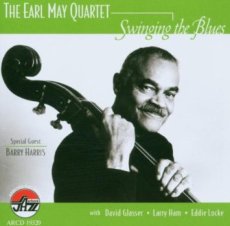
Earl May was born on September 17, 1927 in New York City first gravitated to drums, but at 14 acquired an acoustic bass, later making his professional debut at the Bronx’s 845 Club. While working an insurance job by day, 1949 saw May moonlighting across the New York club circuit, eventually catching the attention of drummer Connie Kay, who invited him to sit in behind Lester Young at Harlem’s now-legendary Minton’s Playhouse. He continued honing his craft in clubs like Minton’s Playhouse with musicians such as Lester Young and Mercer Ellington. A protégé of the legendary Charles Mingus, in 1951 Earl joined the Billy Taylor Trio, appearing regularly in such clubs as the Hickory House, Birdland and the Downbeat Club.
During the Fifties Earl also worked with Charlie Parker, Miles Davis, Quincy Jones, Gene Ammons, Sonny Stitt, Chet Baker, and Lorez Alexandria, Webster Young among others and recorded the classic “Lush Life” with John Coltrane. He left the Billy Taylor Trio in 1959 to form his own group and act as musical director and arranger for Gloria Lynne.
By the mid-sixties May took up the electric bass and led the Earl May Quartet at The New York Playboy Club and the group rapidly became the epitome of great music in the New York club scene.
Over the years Earl has performed or recorded with Dizzy Gillespie, Frank Foster, Cab Calloway, Tommy Flanagan, Barry Harris, Junior Mance, Benny Powell, Carmen Bradford, Frank Foster, Dizzy Gillespie, Linda Hopkins, Doc Cheatham, Charles Brown, Claude Williams, Jon Hendricks, Charles McPherson, Marlena Shaw, Ruth Brown, Winard Harper and Phyllis Hyman to name a few more.
Jazz bassist Earl May, one of the most prodigious and prolific bassists of the postwar era, lent his rich, round sound to every session and performance, was the only bassist to play with his left hand but kept the strings in their normal order and was a member of Local 802 since 1947, passed away on January 5, 2008. He was 80 years old.
Give The Gift Of Knowledge
More Posts: bass
Daily Dose Of Jazz…
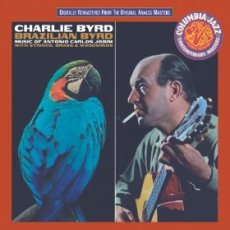
Charlie Lee Byrd was born on September 16, 1925 in Suffolk, Virginia but grew up in Chuckatuck, Virginia and his father taught him to play the acoustic steel guitar at age 10. He went on to Virginia Polytechnic Institute, served in the Army and played in the Special Services band in Paris. Returning to New York he studied composition at Hamett National Music School, taking up classical guitar.
Charlie moved to Washington, D.C. in 1950 and studied classical guitar with Sophocles Papas, then with Andre Segovia. By 1957 he teamed up with bassist Keter Betts and started gigging around D.C. for two years, joined Woody Herman for a State Department goodwill tour.
Byrd was first introduced to Brazilian music by his friend radio host Felix Grant who was well known in Brazil in 1960. A subsequent tour of Brazil and he returned home with recordings from Joao Gilberto and Antonio Carlos Jobim. He met with Stan Getz who convinced Creed Taylor, then at Verve Records to produce the album, recording “Jazz Samba” in 1962 in a building adjacent to All Souls Unitarian Church because of the excellent acoustics found there. And his love affair with Brazilian music began.
Over the course of his career he has toured the world, performed at numerous festivals, played with such jazz legends as Les McCann, Zoot Sims, Vince Guaraldi, his brother bassist Joe Byrd, Chuck Redd, Herb Ellis, Barney Kessel and the list goes on.
Charlie Byrd died of lung cancer on December 2, 1999 at his home in Annapolis, Maryland. He was deemed a Maryland Art Treasure in 1997 and knighted by the government of Brazil as the Knight of the Rio Branco.
Take A Dose On The Road
More Posts: guitar