

Daily Dose Of Jazz…
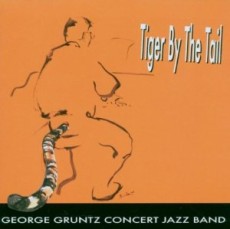
George Gruntz was born in Basel, Switzerland on June 24, 1932. The young pianist won prizes at Zurich Jazz Festivals and in 1958 was pianist with the International Youth Band at the Newport Jazz Festival. While there he accompanied, among others Louis Armstrong and in an instant became famous.
George went on to work with jazz musicians Phil Woods, Roland Kirk, Don Cherry, Chet Baker, Art Farmer, Dexter Gordon, Johnny Griffin and Mel Lewis to name a few. From 1972 to 1994 he served as artistic director for the JazzFest Berlin, composed his first opera, founded the Piano Conclave and the George Gruntz Concert Jazz Band and moderated the TV music series “All You Need Is Love”.
An accomplished arranger and composer, having been commissioned by many orchestra and symphonies, he is also an organist, harpsichordist and keyboardist with more that three dozen albums to his credit. He continued to compose, arrange, record and perform until his death on January 10, 2013.

Put A Dose In Your Pocket
More Posts: harpsichord,keyboard,organ,piano

Daily Dose Of Jazz…
Raymond Mantilla was born on June 22, 1934 in New York City and his early drumming inspiration came from Afro-Cuban jazz. He played with a number of Latin jazz ensembles from the 1950s including the La Playa Sextet, Xavier Cugat, Lou Perez, Rene Touzet, Miguelito Valdez and Monguito Conjunto.
He played behind Eartha Kitt in 1955 and by 1960 was touring with Herbie Mann and recording with Max Roach. He recorded with Al Cohn, Freddie Hubbard, Buddy Rich and Larry Coryell in the early Sixties and then led his own band in Puerto Rico from ’63 to ’69. This was followed with Ray becoming a founding member of Max Roach’s M’Boom percussion ensemble in 1970.
Mantilla was a member of Art Blakey’s Jazz Messengers in the 70s and toured the U.S., Europe, and Japan. He then recorded with Gato Barbieri, Joe Farrell, Richie Cole, Don Pullen, Charles Mingus, Walter Bishop, Jr., and Morgana King and toured Cuba with Dizzy Gillespie.
By the end of the decade he once again founded his own ensemble, the Ray Mantilla Space Station, and through the 1980s toured or recorded with Muhal Richard Abrams, Kenny Burrell, Shirley Scott and Warren Chiasson. In 1991 the noted session player and bandleader put together a new ensemble, the Jazz Tribe and has been recording, performing and touring ever since.
Take A Dose On The Road
More Posts: drums
Daily Dose Of Jazz…
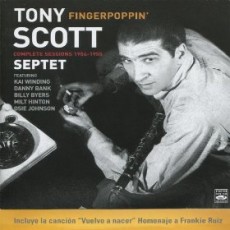
Tony Scott was born Anthony Joseph Sciacca June 17, 1921 in Morristown, New Jersey. He attended Julliard School in the early Forties and by the 50s was working with Sarah Vaughan, Billie Holiday and had a young Bill Evans as a sideman. Late in the decade he won on four occasions the Down Beat critics poll for clarinetist in 1955, 1957, 1958 and 1959 and was known for a more “cool” style than Buddy DeFranco.
For most of his career he was held in some esteem in New Age music circles because of his decades-long involvement in music linked to Asian cultures and to meditation. Despite this he remained relatively little known as the clarinet had been in eclipse in jazz since the emergence of bebop. In 1959 he left New York City and the United States touring South America, Europe, Africa and Southeast Asia. This led to his playing in a Hindu temple, spending time in Japan, and releasing Music for Zen Meditation and capturing Japan’s Down Beat poll for best clarinetist.
He settled in Italy in the 1980s, working with Italian jazz musicians such as Franco D’Andrea and Roman Mussolini, followed by an interest in electronica in his later years. Italian director Franco Maresco produced a documentary on the life of Tony Scott, released three years after his death on March 28, 2007. It was titled Tony Scott: The Story of How Italy Got Rid of the Greatest Jazz Clarinetists.
More Posts: clarinet
Daily Dose Of Jazz…
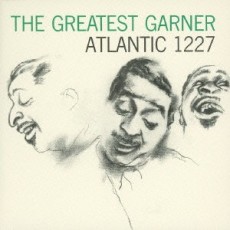
Erroll Louis Garner was born on June 15, 1921 in Pittsburgh, Pennsylvania and began playing piano at age 3. Self-taught, he never learned to read music and remained an “ear player” all his life. At the age of 7, Erroll began appearing on radio station KDKA with a group called the Candy Kids, by 11 he was playing on the Allegheny riverboats and by the time he turned 14 in 1937, he joined local saxophonist Leroy Brown.
He moved to New York in 1944, worked with bassist Slam Stewart and though not a bebop musician in 1947 played with Charlie Parker on the famous “Cool Blues” session. Short in stature (5 foot 2 inches), Garner performed sitting on multiple telephone directories except in New York, where a Manhattan phone book was sufficient. He was also known for his occasional vocalizations while playing, which can be heard on many of his recordings and he helped bridge the gap for jazz musicians between nightclubs and the concert hall.
His best-selling album recorded at an Army base in Carmel, California was Concert By The Sea; and his best-known composition, the ballad “Misty” is a jazz standard and was featured in the 1971 Clint Eastwood vehicle “Play Misty for Me”. The brilliant virtuoso with a distinctive swing style was reportedly Tonight Show host Johnny Carson’s favorite jazz musician, toured both at home and abroad until his death from lung cancer on January 2, 1977.
Give The Gift Of Knowledge
More Posts: piano
Daily Dose Of Jazz…
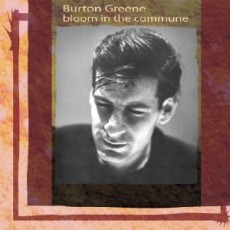
Burton Greene was born June 14, 1937 in Chicago, Illinois and rose to popularity in the Sixties on New York’s free jazz scene gigging with Alan Silva and Marion Brown. He credited the Free Form Improvisation Ensemble in 1963, then joined Bill Dixon’s and Cecil Taylor’s Jazz Composers Guild in ’64.
During this period he gigged with Rashied Ali, Albert Ayler, Gato Barbieri, Byard Lancaster, Sam Rivers, Patty Waters and others while recording two albums as a leader. Burton moved to Europe in 1969, first to Paris then to Amsterdam delving into the Klezmer medium and recording with several different group configurations into the 90s.
Since the mid-1990s Greene has often performed and recorded in New York and along the East Coast with a modest catalogue that includes eleven recordings.. His autobiography written over 20 years, Memoirs of A Musical Pesty-Mystic, was published in 2001. His recent performances and recorded groups based in New York include duets, trios, quartets and quintets with Mark Dresser, Roy Campbell, Lou Grassi, Adam Lane, Ed and George Schuller, Russ Nolan and Paul Smoker.
Take A Dose On The Road
More Posts: piano