
From Broadway To 52nd Street
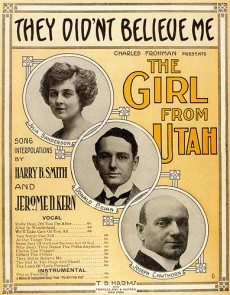
The Girl From Utah, a British import to Broadway, opened at the Knickerbocker Theater on August 24, 1914 and ran for 120 performances. J. A. E. Malone directed this musical that starred Julia Sanderson, Donald Brian, Joseph Cawthorn, Queenie Vassar and Venita Fitzhugh. Composer Jerome Kern was asked to give it an American flavor and along with lyricist Herbert Reynolds they composed “They Didn’t Believe Me”. History contends that this was Kern’s career-making opportunity to express himself and this musical would hint at the emerging American style of musical comedy.
The Story: In London, an American girl named Una is pursued across the Atlantic Ocean to London by a Mormon but is saved from a bigamous marriage when she falls in love with a handsome hoofer.
Broadway History: It was during 19th century that the development of not only the American theatre took place throughout the country but the all powerful “Syndicate” – the cartel of theatre owners who joined forces under the influence of one of Broadway’s early great producers, Abraham Lincoln Erlanger. One of the great stars of theatre in the early twentieth century was George M. Cohan. Rising through the ranks of vaudeville from a child star to adulthood, he flaunted his patriotism not for those born in America but those immigrating to this great country to become citizens and patriots. Cohan epitomized the sense of the country by self-proclaiming himself as a real live nephew of Uncle Sam.
Sponsored By

www.whatissuitetabu.com
More Posts: broadway
From Broadway To 52nd Street
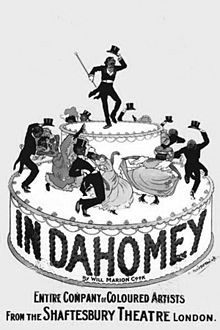
In Dahomey opened on February 18, 1903 at the New York Theater and ran for 53 performances, then considered a successful run. It was a landmark American musical comedy, in that it was “the first full-length musical written and played by blacks significantly marked the first full-length Black to be staged in an indoors venue at a major Broadway house and the first black musical to have its score published, albeit in England. As one of the most successful musical comedies of its era, it propelled composer Will Marion Cook, lyricist Paul Lawrence Dunbar and leading performers Bert Williams, James Smith and George Sisay to become household names. It was “the first African American show that synthesized successfully the various genres of American musical theatre popular at the beginning of the twentieth century—minstrelsy, vaudeville, comic opera and musical comedy.
Though a jazz standard did not emanate from this musical either, the In Dahomey poster features the famous “cake walk” with the character portrayed by Bert Williams and prompted Percy Grainger to write a highly virtuosic concert “rag” titled In Dahomey (Cakewalk Smasher), that he completed in 1909.
The Story: A tale of a group of Blacks, who, having found a pot of gold, move to Africa and become rulers of Dahomey (present-day Benin).
Broadway History: One of the most influential sources of the American musical was one of its most shameful. The minstrel show got its start in the early nineteenth century when a number of white entertainers, mostly of Irish descent, found they could connect with their more raucous audiences by applying burnt cork to their skin and caricaturing black people in various songs, dances and skits. However, the portrayals by white entertainers created a dialogue that became very fashionable, even though they perpetuated negative stereotypes. Black entertainers knew they didn’t speak like that and formed a troupe, and out of that came comic duos on Broadway like Flournoy Miller and Aubrey Lyles in the 20’s, William Gaxton and Victor Moore in the 30’s. But one man transcended minstrelsy’s denigration of his race and became not only the most popular comedian of his day, but the most famous African American since Frederick Douglass. He was Bert Williams, who denied entrance into Stanford University, worked as a banjo player in saloons and minstrels until he teamed up with George Walker. The team gained fame, which led them to head the cast of “In Dahomey” in 1903, the first full-length musical written and played by blacks performed at a major Broadway house.
Sponsored By
www.whatissuitetabu.com

Requisites
The Baddest Monk: This 2012 sophomore offering follows the Dancing Monk debut of the Thelonious Monk trilogy by jazz pianist Eric Reed. Having received critical acclaim for both, Reed along with his colleagues prove once again that he can illustrate the breadth of his thought on one of the most idiosyncratic jazz composers. This is an insightful and vital re-examination by a group of young players of the remarkable talent of the composer and sets a new path for those desiring to partake, understand and appreciate.
Personnel: Eric Reed – piano, Seamus Blake – tenor saxophone, Etienne Charles – trumpet, Matt Clohesy – bass, Henry Cole – drums and Jose James – vocal
Producer: Joe Fields / Savant Records
Record Date: Dubway Studios, New York City / December 5, 2011
Cover: Keiji Obata
Songs: Rhythm-A-Ning, Epistrophy, Green Chimneys, Monk’s Mood, ‘Round Midnight, Evidence, Monk Beurre Rouge, Bright Mississippi, The Baddest Monk

More Posts: collectible,piano

Jazz In Film
The Film: Carmen Jones
The Year: 1954
The Director: Otto Preminger
The Stars: Dorothy Dandridge, Harry Belafonte, Pearl Bailey and Brock Peters.
The Music: Soundtrack work done by Cozy Cole along with great performances by Pearl Bailey, Max Roach, Richie Powell and Curtis Counce.
The Story: This adaptation of the 1944 Broadway success provided a modern Black version of the Merimee story that retained the original Bizet music. At an all-black army camp, civilian parachute maker and “hot bundle” Carmen Jones is desired by many of the men. Naturally, she wants Joe, who’s engaged to sweet Cindy Lou and about to go into pilot training for the Korean War. Going after him, she succeeds only in getting him into the stockade. While she awaits his release, trouble approaches for both of them.

More Posts: film
Requisites
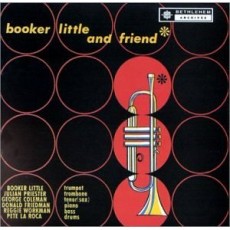
Booker Little and Friends: At the time of Booker Little’s death in 1963, he was just 23 years old, he was already far more than a promising trumpet talent. This reissue of his landmark fourth and final session as a leader, “Victory And Sorrow”, showcases his compositions with trumpet voiced against a backdrop of tenor and trombone. It demonstrates Little’s interest in a mix of complex moods and advanced harmonies, use of multiple keys to create simultaneous joy and mourning, and rhythmic shifts, flaring runs, and surprising intervals.
Personnel: Booker Little – trumpet, Julian Priester – trombone, George Coleman – tenor saxophone, Donald Friedman – piano, Reggie Workman – bass, Pete LaRoca – drums
Record Date: Bethlehem / August 1961 – September 1961
Songs: Victory And Sorrow, Forward Flight, Looking Ahead, If I Should Lose You, Calling Softly, Booker’s Blues, Matilde, plus two previously unreleased takes – Matilde (Alt. Take 4), Matilde (Alt. Take 7)
More Posts: collectible,trumpet