

Daily Dose Of Jazz…
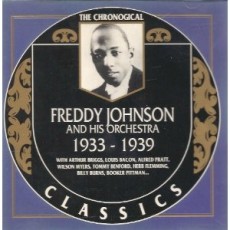
Freddy Johnson was born on March 12, 1904 in New York City. He eventually gained fame and popularity in the 1930s as a swing pianist. He began playing professionally as accompanist to Florence Mills and then formed his own band in 1924. In 1925 he worked with Elmer Snowden and in 1926 he worked with Billy Fowler, then briefly with Henri Saparo and Noble Sissle before joining Sam Wooding’s band on a European tour in 1928.
Wooding and Johnson parted ways a year later and Johnson returned to Paris to do solo work. While in Paris, Freddy along with trumpeter Arthur Briggs and put together a band. Between late 1933 and 1934 Johnson worked with Freddy Taylor’s band, then left for work in Belgium and The Netherlands. In the mid 30’s he made some recordings with the Quintette du Hot Club de France.
While living in Amsterdam he co-lead a band with Lex Van Spall, and they played regularly at the Negro Palace in a trio with Coleman Hawkins. He later worked at the Negro Palace, then with Max Woiski at La Cubana, in Amsterdam where he was arrested by the Nazis and was remanded to a prison camp in Bavaria from 1942-44.
After returning to the States he worked with George James and Gavin Bushell in New York City but by the late 40s and early 50s he worked mostly as a piano and voice coach and also did some solo residencies at Well’s New York. Soon after a touring stint in Europe he became very ill with cancer, infirmed at a Copenhagen hospital in 1960, returned to New York and stayed in St. Barnabas Hospital until his death on March 24, 1961.
More Posts: piano
Daily Dose Of Jazz…
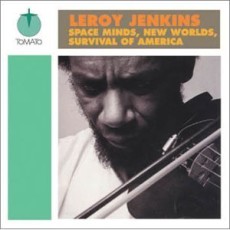
Leroy Jenkins was born on March 11, 1932 in Chicago, Illinois and began playing violin at eight years old, often in church. Another graduate of DuSable High under the tutelage of Walter Dyett, Leroy also played alto saxophone. He went on to graduate from Florida A&M, where he dropped the alto to concentrate on violin.
He returned to Chicago and divided his time from 1965 to 1969 between being involved in the Association for the Advancement of Creative Musicians (AACM) and teaching in the public school system. By the end of the decade he gave up Chicago for Europe and while in Paris, along with Anthony Braxton, Leo Smith and Steve McCall, he founded the creative Construction Company. Jenkins followed this with the Revolutionary Ensemble and formed a trio with Anthony Davis and Andrew Cyrille.
During 1987 he toured Europe as part of Cecil Taylor’s group. He gained recognition for music-theatre works such as “The Mother of Three Sons” and “The Negros Burial Ground”, two collaborations with Ann T. Greene, also “Fresh Faust”, and “The Three Willies”.
Leroy has played with Archie Shepp, Alice Coltrane and Rahsaan Roland Kirk; was a driving force in the free jazz circles and has written numerous pieces for soloists, small groups and large ensembles. Leroy Jenkins, composer, violist and free jazz violinist passed away February 24, 2007.
Daily Dose Of Jazz…
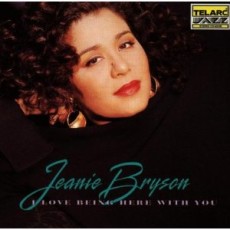
Jeanie Bryson was born March 10, 1958 in New York City, the daughter of songwriter Connie Bryson and Dizzy Gillespie. While matriculating through Rutgers University and studying with jazz pianist Kenny Barron, she began to be increasingly influenced by jazz.
Bryson has performed throughout North and South America, Europe, Israel and Japan and has received international critical acclaim. In addition to her own recordings on Telarc, Bryson has recorded with Etta Jones, Larry Coryell, Grover Washington Jr., Terence Blanchard and Kenny Burrell among others.
Her vocals are a combination of jazz, pop and Latin music and her repertoire is firmly rooted in The Great American Songbook and she has paid tribute to the legacies of Peggy Lee and Dinah Washington. Her “Déjà Blue” project showcased the velvet, sweet, laid-back and melodic voice.
While she continues to perform Jeanie is working on her newest project, “The Dizzy Gillespie Songbook”, a loving and fitting tribute that celebrates her father’s life, his music, and his legacy. She continues to perform and record.
More Posts: vocal
Daily Dose Of Jazz…
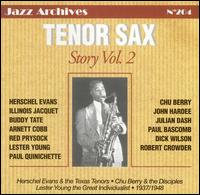
Herschel “Tex” Evans was born March 9, 1909 in Denton, Texas but spent much of his childhood in Kansas City, Kansas learning to play alto saxophone. It was his trombone and guitar-playing cousin, Eddie Dunham who convince him to switch to the tenor, which ultimately established his reputation.
After perfecting his craft in the famous jam sessions held in the jazz district between 12th and 18th streets in Kansas City, Evans returned to Texas in the 1920s and joined the Troy Floyd orchestra in San Antonio in 1929. He stayed with the band until it dispersed in 1932. Evans performed for a time with Lionel Hampton and Buck Clayton in Los Angeles, and in the mid-1930s returned to Kansas City to become a featured soloist in Count Basie’s big band.
For the next three years Herschel’s reputation as a tenor saxophonist was at its peak. His musical duels with fellow band member Lester Young are considered jazz classics. Count Basie’s popular “One O’Clock Jump” featured the contrasting styles of the two musicians and brought to each the praise of both critics and the general public. Evans’s greatest single success was his featured solo on Basie’s hit “Blue and Sentimental”.
Evans also made records with such notable jazz figures as Harry James, Teddy Wilson and Lionel Hampton. Evans has been credited with influencing fellow tenorists Buddy Tate, Illinois Jacquet, and Arnett Cobb. Although not a prolific composer, Evans wrote a number of popular works including the hits “Texas Shuffle” and “Doggin’ Around”. On February 9, 1939, at the age of 29, he died of heart disease in New York City.
More Posts: saxophone

From Broadway To 52nd Street
Greenwillow rose the curtain of the Alvin Theatre on March 8, 1965 with Anthony Perkins as the lead but only lasted 95 performances. Frank Loesser composed the music for the show from which Never Will I Marry rose to stand amongst the other classic jazz tunes.
The Story: A homespun fantasy that had to do with quaint superstitions and folklore of a mythical village located on the Meander River. The whimsical tale takes up the conflict of young Gideon Briggs who would rather stay home and marry his summertime love, but who fears that the curse of his family’s “call to wander solitary” will someday make him run off to sail distant seas.
Jazz History: The birth of funk can probably be traced back to 1967 when bop saxophonist Lou Donaldson hit big with Alligator Boogaloo. It was the start of a movement – and, to many, the demise of the legendary Blue Note label. Jazz labels like Blue Note, Prestige and Atlantic, who stayed alive selling R&B records, recognized the value of funk instantly. These labels, their artists and producers Bob Porter, Francis Wolf and Joel Dorn were the primary movers and shakers of the whole genre. But there were certainly others who came along and funked up their jazz, such as Creed Taylor’s CTI and Kudu output between 1970 and 1975). The whole thing probably ended in 1975, when disco and an increasing array of electronica started taking funk in a new yet still worthy direction. But the musical edge of funk was clearly getting replaced with slicker effects.
A decade later, when jazz was suffering under the post-fusion tradition-bound conservatism of Wynton Marsalis and “the new young lions,” young DJs in London spearheaded by Gilles Peterson began to rediscover these old funk records in thrift shops and spun them for the young dancers in the hippest clubs. Here, “acid jazz” was born. It still took another decade for the US to realize its own funk legacy and by the late 1990s, surviving funk musicians were finally getting paying work and hero worship bestowed upon them.
Sponsored By

www.whatissuitetabu.com