

From Broadway To 52nd Street
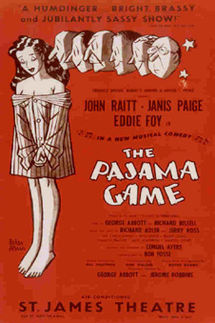
The Pajama Game drew back the first curtain at the St. James Theatre on May 13, 1954 and ran a record 1063 performances catapulting the show into the register of blockbuster musicals. Eddie Foy Jr., John Raitt, Janis Paige and Shirley MacLaine starred in the musical with music written and composed by Richard Adler & Jerry Ross. Jazz has had the privilege to give the song Hey There perpetual encores.
The Story: Adapted from the Broadway play, it’s a story of Sid, a workshop superintendent who must deal with a union demand for a 7.5-cent raise at the Sleep-Tite Pajama Factory. A strike is imminent and Babe the leader of the grievance committee leads the fight. However Sid is attracted to Babe and ensues a course of romance but is deflected. With slowdowns and machinery breakdowns promoting her cause, Sid reluctantly fires her. However he is convinced there is merit to Babe’s championship of the union and plots to get a peek at the books kept by Gladys.
Taking Gladys out to a nightclub Sid wheedles the keys from her but before he can leave the two are discovered by Babe. Sid gets a look at the books, sees that the boss has already tack on the 71/2 cents to production but has keeping the profits for himself. Sid confronts the boss, gets him to agree to the raise, goes to the union rally to bring the news and peace to his love life. Finally accepting her feelings for Sid, she falls for him. Everyone goes out to celebrate at Hernando’s Hideaway.
Jazz History: The free jazz movement, coming to prominence in the late ’50s, spawned very few standards. Free jazz’s unorthodox structures and performance techniques are not as amenable to transcription as other jazz styles. However, “Lonely Woman”, a blues by saxophonist Ornette Coleman, is perhaps the closest thing to a standard in free jazz, having been recorded by dozens of notable performers.
Free jazz is an approach to the music that was first developed in the 1950s and 1960s. Though the music produced by free jazz composers varied widely, the common feature was a dis-satisfaction with the limitations of bebop, hard bop and modal jazz, which had developed in the 1940s and 1950s. Each in their own way, free jazz musicians attempted to alter, extend, or break down the conventions of jazz, often by discarding hitherto invariable features chord changes or tempos. While usually considered experimental and avant-garde, free jazz has also oppositely been conceived as an attempt to return jazz to its “primitive”, often religious roots, and emphasis on collective improvisation.
Sponsored By

www.whatissuitetabu.com
Daily Dose Of Jazz…
Clifton Anderson was born October 5, 1957 in Harlem, New York City, grew up surrounded by music and exhibited an affinity for music at an early age. His father was a church organist/choir director, his mother a singer and pianist. When he was just seven years old he got his first trombone, a gift from his uncle Sonny Rollins.
Clifton attended the prestigious Fiorello LaGuardia High School of Music and Art followed by a year at SUNY – Stony Brook in 1974, then matriculating through the Manhattan School of Music, along with his friends Angela Bofill and Kenny Kirkland. It was during this tenure that he became involved in jazz organizations, ensembles and workshops that led to his first recording date with Carlos Garnett in 1976.
By the time he graduated Anderson was established as one the young “in demand” trombonists on the New York scene. He became a part of Slide Hampton’s “World of Trombones” and played alongside folks like Steve Turre, Clifford Adams, Papo Vazquez, Frank Lacy, Conrad Herwig and Robin Eubanks among others. However, it was J.J. Johnson who remained Clifton’s greatest influence.
The early 1980’s found Clifton working with a “who’s who” of diverse musical giants: from Frank Foster, McCoy Tyner, Clifford Jordan, Stevie Wonder, Dizzy Gillespie, Merv Griffin and The Mighty Sparrow to Lester Bowie, Paul Simon, Muhal Richard Abrams, T.S. Monk and Dionne Warwick among others. During this period Clifton also played on the Broadway shows Dreamgirls and Nine.
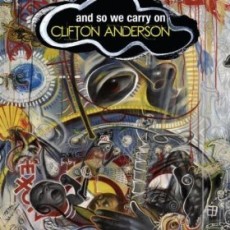
In 1983 Anderson got the call to join his uncle, Sonny Rollins, touring worldwide and appearing on his recordings. As a leader he has recorded three albums “Landmarks”, “Decade” and “And So We Carry On”. Between musical and administrative duties, running Sonny’s merchandising company, he has given academia much, teaching both privately and publicly and as an artist in residence at Duke University. He continues to perform, tour and record.
More Posts: trombone
Daily Dose Of Jazz…
Robert L. Hurst III was born on October 4, 1964 in Detroit, Michigan and began his early music studies playing the guitar before concentrating on the bass. In 1985 he began working with Out Of The Blue and adding such jazz luminaries and contemporaries as Tony Williams, Mulgrew Miller, Harry Connick Jr., Geri Allen, Russell Malone, Terence Blanchard, Pharaoh Sanders, Sting, Carl Allen and Steve Coleman among others to his roster.
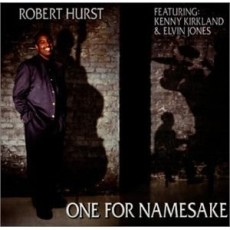
From 1986 to 1991 Hurst played in Wynton Marsalis’s ensemble, played with Branford Marsalis in the early nineties, and debuted as a leader in 1993 recording “Robert Hurst Presents” that reached #13 on the Billboard Top Jazz Albums chart. He has won four Emmy and five Grammy awards and directed, arranged and composed while a member of The Tonight Show Band.
He has scored original music for the films The Wood and Brown Sugar; performed music for Ocean’s 11, Ocean’s 12, Ocean’s 13, and on the Good Night, and Good Luck the soundtrack featuring Dianne Reeves, in which she won the Jazz Vocal Grammy in 2008. His recent recordings with Kenny Garrett and Diana Krall were each nominated for a 2007 Grammy.
No stranger to education Hurst has been involved with the Education of Jazz and Jazz History, receiving the Presidential Scholarship from President Ronald Reagan. He currently holds a position of Associate Professor teaching jazz bass at the University of Michigan’s School of Music, Theatre & Dance, and holds a seat with the Board of Directors for the John Coltrane Foundation.
More Posts: bass
Daily Dose Of Jazz…
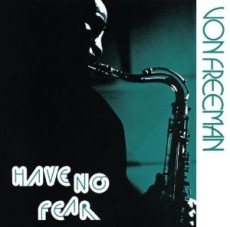
Von Freeman was born Earl Lavon Freeman Sr. on October 3, 1922 in Chicago, Illinois and learned to play the saxophone as a child. Attending DuSable High he studied under band director Walter Dyett. By the time he was 16 he was playing professionally with Horace Henderson’s Orchestra.
After serving in the Navy and playing in the band during WWII, Von returned to Chicago, where he has lived ever since, playing with his brothers George on guitar and Bruz (Eldridge) on drums at the Pershing Hotel Ballroom. Over the years various leading jazzmen such as Charlie Parker, Roy Eldridge and Dizzy Gillespie played with the Freemans as the backing band. In the early 1950s, Von played in Sun Ra’s band.
Freeman’s first venture into the recording studio took place in 1954, backing a vocal group called The Maples for Al Benson’s Blue Lake label. He appeared on Andrew Hill’s second single on the Ping label in 1956, followed by recording for Vee-Jay with Jimmy Witherspoon and Al Smith in the late fifties, and a recorded appearance at a Charlie Parker tribute concert in 1970.
It was not until 1972 that Von recorded under his own name, the album “Doin’ It Right Now” with the support of Roland Kirk. His next effort was a marathon session in 1975 released over 2 albums by Nessa. Since then he has lived, played regularly and recorded in Chicago, his recordings including 3 albums with his son, the tenorist Chico Freeman and “You Talkin’ To Me” with 22-year old saxophonist Frank Catalano, following their successful appearance at the Chicago Jazz Festival in 1999.
Freeman is considered a founder of the “Chicago School” of jazz tenorists along with Gene Ammons, Johnny Griffin and Clifford. His music has been described as “wonderfully swinging and dramatic featuring a large rich sound”. The hard bop tenor saxophonist holds down a regular Tuesday night set and jam session at the New Apartment Lounge on Chicago’s south side, and can also be heard at Andy’s Jazz Club on select weekends. Hard bop tenor saxophonist Von Freeman passed away on August 11, 2012 at age 88 in Chicago, Illinois.
More Posts: saxophone
Daily Dose Of Jazz…
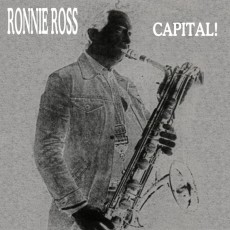
Ronnie Ross was born Albert Ronald Ross on October 2, 1933 in Calcutta, India. A move to London at 13 was where he began his interest in playing saxophone and started out on the tenor. In the ‘50s he played with Tony Kinsey, Ted Heath and Don Rendell and it was during his tenure with Rendell that he switched to the baritone.
Ross played the Newport Jazz Festival in 1958 and formed his own group that year called the Jazz Makers with drummer Allan Ganley. In 1959 he toured the United States and later Europe with the Modern Jazz Quartet. From 1961 to 1965 he played with Bill LeSage, Woody Herman, John Dankworth, Friedrich Guida and Clark Terry.
Ronnie was a saxophone tutor for a young David Bowie, and years later was the soloist on the Lou Reed song “Walk On The Wild Side”, which was co-produced by Bowie. He also had guest appearances as a soloist on several Matt Bianco albums.
Baritone saxophonist Ronnie Ross passed away on December 12, 1991 in London, England. He was 58.
More Posts: saxophone