

Daily Dose Of Jazz…
Lorez Alexandria was born Dolorez Alexandria Turner on August 14, 1929 in Chicago, Illinois and began as a singer in churches in her teens, spending 11 years as part of an “a cappela” choir. Turning to jazz, she worked the local Chicago club scene before moving to Los Angeles in 1962 to further her career.
Although Alexandria never made the anticipated breakthrough to a wider audience, but she was highly regarded as a jazz singer by those who knew her work, whether as critics, musicians or fans. Over the course of her career Lorez recorded with such musicians as King Fleming, Ramsey Lewis, Howard McGhee and Gildo Mahones.
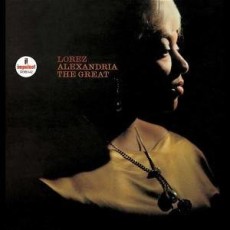
Lorez had an attractive voice, a good feel for jazz phrasing, and a cleanly enunciated delivery that was always highly sensitive to the import of the lyric she was singing. She remains best known for her album Alexandria the Great released in 1964 that featured her in a variety of contexts ranging from big bands to small groups, including several tracks with the Wynton Kelly Trio.
She recorded several albums, including This is Lorez Alexandria with the King Fleming Quartet 1957; Deep Roots 1960; A Woman Knows 1978 and Harlem Butterfly 1984.
Retiring from performing in 1996, she suffered a stroke shortly afterwards, remaining in failing health. Vocalist Lorez Alexandria succumbed to complications from kidney failure on May 22, 2001 in Los Angeles, California.
More Posts: vocal

Daily Dose Of Jazz…
Joe Puma was born on August 13, 1927 in the Bronx, New York. He became known professionally playing with Joe Roland in 1949. During the ‘50s he held down a position as a studio musician working with Louis Bellson, Artie Shaw, Eddie Bert, Herbie Mann, Mat Mathews, Chris Connor and Paul Quinichette. In 1957 he won the “New Star Award for Guitar” from Metronome Magazine.
He went on to record as a leader during this time and into the Sixties working with Morgana King, Bobby Hackett, Gary Burton and Carmen McRae and between 1972 and ’77 the guitarist led an ensemble with Chuck Wayne. He continued to perform and teach into the late 90s.
The typical Puma style was filled with clean melodic lines, perfect “comping” behind the other players. He had a humorous ad lib quality that showed up as “out of tempo” playing or quoting other melodies.
Guitarist Joe Puma left the world eight albums as a leader and numerous others as a sideman, passing away on May 31, 2000 in New York City a few months shy of his 73rd birthday.
More Posts: guitar
Daily Dose Of Jazz…
Patrick Bruce Metheny was born August 12, 1954 in Lee’s Summit, Missouri, a suburb southeast of Kansas City. At 15 he won a Down Beat scholarship to a one-week jazz camp, taken under the wing of guitarist Atilla Zoller and met Jim Hall and Ron Carter In NYC. Following high school graduation in 1972, he briefly attended the University of Miami, was quickly offered a teaching position but moved to Boston, accepting a teaching assistantship at Berklee College of Music with vibraphonist Gary Burton, making his name as a teenage prodigy.
In 1974, Metheny gained notoriety playing two sessions with Paul Bley and Carol Goss’ Improvising Artists label along with bassist Jaco Pastorius. He entered the wider jazz scene in 1975 when he joined Gary Burton’s band and his musical momentum carried him rapidly to the point that he had soon written enough material to record his debut album “Bright Size Life” with Pastorius and drummer Bob Moses.
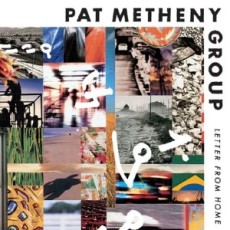
One of the most successful and critically acclaimed jazz and New Age musicians to come to prominence in the 1970s and ’80s, he is the leader of the Pat Metheny Group, is involved in side projects, and has released notable solo, trio, quartet and duet recordings. He has worked with musicians such as Jim Hall, Dave Holland, Roy Haynes, Toninho Horta, Gary Burton, Joni Mitchell, Chick Corea, Pedro Aznar, Jaco Pastorius, Charlie Haden, John Scofield, Jack DeJohnette, Herbie Hancock, Bill Stewart, Ornette Coleman, Brad Mehldau and many others.
His style incorporates elements of progressive and contemporary jazz, post-bop, new age, Latin jazz and jazz-fusion. He has been voted Guitarist of the Year by the Down Beat Magazine Readers Poll several times, was granted the Miles Davis Award by the Montreal International Jazz Festival, has amassed an impressive catalogue of 97 albums as a leader, collaborator or sideman, has three gold albums and has received 20 Grammy Awards.
Guitarist Pat Metheny has been touring for more than 30 years, playing between 120-240 concerts a year.
More Posts: guitar
Daily Dose Of Jazz…
Donny McCaslin was born August 11, 1966 growing up in Santa Cruz, California. Inspired by his pianist/vibraphonist father, Donny began playing the saxophone at 12 and quickly progressing played in his father’s band. While in high school he toured the U.S., Japan and Europe with his own band and youth ensembles. He played the Monterey Jazz Festival for three years as a member of the Festival’s California All-Star Band.
Receiving a full scholarship to Berklee College of Music in 1984, it was during his matriculation that Donny came under the influence of Gary Burton, Herb Pomeroy, Billy Pierce, George Garzone and Joe Viola. He performed regularly around Boston and Cambridge with the True Colors Big Band and in 1987 joined Burton’s group and toured with him for four years.
Moving to New York in 1991 McCaslin replaced Michael Brecker in Steps Ahead, staying with them until ’94. He has played with the Gil Evans Orchestra, the George Gruntz Concert Jazz Band, Danilo Perez, Maria Schneider, and Santi DiBriano. In 2006 he joined the Dave Douglas Quintet.
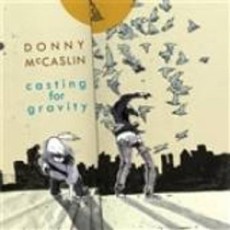
His first release as a leader came in 1998 with “Exile and Discovery” and he has continued performing, recording and issuing releases under his own name with his latest 2012 release “Casting For Gravity”.

More Posts: saxophone
From Broadway To 52nd Street
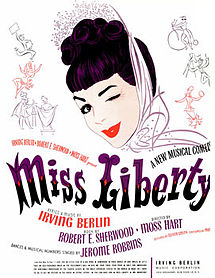
Miss Liberty brought to the stage its star Eddie Albert at the Imperial Theatre on July 15, 1949. The show ran for three hundred and eight performances with music composed by Irving Berlin. The song “You Can Have Him” became a jazz standard.
The Story: In 1885, New York Herald publisher James Gordon Bennett assigns novice reporter Horace Miller to find the woman who served as Frédéric Auguste Bartholdi’s model for the Statue of Liberty. In the artist’s Paris studio, Miller sees a photograph of Monique DuPont and mistakenly believes she was the one. Bennett arranges for her and her grandmother to accompany Horace back to New York City, where she becomes a media darling. When rival publisher Joseph Pulitzer discovers it was Bartholdi’s mother who actually posed for him, he exposes Monique as a fraud in his New York World. She faces deportation until a sympathetic Pulitzer comes to her rescue, paving the way for her to plan a future with Horace, who jilts his American girlfriend Maisie Doll in favor of the French beauty.
Jazz History: As the widely performed bebop or hot jazz began to wane in some sectors of the country, cool jazz began to emerge by the early 1950s. “Cool” was used to describe a kind of toned-down jazz. Later the term became associated with a number of white musicians who relocated to California where they could get day gigs at movie studios, unlike black musicians, while playing jazz at night. In this form it was called West Coast jazz. For white players to represent a kind of cool jazz is ironic since the idea of coolness has its roots in Black culture. Cool jazz contrasts with hot jazz in that it has limited vibrato, restrained timbre, stable dynamics, melodic calm, sophisticated harmonies that tempered the blues idiom.
Sponsored By

www.whatissuitetabu.com