Daily Dose Of Jazz…
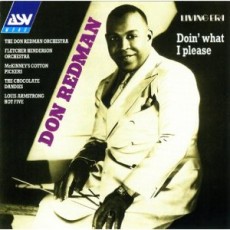
Donald Matthew Redman was born into a musical family on July 29, 1900 in Piedmont, West Virginia. He started playing the trumpet at age 3, joined his first band at 6 and by twelve was proficient on all wind instruments ranging from trumpet to oboe and piano. After studying at Storer’s College in Harper’s Ferry and at the Boston Conservatory, he joined Billy Page’s Broadway Syncopaters in New York.
1922 saw Don joining Fletcher Henderson’s orchestra, mostly playing clarinet and saxophones. He soon began writing the bulk of the orchestra’s arrangements, contributing much to formulate the sound that was to become big band swing. The chief trademark of Redman’s arrangements was that he harmonized melody lines and pseudo-solos within separate sections; for example, clarinet, sax, or brass trios. He played these sections off each other, having one section punctuate the figures of another, or moving the melody around different orchestral sections and soloists. His use of this technique was sophisticated, highly innovative, and formed the basis of much big band jazz writing in the following decades.
By 1927 he joined McKinney’s Cotton Pickers in Detroit as their musical director and leader but by 1931 Redman formed his own band and took up residency at Connie’s Inn in Manhattan. Redman’s band recorded for Brunswick Records, provided music for the Betty Boop series, employed singer Harland Lattimore, known as “The Colored Bing Crosby” and wrote arrangements for musicians and bandleaders like Paul Whiteman, Isham Jones and Bing Crosby. By 1940 Redman had disbanded his orchestra, began freelancing writing arrangements that became hits for Jimmy Dorsey, Count Basie and Harry James. In 1949 he appeared on CBS’s Uptown Jubilee and in the Fifties became musical director for Pearl Bailey.
Don Redman died in New York City at age 64 on November 30, 1964. His family legacy left us two more generations of jazz musicians, as he was the uncle of saxophonist Dewey Redman, and thus great-uncle of saxophonist Joshua Redman and trumpeter Carlos Redman.
Daily Dose Of Jazz…
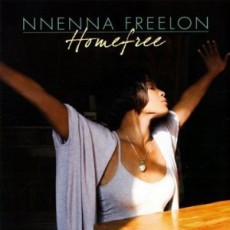
Nnenna Freelon, born Chinyere Nnenna Pierce on July 28, 1954 was raised in Cambridge, Massachusetts and sang in Union Baptist Church and St. Paul AME choirs as a young woman. She graduated from Boston’s Simmons College with a health care administration degree, worked at the Durham County Hospital in North Carolina and by 1990 had been singing for about seven years under her married name.
Attending the Southern Arts Federation conference presented her the opportunity to meet Ellis Marsalis, who became mentor and teacher. He passed her “package” on to George Butler of Columbia Records and in 1992 she was signed and dropped her debut. By 1994 Columbia ended their association and two-years later Concord picked her up.
The singer, composer, arranger, producer has been nominated for a five Grammy Awards, has performed and toured with the likes of Aretha Franklin, Ellis Marsalis, Al Jarreau, Clark Terry, Dianne Reeves, Terence Blanchard and Herbie Hancock, just to name a few. Nnenna has performed at venues such as Carnegie Hall, Montreux, Monterey and Ellington Jazz Festivals, the Kennedy Center, the Apollo Theatre and many more worldwide.
Aside from her many jazz and singing responsibilities, Freelon is the national spokesperson for the National Association of Partners in Education, an arts education organization with over 400,000 school/community partnership programs across the U.S; and her Babysong workshops teaches young mothers and healthcare providers the importance of the human voice for healing, nurturing and brain development in young children. She continues to perform, record and tour.
More Posts: vocal
From Broadway To 52nd Street
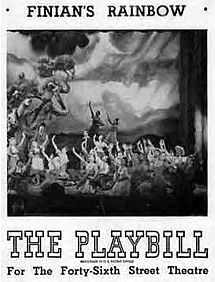
Finian’s Rainbow opened on January 10, 1947 at the 46th Street Theater starring Albert Sharpe, Ella Logan and David Wayne. Burton Lane and E.Y. Harburg composed the score for this stage production that ran 725 performances. The musical would be made into a movie some twenty-one years later to star Fred Astaire and Petula Clark. From this musical came the encores with the jazz classics Old Devil Moon, Look To The Rainbow and How Are Things In Glocca Morra.
The Story: An Irishman named Finian seeking his fortune steals a pot of leprechaun gold and arrives in America to plant it at Fort Knox and watch it grow. However, the leprechaun who follows him is threatened to become human if it is not returned. When they stop in Rainbow Valley, Finian’s daughter falls in love with a local. During his brief stay, Og the leprechaun, convinces racist Senator Rankin to turn over a new leaf by magically turning him black. The Senator recants and Finian gives back the gold and continues his wanderings.
Jazz History: Jazz was created in 1947 as an artist’s book of some one hundred prints based on paper cutouts by Henri Matisse, who was in his seventies and in poor health when he began this project. No longer able to draw or paint easily with a pencil or brush, he used scissors to cut out simple forms from brightly colored paper painted to his specifications with gouache. He then arranged them on another sheet of gouache-painted paper.
The original intention was for Matisse to illustrate poems written by a French author. As Matisse began, he used a large fluid brush to write notes to himself on construction paper about his thoughts as he created the images. The simple visual appearance of the words pleased Matisse, and he suggested using his roughly painted words in juxtaposition with the images, rather than the original poems. The publisher agreed.
None of the original copies were bound, and many of the purchasers arranged with prominent artists like Cocteau or famous graphic designers to create binders for the pages. Each of the pages is about 24 inches by 12 inches and folded in the center. The original edition of September 30, 1947 consisted of 250 sets of prints and sold for $120 each.
Sponsored By

www.whatissuitetabu.com
Daily Dose Of Jazz…
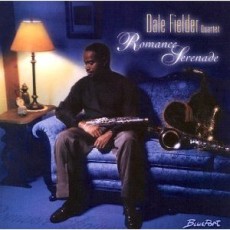
Dale Fielder was born July 27, 1956. Growing up in Midland, a small suburb outside Pittsburgh, Pennsylvania he studied oboe, bassoon and tuba in the school system and clarinet, saxophone, composition and arranging privately with Pittsburgh area tenor saxophonist Phillip Celli. An alumnus of the University of Pittsburgh Jazz Studies Program, Dale studied as an ethnomusicology major under Dr. Nathan Davis. His debut jazz performance was as a member of the Joe Harris Quartet, former drummer with the Charlie Parker Quintet and Dizzy Gillespie Orchestra.
Fielder is a recipient of a NEA grant, has completed his first large work “The Aquarian” for alto saxophone and chamber orchestra; spent eight years in NYC, moved to Los Angeles, began studying with alto legend, Charles McPherson. He has recorded a dozen CDs as a leader including the top-ten critically acclaimed “Dear Sir: Tribute To Wayne Shorter”; he received his first commission and wrote the extended eleven-movement jazz suite, “Ocean Of Love And Mercy”; was selected as BET’s 1999 Jazz Discovery winner and performs throughout Europe and Asia with his quartet.
If originality is the barometer of what truly makes a great jazz artist, Dale Fielder possesses a quality of originality in his voice. The multi-instrumentalist offers rare and obscure jazz classics to his audience coupled with his original compositions, giving the listener a variety of new concepts and presentations. He continues his performance, recording and touring.
More Posts: saxophone