Daily Dose Of Jazz…
Phil Woods was born Philip Wells Woods on November 2, 1931 in Springfield, Massachusetts. He studied music with his great influence Lennie Tristano, at the Manhattan School of Music and at The Julliard School.
After moving to France in 1968, Phil led the avant-garde jazz group The European Rhythm Machine, and then returned to the United States in 1972 and unsuccessfully attempting to establish an electronic group formed a quintet, which is still performing with some changes of personnel.
Although Woods is primarily a saxophonist he is also a fine clarinet player and solos can be found scattered through his recordings. His pop credits include the alto solos on Billy Joel’s Just The Way You Are, Steely Dan’s Doctor Wu and Paul Simon’s Have A Good Time.
Phil has worked with the likes of Manny Albam, Kenny Burrell, Gary Burton, Ron Carter, Lou Donaldson, Bill Evans, Art Farmer, Dizzy Gillespie. Stephane Grappelli, Milt Jackson, Quincy Jones, Mundell Lowe, the Modern Jazz Quartet, Thelonious Monk, Oliver Nelson, Lalo Schifrin, Shirley Scott, Clark Terry and Ben Webster among others.
He has amassed 34 sessions as a sideman and nearly four-dozen albums as a leader and has been nominated for seven Grammy Awards and won one for Images: “Best Large Jazz Ensemble Performance”, and three for “Best Instrumental Jazz Performance, Individual or Group” for Live from the Show Boat, More Live, and At the Vanguard.
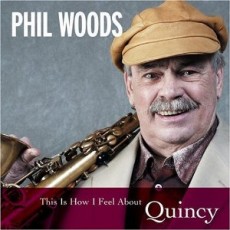
His 2005 documentary film “A Life in E Flat” – Portrait of a Jazz Legend” offers an intimate portrait of Woods during a recording session of the Jazzed Media album This is How I Feel About Quincy. In 2007, Phil received a “Jazz Master” award from the National Endowment of the Arts. Saxophonist, clarinetist and composer Phil Woods was married to Chan Parker, the widow of Charlie Parker, until her death in 1999. He continued to perform, record and tour until his passing on September 29, 2015 in East Stroudsburg, Pennsylvania.

Daily Dose Of Jazz…
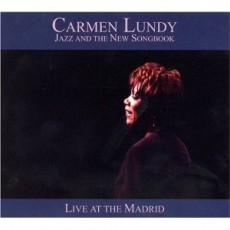
Carmen Lundy was born November 1, 1954 in Miami, Florida and at the age of six began to study the piano. After joining her church junior choir, she decided to become a singer when she was 12 years old. While an opera major at the University of Miami she sang with a jazz band and her decision to sing vocal jazz was cemented.
Moving to New York in 1978 Carmen was hired by the Mel Lewis/Thad Jones Big Band and performed her first engagement at the Village Vanguard in Greenwich Village. Two years later she formed her own trio, performing with pianists John Hicks and Onaje Allan Gumbs. She has also performed with Walter Bishop Jr., Don Pullen, Mulgrew Miller, Terri Lyne Carrington, Courtney Pine, Bill O’Connell, Steve Berrios, Marian McPartland, Kenny Kirkland and numerous others.
Lundy recorded her first album of original compositions Good Morning Kiss in 1985 followed by her sophomore project Night and Day the next year featuring musicians Kenny Kirkland, Alex Blake, her brother Curtis Lundy, Victor Lewis, Rodney Jones and Ricky Ford.
Carmen played the lead role in the European tour of Duke Ellington’s Broadway musical, Sophisticated Ladies. Off-Broadway she portrayed Billie Holiday in Lawrence Holder’s They Were All Gardenias. She made her television debut in 1990 as the star of the CBS pilot-special Shangri-La Plaza in the role of Geneva.
A composer, arranger, producer, actress, painter, and sophisticated vocalist well known for her progressive bop and post-bop styling’s, Lundy has composed and published forty songs with favorites such as Quiet Times, Forgive Me, The Out Crowd, and Never Gonna Let You Go that have been recorded by Kenny Barron, Ernie Watts and Straight Ahead. With thirteen albums to her credit Carmen Lundy continues to focus on original material as she moves her three-decade career forward.
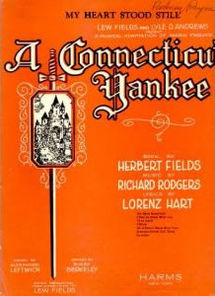
From Broadway To 52nd Street
A Connecticut Yankee opened on November 3, 1927 in the Vanderbilt Theatre and ran for four hundred and eighteen performances starring William Gaxton, Constance Carpenter and Nana Bryant.Richard Rodgers and Lorenz Hart composed the music for this delightful romp and from the body of music came two jazz standards Thou Swell and My Heart Stood Still. Based on the Mark Twain fantasy.
The Story: A modern man is thrust back to King Arthur’s Court in a dream caused by a blow to the head given by his fiancée for flirting with a girl. In his dream appear all the people important in his life, each taking on the personality he perceives in real life. While at court he falls in love with the girl, his attempts to woo her are thwarted by Merlin and Morgan le Fay. When he awakens he leaves his fiancée and decides to marry the girl.
Jazz History: Four clubs were pivotal in setting up The Street. 21 brought glamour, high society, top politicians and the columnists who spread the fame of The Street. Tony’s at No. 57-59 attracted the literary and theater set of the famous Algonquin Roundtable. At No. 33 Leon & Eddie became home for the tourists, cloak and suiters and show biz folk who couldn’t make it at 21 or Tony’s. At Joe Helbeck’s Onyx, originally an “in” spot for studio musicians at No. 35 triggered the awareness and influx of the public through its song hits.
In the early thirties, humorist Robert Benchley along with Jack Kriendler, one of the founder-owners of 21 drank their way west to 6th Avenue and back up the even numbered side of the street east to 5th counting the number of speakeasies and coming up with no less than 38.
Sponsored By

www.whatissuitetabu.com
More Posts: broadway
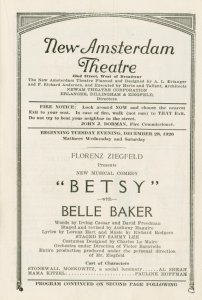
From Broadway To 52nd Street
Richard Rodgers and Lorenz Hart wrote the musical Betsy as a vehicle for an actress named Belle Baker. When its producer Flo Ziegfeld decided that the show needed a big hit ballad, he went straight to Irving Berlin and asked him for one and Blue Skies was quickly dropped into the musical and on opening night on December 28, 1926 in the New Amsterdam Theatre, Rodgers and Hart – who never countenanced interpolations into their shows – sat in their house seats, fuming. The show faded away after only thirty-nine performances, however, Blue Skies went on to become part of show business history and a popular standard.
Broadway History: At its height in 1928, Broadway had been reduced to a twelve-block area between 41st and 53rd streets, however it originally encompassed an area stretching from 35th to 54th street, between 6th and 8th avenues. Although the district was comprised of nearly 80 theatres only four theatres are actually located on Broadway, The Marquis at 46th, The Palace at 47th, The Winter Garden at 50th and The Broadway at 53rd Street. The balance of the legitimate houses was located either east or west of this avenue. This however was not always the case. In 1810, if you wandered up Broadway north of the Battery towards the villages of Greenwich or Harlem farther to the north of the common pasture, Sheep’s Meadow; past Wall Street and Maiden Lane, at City Hall Park you would have passed the beautiful Park Theatre on Park Row. A second theatre, The Bowery, was built in 1821 and the migration of “mid-town” towards the north was well underway.
Sponsored By
www.whatissuitetabu.com
More Posts: broadway
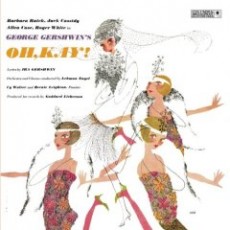
From Broadway To 52nd Street
On November 8, 1926 The Imperial hosted the opening night of this new musical “Oh Kay!” starring Gertrude Lawrence, Oscar Shaw and the Fairbanks twins. The show ran for 256 performances and with the assistance of George and Ira Gershwin gave the world a Broadway melody destined to become a jazz standard – Someone To Watch Over Me.
The Story: It is 1926, the Jazz Age and the era of Prohibition. Jimmy Winter is very popular among the young ladies, and in the imaginary town of Beachampton, they are cleaning the living room of his Long Island, New York estate, declaring that “The Woman’s Touch” is exactly what his home needs. Jimmy Winter spends so little time on his Long Island estate, Kay Denham, posing as a cook, helps her rum-running brother, a titled English bootlegger, cache his illegal booze there. When Jimmy returns unexpectedly to get married, he falls in love with Kay. As a result, he helps Kay outmaneuver revenue agents and after renouncing his numerous other promises of marriage, agrees to marry Kay.
Jazz History: West 52nd Street is best known as the “Street of Jazz” or “The Street That Never Sleeps”. It ran east to west from 5th to 6th Avenues and was renowned in its heyday during and after Prohibition from 1925 to 1960. 52nd Street hosted such celebrated establishments as the Hickory House, Jimmy Ryan’s, the Famous Door, the Iron Gate, Leon & Eddie, 21, Tony’s, The Onyx, The Three Deuces, Downbeat, The Yacht Club, The Wing Club and Kelly’s Stable.
From 1935 to 1945 this monochrome of five story brownstone buildings in whose drab and cramped street level interiors – once known as English basements – flourished as speakeasies and jazz clubs and by 1936 it became also known as “Swing Street” and served as the launching pad for more singers, more hit songs and more instrumentalists than Chicago, New Orleans, Memphis or Los Angeles.
Sponsored By
www.whatissuitetabu.com
More Posts: broadway