


The Jazz Voyager
Rest’Ô Jazz: 8, rue Amélie, Toulouse, France. Telephone: +33 5 61 57 96 95 Fax: +33 5 61 57 96 95 Contact: Yannick Orthlieb. The Rest’Ô Jazz is open from Tuesday to Saturday with live jazz every night.
Since 2004, the Rest’Ô Jazz has presented the tradition of New Orleans Jazz Clubs distilling a unique atmosphere in Toulouse. All year long, jazz influences adapt to any purpose. From Louis Armstrong to The Mississippi Jazz Band, from Django Reinhardt to Gadjo Zaz Trio, from Count Basie to The Philippe Laudet Jazz Odyssée.
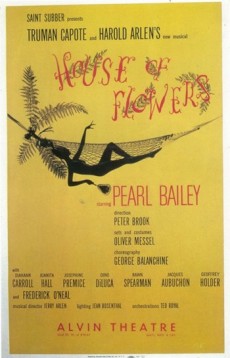
From Broadway To 52nd Street
House Of Flowers opened at the Alvin Theatre on December 12, 1954 with music by Harold Arlen and lyrics and book by Truman Capote. This was his only Broadway musical based on his own short story, which was first published as one of three extra pieces in the Breakfast At Tiffany’s novella. Pearl Bailey, Diahann Carroll, Juanita Hall, Alvin Ailey, Geoffrey Holder, Ray Walston and Carmen de Lavallade starred for 165 performances. The composition that emerged from this musical to become a jazz standard was “A Sleepin’ Bee”.
The Story: During a trade war between two Haitian brothel keepers, Madame Tango and Madame Fleur, the latter sells one of her girls, Ottilia, to a rich lord. Ottilia turns him down preferring young, handsome but poor mountain boy Royal. and despite Fleur’s machinations to seal Royal in a barrel and toss him into the ocean, he escapes his watery grave on the back of a turtle. The lovers eventually marry and live happily ever after.
Jazz History: Hard bop, an extension of bebop (or “bop”) music that incorporates influences from rhythm and blues, gospel, and blues especially in the saxophone and piano playing, developed in the mid-1950s, partly in response to the vogue for cool jazz in the early 1950s. The hard bop style coalesced in 1953 and 1954, paralleling the rise of rhythm and blues. Miles Davis’ performance of “Walkin'”, the title track of his album of the same year, at the very first Newport Jazz Festival in 1954, announced the style to the jazz world. The quintet, Art Blakey and the Jazz Messengers featuring pianist Horace Silver and trumpeter Clifford Brown were leaders in the hard bop movement along with Davis.
Modal jazz recordings, such as Davis’ Kind of Blue became popular in the late 1950s. Popular modal standards include Davis’s “All Blues All” and “So What”, John Coltrane’s “Impressions” and Herbie Hancock’s “Maiden Voyage”. These recordings would eventually lead to the formation of Davis’ second great quintet, which included saxophonist Wayne Shorter and pianist Herbie Hancock, recorded a series of highly acclaimed albums in the mid-to-late 1960s.
Sponsored By

www.whatissuitetabu.com

From Broadway To 52nd Street
Our journey from Broadway to 52nd Street continues with Kismet that opened as a play on December 25, 1911 at the Knickerbocker Theatre and ran for 184 performances. However, it wasn’t until almost 42 years later to the day that it opened on Broadway as a musical on December 3, 1953. Two songs, Stranger In Paradise and Baubles, Bangles & Beads came from the musical composed by Robert Wright and George Forrest to become jazz standards. The musical ran for 583 performances with Ronald Coleman, Marlene Dietrich and Edward Arnold playing the musicals starring roles.
The Story: Haji, a wily beggar and poet is arrested on a minor infraction by the Wazir, who agrees to release him if he kills the Caliph. Hajj’s attempts fail and he is thrown in jail with his old enemy the sheik. He kills the sheik and escapes in his clothing. Learning his daughter is a concubine in the Wazir’s harem, Hajj drowns the Wazir and frees his daughter. The Caliph marries the daughter but by law must banish Hajj. When Hajj returns, the Caliph looks the other way and allows him to beg and recite poetry.
Broadway History: In the 1950s, Broadway musicals were a major part of American popular culture. Every season saw new stage musicals send songs to the top of the charts. Public demand, a booming economy and abundant creative talent kept Broadway hopping. To this day, the shows of the 1950s form the core of the musical theatre repertory. The best of these musicals integrated every element, offering recognizable characters singing in stories told with wit and genuine heart – in short, they applied the Rodgers & Hammerstein formula. The two songwriters were international celebrities, so the media treated each new Rodgers & Hammerstein stage show as a major event.
Oscar Hammerstein II died due to stomach cancer a few months after The Sound of Music opened, ending a career that spanned the golden age of musical theatre and film. After working with the innovative Jerome Kern Jerome and operetta master Sigmund Romberg, he did his finest work with Rodgers, and later coached young Stephen Sondheim. More than any other individual, Hammerstein had turned the once-innocuous Broadway musical into a potent dramatic form, and had turned lyrics into essential dramatic tools. He did it by being a superb storyteller and a dedicated craftsman. Even when dealing with serious issues, he always kept his focus on intriguing characters caught in remarkable situations.
Sponsored By
www.whatissuitetabu.com

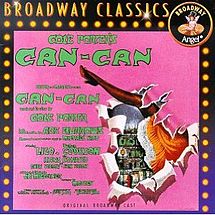
From Broadway To 52nd Street
Can-Can was first seen on the stage of the Shubert Theatre on May 7, 1953 and the audience heard music composed by Cole Porter. The show ran for 892 performances. The original Broadway production ran for over two years starring Gwen Verdon in only her second Broadway role. Both she and and choreographer Michael Kidd won Tony Awards and were praised, the score and book received tepid reviews. However, three songs that rose to become jazz standards were I Love Paris, Just One Of Those Things and It’s All Right With Me.
The Story: In 1893 Paris, the dance hall Bal du Paradis in Montmartre owned by La Môme Pistache, is being threatened with closing by a self-righteous judge, Aristide Forestier. Offended by the scandalous but popular dance that the attractive dancers perform, the “Can-Can”, the judge sends the police to harass the owner and dancers, but the police like the dancers so much that they are reluctant to testify against them in court. Deciding to gather evidence, the judge takes a trip to the club. Once there, he and the owner, La Môme, fall in love but he gets the evidence to send the owner and girls to jail.
One of the dancers, Claudine, a laundry girl by day, has been pursued by art critic Hilaire, however, Claudine is in love with sculptor Boris but still arranges to have dinner with Hilaire to get a favorable review for her love. Conflicted between love and right and wrong, the judge conceded, “obscenity is in the eye of the beholder”. And gets caught in a scandalous kiss with the proprietress. Eventually, Hilaire writes a gushing review of Boris’s work. Judge Aristide loses his judgeship and is disbarred, but La Môme and the girls all go to court with him and all win their cases.
Jazz History: Live jazz was recorded, as early as 1935, but for some reason it was not considered feasible to reproduce it on 78 rpms for public consumption. This precedent was first broken in 1945 by Norman Granz, who, as one of jazz’s liveliest aficionados, originated in the early forties the notion of taking on tour for concert appearances a select group of musicians. It was an arrangement he called “Jazz at the Philharmonic”. In 1944, unbeknownst to the participating musicians, he recorded sections of a concert he was producing in Los Angeles. He then released them soon afterwards in a 12-inch 78 rpm album of three records, and there were just two tunes, “Lady Be Good” and “How High the Moon”, each of which covered three sides, or approximately fifteen minutes of playing time. His experiment proved a huge success and he released fifteen albums since then, the last an entire concert on three 12-inch LPs, amounting to about two hours of music. Other record companies followed suit, using the advantageous expanded playing time of the LP, and the record stores were stocked with live performances of all varieties and qualities, ranging from nightclub stints to private jam sessions.
Sponsored By
www.whatissuitetabu.com