

Daily Dose Of Jazz…
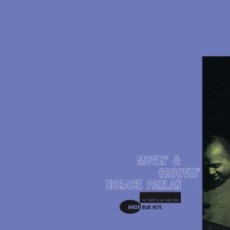
Horace Parlan was born on January 19, 1931 in Pittsburgh, PA who became an influential hard bop and post-bop pianist. Stricken with polio as a child that partially crippled his right hand, Parlan turned this would be handicap into what has been described as a “pungent left hand chord voicing style while complimenting highly rhythmic phrases with this right”.
He began playing in R&B bands in the 50’s until his move to New York where he joined Charles Mingus’ band from 1957 to 1959, a collaboration that greatly influenced Parlan’s career. Time would see him playing with Booker Ervin, Eddie Lockjaw Davis, Johnny Griffin and Rahsaan Roland Kirk; was the house rhythm section for Minton’s Playhouse in Harlem with bassist George Tucker and drummer Al Harewood while recording a strong series of sessions for Blue Note in the 60’s.
By 1973 Horace was on his way to Europe, settling in Copenhagen and gained international recognition through his Steeplechase recordings including exceptional duet dates with Archie Shepp. He also recorded with Dexter Gordon, Red Mitchell and in the 80’s with Frank Foster and Michael Urbaniak.
His later work, notably a series of duos with the tenor saxophonist Archie Shepp, including the album Goin’ Home, is steeped in gospel music. He has recorded nearly two-dozen albums as a leader and more as a sideman. In 2000 he was a recipient of the Ben Webster Prize given by the Ben Webster Foundation. Horace Parlan, the hard bop/post-bop pianist who attributes Ahmad Jamal and Bud Powell as his major influences, resided and performed regularly in Copenhagen, Denmark until his passing on February 23, 2017 in Korsør, Denmark.

More Posts: piano
Daily Dose Of Jazz…
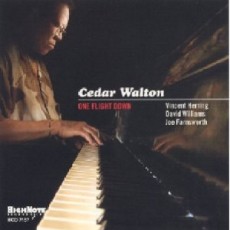
Cedar Walton was born Cedar Anthony Walton Jr. was born January 17, 1934 in Dallas Texas. After attending the University of Denver, he moved to New York in 1955. A two-year stint in the Army saw him performing in a jazz ensemble, whereupon his discharge he joined Kenny Dorham’s band. By the late 1950s Walton was playing with J. J. Johnson, the Art Farmer/Benny Golson Jazztet and Gigi Gryce. In 1959 he recorded as a member of John Coltrane’s group on his seminal work Giant Steps.
In the early 1960s, Cedar joined Art Blakey’s Jazz Messengers and for three years held the position of pianist/arranger, playing with Wayne Shorter and Freddie Hubbard. He left the Messengers in 1964 and by the late Sixties was part of Prestige Records’ house rhythm section, where in addition to releasing his own recordings, he recorded with Sonny Criss, Pat Martino, Eric Kloss, and Charles McPherson.
Although he has been one of the finest interpreters of standards, Walton is considered one of the jazz world’s most underrated composers contributing “Bolivia”, “Fantasy in D”, Mosaic and “Ugetsu”.
During the mid-1970s, Walton led the funk group Mobius. He has recorded with Hank Mobley, Abbey Lincoln, Lee Morgan and led the group Eastern Rebellion with rotating members included Clifford Jordan, George Coleman, Bob Berg, Sam Jones and Billy Higgins.
In January 2010, he was inducted as a member of the National Endowment for the Arts Jazz Masters. Since first recording as a leader he has recorded some four-dozen albums and an equal amount as a sideman. Pianist Cedar Walton continued to lead his own groups and freelance until his death on August 19, 2013.

More Posts: piano
Daily Dose Of Jazz…
George Colligan was born on December 29, 1969 in New Jersey and raised in Columbia, Maryland, a suburb of Baltimore. He attended the Peabody Institute, majoring in classical trumpet and music education. In high school he learned to play the drums and later switched to piano.
Moving to New York City he quickly became an in-demand sideman working with Phil Woods, Billy Higgins, Gary Bartz, Nicholas Payton, Buster Williams, Don Byron, Vanessa Rubin, Christian McBride and Cassandra Wilson and many others.
George’s eclectic style incorporates everything from show tunes to funk, from free improvisation to modern classical music. He performs at festivals all over the world, including the North Sea Jazz Festival, the Edinburgh Jazz & Blues Festival, Vancouver International Jazz Festival, and the Cancun Jazz Festival.
As an educator, Colligan has taught at the Juilliard School of Music, the University of Manitoba, was the songwriter-in-residence at Aqua Books and has taught jazz history, piano, drums, trumpet, and led many different master classes. Continuing to perform and record, George Colligan is currently an Assistant Professor and Jazz Ensembles Coordinator at Portland State University in Oregon.

Daily Dose Of Jazz…
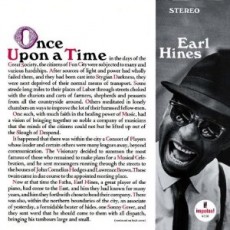
Earl “Fatha” Hines was born Earl Kenneth Hines on December 28, 1903 in Duquesne, Pennsylvania. The youngster took classical piano lessons and by eleven was playing organ in his local Baptist church. Having a “good ear and a good memory” he could re-play songs and numbers he heard in theaters and park concerts. At 17, with his father’s approval, Hines moved away from home to take a job playing piano in a Pittsburgh nightclub with baritone Lois Deppe & his Symphonian Serenaders. He would accompany Deppe on his concert trips to New York and record his first four sides for Gennett Records in 1923 that included Hines’ composition Congaine.
In 1925 Hines moved to Chicago, Illinois, then the world’s “jazz” capital, home to Jelly Roll Morton and King Oliver. He started in The Elite no. 2 Club but soon joined Carroll Dickerson’s band, touring with him on the Pantages Theatre Circuit to Los Angeles. He met Louis Armstrong in the poolroom at Chicago’s Musicians’ Union and becoming good friends played together Louis was astounded by Hines’s avant-garde “trumpet-style” piano playing. They played together in Dickerson’s band, Louis’ Hot Five and The Unholy Three.
Hines joined clarinetist Jimmy Noone, recorded his first piano solos for QRS Records in 1928, then for Okeh in Chicago. In Chicago he lead his own big band at the Capone controlled Grand Terrace Café, working continuously through the Great Depression. He influenced or taught Nat “King” Cole, Jay McShann and Art Tatum. Fatha brought along in his band Dizzy Gillespie, Budd Johnson, Ray Nance, Trummy Young, Harry “Pee Wee” Jackson, Charlie Parker, Scoops Carry, Teddy Wilson, Omer Simeon and Nat “King” Cole, along with vocalists Sarah Vaughan and Billy Eckstine among others.
He laid the seeds for bebop bringing modern players like Gene Ammons, Benny Carter Wardell Gray, Bennie Green and shadow Wilson to name a few. Earl would hire and all-women group during WWII, fronted Duke Ellington’s band when he was ill, and had a serious head injury from a car crash that affected his eyesight for the rest of his life.
Earl “Fatha” Hines was one of the most influential figures in the development of modern jazz piano and according to one major source, is “one of a small number of pianists whose playing shaped the history of jazz”. To name a few would be an injustice to those unmentioned as his list of recordings with jazz notables runs endlessly.
Over the course of his career Earl joined up again with Armstrong in what became the hugely successful “Louis Armstrong and his All-Stars small-band”, he won Downbeat Magazine’s Hall of Fame “International Critics Poll” and elected him the world’s “No. 1 Jazz Pianist”, made a hour long documentary at Blues Alley in Washington, DC, played solo at the White House and for The Pope, and played and sang his last show in San Francisco a few days before he died in Oakland, California on August 22.1983. On his tombstone is the inscription: “Piano Man”.

More Posts: piano
Daily Dose Of Jazz…
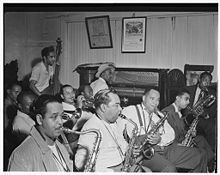
Eddie Wilcox was born in Method, North Carolina on December 27, 1907. He studied at Fisk University, where he met Jimmie Lunceford and played with him in college bands and then professionally in the mid-1920s. In 1929 he became the main arranger for the ensemble, and remained so until Lunceford’s death in 1947.
Wilcox was named co-leader with Joe Thomas after Lunceford died, and became sole leader in January 1949, where he remained until the group disbanded early in the 1950s.
His 1952 recording of the Bennie Benjamin and George David Weiss composition “Wheel of Fortune” became a hit in the U.S., peaking at #14. Following this Wilcox played solo at the Cafe Riviera in New York City for nearly a decade.
He and Teddy McRae founded the Raecox record label in the 1950s that produced and released R&B music. He also worked as an executive for Riviera and Derby record labels. Working with jazz trombonist Big Chief Russell Moore shortly before his death, pianist and arranger Eddie Wilcox passed away on September 29, 1968.
