

Daily Dose Of Jazz…
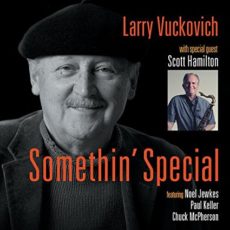
Larry Vuckovich was born on December 8, 1936 in Kotor, Montenegro and spent his childhood in Yugoslavia where he received classical piano lessons. He became familiar with jazz listening to radio broadcasts of AFN and Voice of America. Suffering persecution under Tito, his family emigrated to the US in 1951, received political asylum and settled in San Francisco, California.
Visited local jazz clubs Larry listened to jazz greats such as Miles Davis, Dizzy Gillespie and John Coltrane, and started playing jam sessions with musicians on the local jazz scene such as John Handy and Cal Tjader. He studied music at San Francisco State University alongside Roland Kirk, Mickey Roker and Bob Cranshaw, while getting instructed by Vince Guaraldi.
1959 saw Vuckovich starting his professional career in the band of Brew Moore. Soon thereafter, he accompanied singers like Irene Kral, David Allyn and Mel Tormé. By 1965 he had joined the band of Jon Hendricks to tour with him throughout the world, before settling in Munich, Germany as house pianist of the jazz club Domicile. While working there, he performed with Lucky Thompson, Pony Poindexter, Clifford Jordan, Dexter Gordon, Slide Hampton and Dusko Goykovich among others.
Returning to San Francisco he took up residency at the Keystone Korner until 1983 playing with the likes of Arnett Cobb, Buddy Tate, Leon Thomas, Philly Joe Jones and Charles McPherson. From 1985 to 1990, Vuckovich worked in New York City with Curtis Fuller, Milt Hinton, Al Cohn, Tom Harrell and many others. Afterwards, he returned to the West Coast in order to pursue projects of his own, which included bands Blue Balkan, Young at Heart and La Orquesta el Vuko.
He has also performed with Bobby Hutcherson, Larry Grenadier, Hadley Caliman, Cal Collins and Eddie Vinson. He became the artistic director for the West Coast Jazz Festival and the Nappa Valley Jazz Festival and founded his own label “Tetrachord Music”, for which he also acts as producer. Pianist Larry Vuchovich continues to perform, tour and record under his own name for Concord, Hot House, Inner City and Palo Alto Jazz record labels

Uplift Someone’s World

More Posts: piano
Daily Dose Of Jazz…
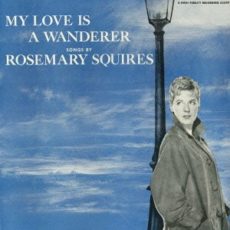
Rosemary Squires was born Joan Rosemary Yarrow on December 7, 1928 in Bristol, England. The daughter of a civil servant, she took singing, guitar and piano lessons while at St. Edmund’s Girls’ School in Salisbury, Wiltshire. Initially she started out entertaining troops on nearby UK and US army bases around Salisbury, added singing with various musical groups and a Polish military band, all the while maintaining a couple of jobs to pay the rent.
She eventually became a professional singer performing with big bands such as Ted Heath, Geraldo and Cyril Stapleton, and the small jazz bands of Max Harris, Kenny Baker and the Alan Clare band, appearing with the latter in the BBC Festival of Jazz at the Royal Albert Hall. In 1948 at 20 years of age she moved to London and by the 1950s on through the Sixties Squires became a regular on the BBC Light Programmes like Melody Time and Workers’ Playtime.
Coming to the United States Rosemary worked with Danny Kaye and Sammy Davis Jr., as well as appearing on the Johnny Carson Show. In 1994 Squires was part of the entertainment for Prince Edward’s 30th birthday celebrations. During the 2012 Royal Diamond Jubilee year she undertook two countrywide tours to celebrate her own diamond jubilee in show business including two appearances at the Royal Festival Hall. Over the course of her career she made numerous television appearances, was awarded the Gold Badge of Merit by the British Academy of Songwriters, was made a Member of the Order of the British Empire in 2004 for her services to music and charity, and was awarded the British Music Hall Society’s Lifetime Achievement Award. Vocalist Rosemary Squires continues to perform at local charity events.
Jazz Is Global – Share
More Posts: vocal

Daily Dose Of Jazz…
Jay Leonhart was born December 6, 1940 in Baltimore, Maryland and grew up in a musical family, with his parents and six siblings all played the piano. By the age of seven he and his older brother Bil were playing banjos, guitars, mandolins and basses. They played country music, jazz and anything with a beat. In their early teens, the brothers were television stars in Baltimore and were touring the country performing on their banjos.
By fourteen Jay started playing the bass in The Pier Five Dixieland Jazz Band in his hometown. He studied at The Peabody Institute, attended The Berklee College of Music and The Advanced School of Contemporary Music in Toronto. He then left school to start touring with the traveling big bands of the late 1950s and early 1960s.
At 21 Leonhart moved to New York City to start his career and played lots of funky road gigs with big bands, small bands and singers, visiting many little jazz joints around the world. He eventually began playing for many of the great jazz musicians, big bands, and singers like Thad Jones and Mel Lewis, Lou Marini, Tony Bennett, Marian McPartland, and Jim Hall.
Becoming a very busy New York City studio musician he played every musical genre from James Taylor to Ozzy Osbourne and Queen Latifah, as well as Barbara Carroll, Peggy Lee, Eddie Higgins, Terry Clarke, Gerry Mulligan, Donnie O’Brien, Bucky Pizzarelli, Daryl Sherman and Bluesiana Triangle. Between 1975 and 1995 he was named The Most Valuable Bassist in the recording industry three times by the National Academy of Recording Arts and Sciences.
Bassist Jay Leonhart has now recorded fifteen solo albums and is performing a one-man show called The Bass Lesson about his life in the music business and song. He has toured worldwide for more than forty years and currently performs regularly with trombonist Wycliffe Gordon in a duo which began as a result of their recording This Rhythm on My Mind.
Sponsored By
Voices From The Community
More Posts: bass

Daily Dose Of Jazz…
Alvin Owens “Red” Tyler was born on December 5, 1925 and raised in New Orleans, Louisiana. He was known as “Red” because of his light tanned skin.He grew up listening to the city’s marching bands but didn’t begin playing saxophone until after he joined the US Navy in 1945. After his discharge he joined the Grunewald School of Music and by 1949 he started his career by joining the Dave Bartholomew’s R&B band, whose other members included Ernest McLean, Frank Fields, and Earl Palmer.
Red made his recording debut on Fats Domino’s first session at Cosimo Matassa’s studio, when he recorded The Fat Man. He went on to play on recording sessions for Little Richard, Lloyd Price, Aaron Neville, Lee Dorsey, and numerous other rhythm and blues artists, often helping with the songs’ arrangements. In 1955, he began working for Johnny Vincent’s Ace Records as an A&R man, overseeing sessions by Huey “Piano” Smith, Frankie Ford and others. He also recorded an album, Rockin’ and Rollin’, credited to Alvin ‘Red’ Tyler and the Gyros, with a band that included Fields, Allen Toussaint, and James Booker.
Leaving Ace in 1961, Tyler helped Harold Battiste found his AFO (All For One) record label, which had a hit with Barbara George’s I Know in 1962. He then moved to California where he recorded with Sam Cooke, Larry Williams and others, before returning to New Orleans in the mid-1960s. He co-owned Parlo Records, which found success in 1967 with Aaron Neville’s Tell It Like It Is. He is listed as one of three songwriters of the instrumental, Java, originally recorded by Allen Toussaint. Covered by New Orleans trumpet player Al Hirt, it eventually reached the charts in 1964 and peaked at #4.
Though he primarily played R&B during th early part of his career, during this period Red also played jazz in club jam sessions and regarded himself as primarily a jazz musician. From the mid-1960s Red worked as a liquor salesman and began leading his own jazz band, the Gentlemen Of Jazz, in clubs and hotel residencies in New Orleans, and played with other jazz musicians including Ellis Marsalis.
The baritone saxophone had been his primary instrument during his years as a studio musician, but his jazz playing gradually came to rely on the tenor saxophone. He recorded two jazz albums, Graciously and Heritage In the mid-1980s, with vocals by Johnny Adams and Germaine Bazzle, on the Rounder Records label. In 1994, he recorded the album The Ultimate Session with Toussaint, Earl Palmer, Mac Rebennack, and other New Orleans musicians.
Red Tyler passed away at age 72 in New Orleans on April 3, 1998. After his death, the New Orleans Jazz Festival organised a concert in his honor, featuring many New Orleans leading musicians.
Give A Gift Of Jazz – Share
More Posts: saxophone

Daily Dose Of Jazz…
Russell Jacquet was born on December 4, 1917 in Saint Martinville, Louisiana, the elder brother of tenor saxophonist Illinois Jacquet. He had stints with Floyd Ray and Milt Larkin before he studying music at Wiley College and Texas Southern University.
Moving west he played with his brother’s band for a time, later forming his own group, that became the house band at the Cotton Club from 1945 to 1949. After that residency ended Russell rejoined his brother’s group. He would later play with several small groups in Oakland, California, as well as in Houston, Texas with Arnett Cobb. He also performed with his brother on a few dates in New York City.
Trumpeter Russell Jacquet passed away on February 28, 1990 in Los Angeles, California. He left a small catalogue of recordings as a leader during his Cotton Club years and four as a sideman with his brother, recorded between 1951 and 1969 on Clef, Argo and Prestige record labels.
Inspire A Young Mind
#preserving genius
More Posts: trumpet