

Daily Dose Of Jazz…
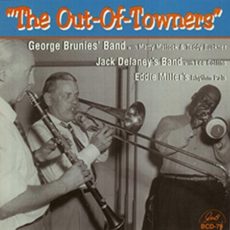
George Clarence Brunies, a.k.a. Georg Brunis was born into a musical family on February 6, 1902 in New Orleans, Louisiana.. His father led a family band with his brothers Henry, Merritt, Richard, and Albert who all became noted professional musicians. By the age of 8 he was already playing alto saxophone professionally in Papa Jack Laine’s band, but a few years later he switched to trombone.
Though Brunies never learned to read music, he played with many jazz, dance, and parade bands in New Orleans, quickly picking up tunes and inventing a part for his instrument. He first went to Chicago, Illinois in 1919 with a band led by Ragbaby Stevens, then worked the riverboats up and down the Mississippi River.
By 1921 he returned to Chicago and joined a band of his New Orleans friends playing at the Friar’s Inn, and this band eventually became famous as the New Orleans Rhythm Kings. His trombone style was influential to the young Chicago players, and his records were much copied. In this era Brunies was never bested as he could play anything any other trombonist could play as well or better. He would often end battles of the bands or cutting contests by outplaying other trombonists while operating the slide with his foot.
In 1924 after the Rhythm Kings broke up in Chicago, George joined the Ted Lewis band, which he played with through 1934. He spent some time with Louis Prima’s band, then landed a steady gig at the New York City jazz club Nick’s through 1938. In 1939 he joined Muggsy Spanier, with whom he made some of his most famous recordings. The following year he returned to Nick’s, where he remained through 1946 and then worked with Eddie Condon.
In 1949 Brunies returned to Chicago and landed at the 1111 Club leading his own band. Often showing off his unusual technical abilities and bizarre sense of humor at the same time, for example, he would lie on the floor and invite the largest person in the audience to sit on his chest while he played trombone. Believing that this name change would increase his good luck, on the advice of a numerologist, he changed his name to Georg Brunis in the late 1940s. While in residence every now and then other well-known jazz musicians would sit in and play until the wee hours.
Trombonist George Brunies, known as the King of the Tailgate Trombone, passed away in Chicago on November 19, 1974.
Sponsored By

Voices From The Community

#preserving genius
More Posts: trombone
Daily Dose Of Jazz…
Jacqui Dankworth was born on February 5, 1963 in Northampton, Northamptonshire, England to Cleo Laine and John Dankworth. She attended St. Christopher School in Hertfordshire and is an alumna and fellow of Guildhall School of Music & Drama.
Her vocal talents led her to work as an actress with the Royal Shakespeare Company, the Royal National Theatre, and in West End Theatre. She played Cinderella in the musical Into the Woods and appeared the film Shoreditch, singing the song My Man by Billie Holiday.
In 2003, Jacqui released her first album, As the Sun Shines Down on Me on the Candid Records label. This album brought her to the attention of Michael Parkinson and BBC Radio 2, and she began appearing regularly on air throughout that year. She was featured on Courtney Pine’s album Devotion, and performed with Pine at the Royal Festival Hall as part of the London Jazz Festival.
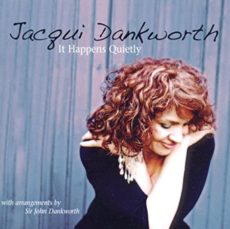
She followed the success of As the Sun Shines Down on Me with the 2004 release, Detour Ahead. She has followed these two releases by recording Back to You, It Happens Quietly and Live To Love. Vocalist Jacqui Dankworth continues to perform, record and tour.
Sponsored By

www.whatissuitetabu.com
#preserving genius
More Posts: vocal
Daily Dose Of Jazz…
George Bouchard was born Feb. 4, 1944 in Buffalo, New York and was the eldest of three children. His father worked in a factory and the family lived for much of his childhood in an apartment above the family delicatessen. He took saxophone lessons from the owner of a music store but was mostly self-taught, drawing inspiration from famous musicians like Charlie Parker and John Coltrane.
When he was 19, on the night after President Kennedy was assassinated, he found solace watching a jazz band play at a nightclub near his Buffalo home and decided he wanted a career in music. He earned a degree in economics from the University at Buffalo and a master’s in music from Memphis State University. He served in the Navy from 1966 to ’69.
As an educator he spent more than thirty years as a professor teaching music at Nassau Community College and 40 years of teaching during the summers at the Jamey Aebersold Jazz Workshops at the University of Louisville in Kentucky. He released four compact discs as a leader, received numerous awards for excellence in music education and for advancing the arts on Long Island, wrote a widely used instructional book called Intermediate Jazz Improvisation, and performed regularly with his group, The George Bouchard Band.
Soprano saxophonist and composer George Bouchard passed away from cancer on August 12, 2015 in Westbury, New York at age 71.
Sponsored By

#preserving genius
More Posts: saxophone
Daily Dose Of Jazz…
John Richard Handy III was born on February 3, 1933 in Dallas, Texas and first came to prominence while working with Charles Mingus in the 1950s. By the 1960s, he was leading several groups, among them a quintet with violinist Michael White, Jerry Hahn on guitar, Don Thompson on bass, and drummer Terry Clarke. This group’s performance at the 1965 Monterey Jazz Festival was recorded and released as an album and he received Grammy nominations for jazz performance of Spanish Lady and jazz composition for If Only We Knew.
As an educator Handy has taught music history and performance at San Francisco State University, Stanford University, the University of California, Berkeley, the San Francisco Conservatory of Music, and other schools.
The 1980s saw John working on the Mel Martin project Bebop & Beyond, recording tribute albums to Dizzy Gillespie and Thelonious Monk. He has recorded some eighteen albums as a leader for Roulette, Columbia, Impulse!, Warner, MPS, Milestone, Koch Int’l and Boulevard record labels. He has had one compilation released of selections from In The Vernacular and No Coast Jazz, and and has recorded two albums with Brass Fever, as well as, five albums during his time with Mingus.
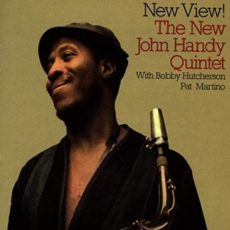
Alto saxophonist John Handy, who also plays tenor and baritone saxophone, saxello, clarinet, oboe and sings, continues to perform and record.
Sponsored By

#preserving genius
Daily Dose Of Jazz…
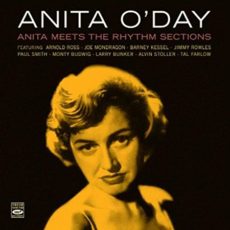
Joe Mondragon was born on February 2, 1920 in Antonito, Colorado. An autodidact on bass, he began working professionally in Los Angeles, California before serving in the Army during World War II. After his discharge he joined Woody Herman’s First Herd in 1946.
Over the next two decades, Mondragon became one of the more popular studio bassists for jazz recording on the West Coast, appearing on albums by June Christy, Buddy Rich, Buddy DeFranco, Marty Paich, Claude Williamson, Bob Cooper, Harry Sweets Edison, Gerry Mulligan, Art Pepper, and recording the Duke Ellington Songbook with Ella Fitzgerald in 1956. He also played on soundtracks for films such as The Wild One and Pete Kelly’s Blues.
Though Joe never recorded as a leader, he did however, record 45 albums as a sideman with Georgie Auld, Chet Baker, Louis Bellson, Buddy Bregman, Hoagy Carmichael, Herb Ellis, Jimmy Giuffre, Woody Herman, Harry James, Stan Kenton, Barney Kessel, Henry Mancini, Shelly Manne, Carmen McRae, Jack Montrose, Gerry Mulligan, Oliver Nelson, Art Pepper, Shorty Rogers, Pete Rugolo, Lalo Schifrin, Bud Shank and others.
Bassist Joe Mondragon passed away in July 1987 in Ohkay Owingeh, New Mexico.
Sponsored By

#preserving genius
More Posts: bass