

Daily Dose Of Jazz…
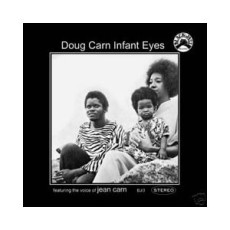
Doug Carn was born on July 14, 1948 in New York City but was raised in St. Augustine, Florida, where his mother, Gwendolyn Seniors Carn, taught music in the St. Johns County Public School System. Her unique and special teaching abilities provided a fertile ground for his future development, and he started piano lessons at the age of five but switched to the alto sax at eight.
Doug was introduced to all of the jazz of the late Forties and early Fifties by his a jazz aficionado and deejay uncle, Bill Seniors. By his early teens, Doug had formed his first group, The NuTones, that played a variety of jazz, R&B and Rock ‘n Roll hits for dances, proms and club dates all over Florida and southeast Georgia. In addition, he held down a post as organist for the A.M.E. church in its 11th Episcopal District.
During his sophomore year in high school, Doug started to play the oboe that would eventually earn him a full scholarship to Jacksonville University. Graduating valedictorian of his high school class, Carn turned down a full scholarship to the U.S. Air Force Academy to pursue his music.
After college Carn settled in Los Angeles where his creative writing abilities and spiritual ideology began to bear fruit. He was leading an organ trio and studying with Larry Young, Jr. when the word started to get around about Doug’s multi-faceted talents. He was soon discovered by Gene Russell who had heard about Doug’s innovative lyric adaptation of contemporary jazz classic, i.e., Wayne Shorter’s “Infant Eyes” Coltrane’s “A Love Supreme,” Bobby Hutcherson’s “Little B’s Poem” and Horace Silver’s “Peace.”
He garnered critical acclaim as a “jazz spatialist” for his “deft orchestrations” and horn arrangements. They were inspired by a natural ability to speak the be-bop language and a solid foundation in the classical tradition. He produced several landmark albums on the Black Jazz label such as “Adam’s Apple” and with his wife Jean “Infant Eyes” and “Search for a New Land”. He has worked with many great jazz musicians over the years, a list to numerous to name but included Lou Donaldson, Stanley Turrentine and Irene Reid and continues to record, perform and tour.
More Posts: piano
From Broadway To 52nd Street
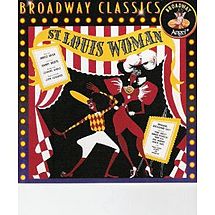
St. Louis Woman opened on March 30, 1946 on the stage of the Martin Beck Theatre and ran for 113 performances. Harold Arlen composed the music and Johnny Mercer wrote the lyrics for the musical with one tune standing the test of time to become a jazz standard – Come Rain Or Come Shine. The original cast included Robert Pope, Harold Nicholas, Fayard Nicholas, June Hawkins, Pearl Bailey, Ruby Hill, Rex Ingram and Milton J. Williams.
The Story: Set in St. Louis in 1898, Little Augie, a jockey who is on a winning streak, is enamored with Della Green, the belle of St Louis. Della, however, is the girlfriend of abusive Bigelow Brown, the proprietor of the local bar. Decides to leave him, Brown’s previous mistress, Lila, is still around which produces complications.
It’s cakewalking time and Augie attracts the attention and admiration of Della with his virtuoso performance of the cakewalk. Things go so well between them that they agree to set up home together and prepare plans to marry. While Augie is off at the racetrack, Della gets an unwelcome visit from Biglow Brown who beats. Lila enters, begs for a reconciliation, Augie returns, shot is fired, curse is casted on Augie for the shot that in fact was fired by Lila.
At Brown’s funeral suspected Augie is exonerated by Lila’s confession but the curse seems to be working. His horses no longer win and Della blames herself for the troubles. Della leaves feigning no love for Augie but her new friend tells him her true feelings. Believing the curse to be so much mumbo-jumbo, he’ll win his next race and he and Della get back together again.
Jazz History: Charlie Parker began rising in prominence in the early 1940s, and he played frequently with bands led by Jay McShann, Earl Hines, and Billy Eckstine. In 1945, a young Miles Davis Miles Davis moved to New York and became intrigued with Parker and the emerging bebop style. He studied at Juilliard, but had trouble earning respect among jazz musicians because of his unrefined sound. Soon he would work his way into Parker’s quintet. In 1945, the term ‘moldy fig’ was coined to refer to swing musicians who were reluctant to accept that bebop was the new path of jazz development.
In the mid 1940s Charlie Parker began to deteriorate from drug use. He was admitted to Camarillo State Hospital after a breakdown in 1946. His stay there inspired the song “Relaxin’ at Camarillo”.
In 1947, tenor saxophonist Dexter Gordon achieved fame for recordings of “duels” with saxophonist Wardell Gray. Gordon’s virtuosity and aggressive tone attracted the attention of young alto saxophonist John Coltrane, who would shortly thereafter switch to tenor saxophone.
In 1948, Miles Davis and drummer Max Roach, fed up with Charlie Parker’s reckless lifestyle, left his band. Davis formed his own nonet. In 1949 recorded the unconventional ensemble. Some of the arrangements were by a young Gil Evans, and the restrained style of the music came to be known as cool jazz. The record, released almost a decade later, in 1957, was called Birth of the Cool.
By the end of the 1940s, bebop was the ideal among young jazz musicians. Unlike swing, bebop was untethered to popular demands. Its primary concern was musical advancement.
Sponsored By

www.whatissuitetabu.com
Daily Dose Of Jazz…
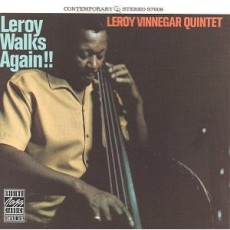
Leroy Vinnegar was born on July 13, 1928 in Indianapolis, Indiana and the self-taught bassist established his reputation in Los Angeles during the 50s and 60s. His trademark was the rhythmic “walking” bass line, a steady series of ascending or descending notes, and it brought him the nickname “The Walker”. Besides his jazz work, he also appeared on a number of soundtracks and pop albums, notably Van Morrison’s 1972 album, Saint Dominic’s Preview.
He recorded extensively as both a leader and sideman and came to public attention in the 1950s as a result of recording with Lee Konitz, Andre Previn, Stan Getz, Shorty Rogers, Chet Baker, Shelly Manne, Joe Castro and Serge Chaloff. He played bass on Previn and Manne’s My Fair Lady album, one of the most successful jazz records ever produced. He also performed on another of jazz’s biggest hit albums, Eddie Harris and Les McCann’s “Swiss Movement” released in 1969.
Moving to Portland, Oregon in 1986, the Oregon State Legislature honored him in 1995 by proclaiming May 1st as Leroy Vinnegar Day. The bassist died from a heart attack at the age of 71 in Portland on August 3, 1999.
More Posts: bass
Daily Dose Of Jazz…
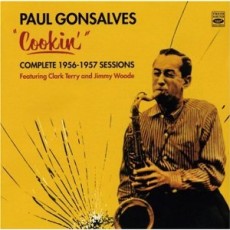
Paul Gonsalves was born July 12, 1920 in Brockton, Massachusetts to Cape Verdean parents. His first instrument was the guitar, and as a child he was regularly asked to play Portuguese folk songs for his family. Growing up in New Bedford, Massachusetts he was a member of the Sabby Lewis Orchestra.
His first professional engagement in Boston was with the same group on tenor saxophone, that he had learned to play prior to and during World War II military service. After the war he played in Count Basie and Dizzy Gillespie’s big bands before joining the Duke Ellington Orchestra in 1950.
At the 1956 Newport Jazz Festival, Gonsalves’ solo in Ellington’s song “Diminuendo and Crescendo in Blue” contained 27 choruses and the publicity from which is credited with reviving Ellington’s career. This performance is captured on the album Ellington at Newport. He was a featured soloist in numerous Ellingtonian settings and received the nickname “The Strolling Violins” from Ellington for playing solos while walking through the crowd.
Tenor saxophonist Paul Gonsalves died on May 15, 1974 in London just a few days before Duke Ellington’s death. Gonsalves and Ellington, along with trombonist Tyree Glenn, lay side-by-side in the same New York funeral home for a period of time.
More Posts: saxophone
Daily Dose Of Jazz…
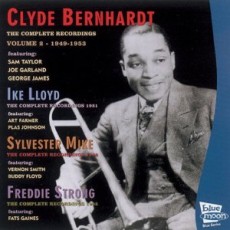
Clyde Bernhardt, born July 11, 1905 in Gold Hill, North Carolina, grew up in Harrisburg, Pennsylvania. He started playing trombone at 17 and in the Twenties performed in a series of lesser-known ensembles such as Bill Eady’s Ellwood Syncopators, Tillie Vennie, Odie Cromwell’s Wolverine Syncopators and The Whitman Sisters to name a few. In 1931 he worked with King Oliver and throughout the thirties played with Alex Hill, The Alabamians, Billy Fowler, Ira Coffey’s Walkathonians and Vernon Andrade.
In 1937 he joined the orchestra of Edgar Haye until 1942 then worked with Jay McShann, Cecil Scott, Luis Russell, Leonard Feather, Pete Johnson, Wynonie Harris, Claude Hopkins and the Bascomb brothers. He led his own ensemble, called the Blue Blazers, before returning to play with Russell from 1948-51. He recorded as a leader between 1946 and 1953, and on some of the recordings he sings under the pseudonym Ed Barron.
From 1952 to 1970 he played part-time with Joe Garland’s Society Orchestra followed with his leading the Harlem Blues and Jazz Band from 1972 and 1979 with sidemen Doc Cheatham, Charlie Holmes, Happy Caldwell, Tommy Benford and Miss Rhapsody. Shortly before his death he published his autobiography “I Remember” co-written with Sheldon Harris. As Bernhardt’s health began to fail in 1979, he gave up band leadership but played in Barry Martyn’s Legends of Jazz until his death on May 20, 1986 in Newark, New Jersey.
More Posts: trombone