
Requisites
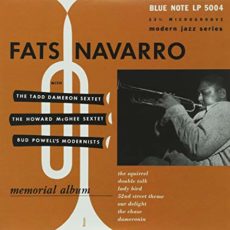
The Memorial Album is a 1947 album by Fats Navarro recorded on the Blue Note record label with The Tadd Dameron Sextet, The Howard McGhee Sextet and Bud Powell’s Modernists. The cover was design by noted jazz musician, book and album cover designer Paul Bacon.
This album was part of their Modern Jazz Series and recorded at WOR Studios, NYC on September 26, 1947 (A1, A4, B2, B3), Apex Studios, NYC, September 13, 1948 (A3), Apex Studios, NYC, October 11, 1948 (B1) and WOR Studios, NYC, August 9, 1949 (A2)
Tracklist:
A1 The Squirrel – Composer: Tadd Dameron A2 52nd St. Theme – Composer: Thelonious Monk A3 Lady Bird – Composer: Tadd Dameron A4 The Chase – Composer: Tadd Dameron B1 Double Talk – Composer: Fats Navarro*, Howard McGhee* B2 Dameronia – – Composer: Tadd Dameron B3 Our Delight – Composer: Tadd DameronPersonnel Credits: Alto Saxophone – Ernie Henry (tracks: A1, A4 to B3) Bass – Curly Russell (tracks: A3, B1), Nelson Boyd (tracks: A1, A4, B2, B3), Tommy Potter (tracks: A2) Drums – Kenny Clarke (tracks: A3, B1), Roy Haynes (tracks: A2), Shadow Wilson(tracks: A1, A4, B2, B3) Piano – Bud Powell (tracks: A2), Milton Jackson* (tracks: B1), Tadd Dameron (tracks: A1, A3, A4, B2, B3) Tenor Saxophone – Charlie Rouse (tracks: A1, A4, B2, B3), Sonny Rollins (tracks: A2), Wardell Gray (tracks: A3) Trumpet – Fats Navarro, Howard McGhee (tracks: B1)

More Posts: choice,classic,collectible,collector,history,instrumental,jazz,music,trumpet

The Jazz Voyager
Maryland is the next destination for The Jazz Voyager to become a part of history with the opening of the new Keystone Korner Baltimore. For those of you who remember or are familiar with the name, you may know Todd Barkan founded his jazz club in San Francisco, California in 1972. Now on the East Coast, the Korner has risen from the ashes to honor the rich jazz history of the city and establish itself as a premier venue for jazz in 2019.
Partnering with chef Robert Wiedmaier, the two resurrected the chef’s Mussel Bar as the new jazz spot and along with top-flight jazz are serving up a menu of outstanding cuisine and libations in this relaxed and welcoming setting. Located at 1350 Lancaster Street 21231, in the Harbor East neighborhood, where the inner harbor has long been attracting residents and visitors of the city.
This trip the Jazz Voyager is going to enjoy the talented pianist Bill Charlap and trumpeter Jon Faddis for a cover of $20 – $35. Carrying-on the original mission of providing the best music in the world for the most affordable prices in the most loving environment, reservations are recommended and can be made by calling 410-946-6726.

More Posts: adventure,club,genius,jazz,museum,music,preserving,restaurant,travel,voyager
Hollywood On 52nd Street
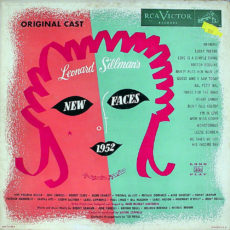
Guess Who I Saw Today is a popular jazz song composed by Murray Grand with lyrics by Elisse Boyd. The song was originally composed for Leonard Sillman’s Broadway musical revue New Faces of 1952 in which it was sung by June Carroll.
The revue opened on Broadway at the Royale Theatre on May 16, 1952 and ran for 365 performances. It was produced by Leonard Sillman, directed by John Murray Anderson and John Beal with choreography by Richard Barstow. The sketches were written by Ronny Graham and Brooks. The songs were composed by, among others, Harnick, Graham, Murray Grand and Arthur Siegel.
The cast featured Graham, Kitt, Clary, Virginia Bosler, June Carroll, Virginia De Luce, Alice Ghostley, Patricia Hammerlee, Carol Lawrence, Paul Lynde and Bill Milliken. De Luce and Graham won the 1952 Theatre World Award. The revue marked Kitt’s Broadway debut, singing a sultry rendition of “Monotonous”, about how boring a life of luxury was.
Two years later, the name was abridged to New Faces and was adapted into a motion picture filmed in Cinemascope and Eastmancolor and was released by 20th Century Fox on March 6, 1954. It helped jumpstart the Hollywood careers of several young performers including Paul Lynde, Alice Ghostley, Eartha Kitt, Robert Clary, Carol Lawrence, Ronny Graham, performer/writer Mel Brooks (as Melvin Brooks), and lyricist Sheldon Harnick.


Daily Dose Of Jazz…
Joe Harris was born on December 23, 1926 in Pittsburgh, Pennsylvania, growing up in the Manchester neighborhood. He learned to play the drums by taking lessons at an early age from Pittsburgh’s Bill Hammond, who taught his the rudiments of drumming. His musical education included symphonic percussion such as tympani and xylophone and by age 18 he was playing in big bands and touring the country.
As a young man in 1946 he moved to New York City, where he played with Dizzy Gillespie over the next two years, helped pioneer Latin jazz, and anchored the house band at the famed Apollo Theater. Balancing jazz with the heavier R&B sounds of tenor saxophonist Arnett Cobb in the late ’40s, Harris gigged with singer Billy Eckstine in 1950, and worked with Erroll Garner, Jimmy Heath, Ella Fitzgerald, Sarah Vaughan, Sonny Rollins, Stan Getz, Billie Holiday and James Moody.
Following a decade as one of the early bebop drummers, Joe took off for Sweden with his first tour in the summer of 1956 with trumpeter Rolf Ericson. His subsequent expatriate status put him in the company of other transplanted instrumentalists including trumpeter Benny Bailey, with whom he recorded from 1957 – 59, and pianist Freddie Redd. He taught himself to speak Swedish fluently and learned a fair amount of German and Japanese, eventually moved to Sweden, married and had a daughter before living in Germany and Japan for a time.
Harris eventually returned to the States for TV work in Los Angeles, California among other things. The drummer would later study music in the Far East, Egypt, Africa and Latin America prior to settling back in his native Manchester, scaling back his performance schedule with local musicians. He continued to practice daily, mentor students and teaching jazz history and drums for years at the University of Pittsburgh until his death on January 27, 2016 at age 89.

More Posts: drums
Hollywood On 52nd Street
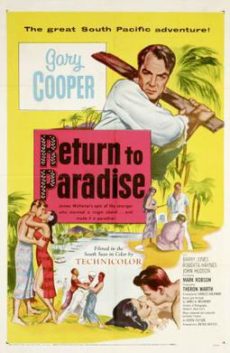
Return to Paradise is a jazz standard that was written by Dimitri Tiomkin and Ned Washington for the movie of the same name. The film was set and principal photography was shot in Samoa and released by United Artists in 1953. It starred Gary Cooper, Barry Jones and Roberta Haynes and the screenplay by Charles Kaufman was based on the 1951 short story Mr. Morgan by James Michener in his short story collection Return to Paradise, his sequel to Tales of the South Pacific.
The Story
During the 1920s, itinerant American beachcomber Mr. Morgan (Cooper) is deposited on the island of Matareva in the South Pacific. Deciding to stay, he is confronted by Pastor Cobbett (Jones), who lost both his father and his wife as a young missionary on the island and rules the island as a Puritanical despot, using local bullies as wardens to enforce his rules. Morgan wins the support of the natives after defeating the wardens with the aid of an empty shotgun.
Morgan has an illegitimate child with an island girl who dies in childbirth. Leaving his daughter with her grandmother he leaves the island, only to return during World War II. Cobbett has changed, his daughter Turia is now grown and in love with a stranded Navy pilot and Morgan now has to face the inevitable possibility of a repeat of his indiscretion with his daughter. Forcing the split by making the pilot and his crew leave the island, Turia is upset but reconciles with her father who decides to stay on with her on the island.