

Requisites
Double Take ~ Freddie Hubbard and Woody Shaw | By Eddie Carter
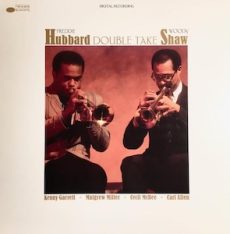
Freddie Hubbard and Woody Shaw were two of my mom’s favorite trumpet players, and one of her favorite albums inspired this morning’s discussion. Double Take (Blue Note BT-85121) is the first of two collaborations by Hubbard and Shaw, the other being The Eternal Triangle, recorded two years later. The sextet features Freddie Hubbard on flugelhorn (track: A3, B2) and trumpet (tracks: A1, A2, A4, B1, B3), Woody Shaw on trumpet, Kenny Garrett on alto saxophone (tracks: A1 to A4, B1, B3) and flute (track: B2), Mulgrew Miller on piano, Cecil McBee on bass, and Carl Allen on drums. I own the 1985 U.S. stereo release.
The set opens with Clifford Brown’s Sandu, and the sextet’s mellow melody is led by the front line. Woody is smooth as velvet on the first solo, followed by Kenny’s warm, mellow notes in a short statement. Freddie is up next and swings comfortably to the rhythm section’s support. Mulgrew takes a final short solo before the group reconvenes for the theme’s return. The trio’s introduction opens the tune for the ensemble’s leisurely melody of Boperation by Fats Navarro and Howard McGhee. Freddie takes the lead this time and gets down to business. Kenny swings through the second solo with rich, melodic lines. Woody follows with renewed vitality in the third reading. Mulgrew and Cecil share the last spot with two concise comments ahead of the sextet’s climax.
Lament for Booker by Freddie Hubbard is his tender ballad dedicated to Booker Little. Mulgrew’s delicately gentle introduction gets things started, with Freddie’s flugelhorn leading the group’s melody. As the song’s only soloist, he gives an elegantly graceful performance as the rhythm section provides a lush foundation, leading to the haunting finale. Hub-Tones, one of Freddie Hubbard’s signature compositions, picks up the pace significantly for the sextet’s brisk theme. Woody launches into an exhilarating opening statement. Kenny meets the challenge with a lively second statement. Freddie is at his sharpest in the third lively interpretation, then Mulgrew continues motoring along in the fourth reading. Carl gets a chance to shine briefly before the sextet’s theme restatement fades out softly.
Side Two takes off with the ensemble’s swinging rendition of Desert Moonlight by Lee Morgan. Woody leads the brisk melody and makes an energetic opening statement. Kenny, who isn’t featured in the theme, gets cooking in the second solo. Freddie takes over to give a short, sparkling interpretation, followed by Mulgrew, who gets one quick chorus before the theme is restated. Just a Ballad for Woody is a very pretty ballad written by Woody Shaw and his wife, Theresa Trainello. Woody leads the group again on the tender theme, with Freddie in a supporting role on flugelhorn and Kenny switching to flute on this tune. Woody has the first spot and gives a hauntingly dreamy performance. Kenny concludes the solos with a beautifully tender statement before the theme’s restatement and soft ending.
The sextet turns the temperature up one final time with Kenny Dorham’s Lotus Blossom. This is a showcase for both trumpeters, with Kenny stepping aside for Woody to lead the melody. Freddie is firing on all cylinders for the first solo; then Woody follows with a scintillating statement that will awaken the listener’s senses. The two trumpeters have a vigorous conversation before Carl makes a concise comment, leading to the spirited reprise and climax. Michael Cuscuna produced Double Take, and Rudy Van Gelder was behind the dials of the recording console. It’s a digital recording, but the sound quality is superb, with a stunning soundstage emerging from your speakers as if the musicians are playing in front of the sweet spot in your listening room.
To me, Double Take is more than an exemplary album showcasing two of jazz’s renowned trumpeters; it embodies a heartfelt love letter to trumpet players everywhere. The musicianship is exceptional, and every track was thoughtfully composed by a trumpeter, adding to its special charm. If you’re a fan of either Freddie Hubbard or Woody Shaw, I cordially encourage you to check out Double Take on your next record-shopping trip. It’s a terrific collaboration and an excellent display of both musician’s artistry that should become a welcome addition to your library!
Album Note. Freddie Hubbard is heard in the center of “Lament for Booker,” and Woody Shaw is heard in the center of “Just a Ballad for Woody.” Hubbard plays lead and is heard on the right channel on “Sandu” and “Boperation.” Shaw plays lead on “Just a Ballad for Woody” and is heard on the right channel on the remaining selections.
~ The Eternal Triangle (Blue Note B1-48017) – Source: Discogs.com © 2026 by Edward Thomas Carter
More Posts: choice,classic,collectible,collector,history,instrumental,jazz,music,trumpet