

Daily Dose Of Jazz…
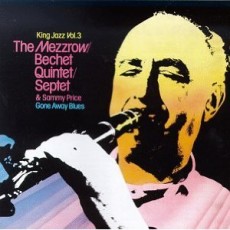
Milton Mesirow, better known as Mezz Mezzrow was born November 9, 1899 in Chicago, Illinois. The clarinetist and saxophonist has never been ranked as one of the best jazz musicians, organizing and taking part in some magnificent recording sessions involving the best black musicians of the 1930s/40s, including Benny Carter, Teddy Wilson, Frankie Newton, Tommy Ladnier and most importantly Sidney Bechet. His 1938 sessions for the French jazz critic Hugues Panassie, which he is well-known for organizing and financing, involved Bechet and Ladnier and helped spark the “New Orleans revival”.
Mezzrow became better known for his drug-dealing of marijuana than his music. His nicknames “Mezz” and “Muggles” that became slang for marijuana were used in song, the former in the Stuff Smith tune “If You’re A Viper” and the later was the title of a 1928 Louis Armstrong recording and for a brief time was his manager.
In the mid-1940s Mezzrow started his own record label, King Jazz Records, featuring himself in groups that usually included Sidney Bechet and, often, trumpeter Oran “Hot Lips” Page. Mezzrow also can be found and heard playing on six recordings by Fats Waller and his appearance at the 1948 Nice Jazz Festival was a surprise hit.
Following that appearance he made his home in Paris, France and organized many bands that included French musicians like Claude Luter, as well as visiting American artists like Peanuts Holland, Jimmy Archey, Kansas Fields, Lionel Hampton and Buck Clayton, with whom in 1953 he made what is probably his best ever recording: a version of the Louis Armstrong classic “West End Blues”.
Mezz Mezzrow, clarinetist, saxophonist, author and colorful character died on August 5, 1972 in Paris, France.
Daily Dose Of Jazz…
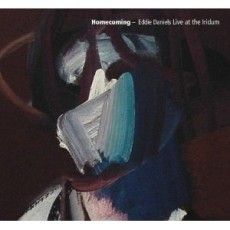
Eddie Daniels was born on October 19, 1941 in New York City and grew up in the Brighton Beach neighborhood of Brooklyn. He became interested in jazz as a teenager when impressed by listening to the recordings of the musicians accompanying singers, such as Frank Sinatra. Eddie’s first instrument was the alto saxophone, started on clarinet at 13 and later received his Masters in Clarinet from Julliard. By 15 he would add the Newport Jazz Festival Youth Competition to what would become a long list of credits. By the time he entered college, he was playing alto, clarinet and adding tenor saxophone to his arsenal.
Daniels has led a variety of bands from small combos to orchestras and has toured worldwide, recorded and appeared on television. Since the 1980s he has focused mainly on the clarinet and in 1989 he won one of many Grammy awards for playing on the Roger Kellaway arrangement of “Memos From Paradise”.
Over the course of his career he has captured Down Beat Magazine’s International Critics New Star on Clarinet Award, played and recorded with the Thad Jones/Mel Lewis Orchestra at the Village Vanguard, George Benson, Joe Farrell, Johnny Hammond, Richard Davis, Yusef Lateef, Airto Moreira and Don Patterson Gordon Goodwin’s Big Phat Band. Clarinetist Eddie Daniels, who also plays saxophone, flute and piccolo, performs commissioned classical compositions, has revolutionized the blend of classical and jazz and continues to tour and record.
Daily Dose Of Jazz…
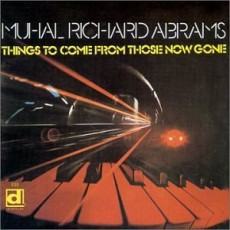
Muhal Richard Abrams was born on September 19, 1930, in Chicago, Illinois. He didn’t start his musical training until his enrollment in Roosevelt University but not hearing what he heard in the streets caused him to study piano on his own. His natural ability to study and analyze things allowed him to read, identify the key the music was in, then the notes and how to play the piano. Listening to Art Tatum, Charlie Parker, Bud Powell, Thelonious Monk and many others, he concentrated on the composition of Duke Ellington and Fletcher Henderson pieces. Although it took a lot of time and sweat, he was soon playing on the scene.
Abrams’ first gigs were playing the blues, R&B, and hard bop circuit in Chicago and working as a sideman with everyone from Dexter Gordon and Max Roach to Ruth Brown and Woody Shaw. In 1950 he began writing arrangements for the King Fletcher Band, and in 1955 played in the hard-bop band Modern Jazz Two + Three, with tenor saxophonist Eddie Harris.
After this group folded he kept a low profile until he organized the Experimental Band in 1962, a contrast to his earlier hard bop venture in its use of free jazz concepts. This band, with its fluctuating lineup, evolved into the Association for the Advancement of Creative Musicians (AACM), emerging in May 1965 with Abrams as its president. Opting not to play in smoky nightclubs they often rented out theatres and lofts where they could perform for attentive and open-minded audiences.
His landmark album “Levels and Degrees of Light” in 1967 saxophonists Anthony Braxton and Maurice McIntyre, vibraphonist Gordon Emmanuel, violinist Leroy Jenkins, bassist Leonard Jones and vocalist Penelope Taylor. However, he never strayed too far from hard bop during this period playing with Eddie Harris, Dexter Gordon and other hard boppers.
Moving to New York in 1975, Abrams became a part of the local Loft Jazz scene and in 1983 he established the New York chapter of the AACM. Over the course of his career he composed for symphony orchestras, classical works, string quartets, solo piano, voice, and big bands in addition to making a series of larger ensemble recordings that include harp and accordion. He has recorded extensively under his own name frequently on the Black Saint label and as a sideman on others’ records, working with the likes of Marion Brown, Chico Freeman, Eddie “Lockjaw” Davis, Art Farmer, Sonny Stitt, Art Ensemble of Chicago, and numerous others.
Muhal Richard Abrams, educator, administrator, composer, arranger, cellist, clarinetist and pianist was given a Lifetime Achievement Award by the Vision Festival, New York City’s premier jazz festival and in 2010 was honored as a NEA Jazz Master. He continues to perform and record.
Daily Dose Of Jazz…
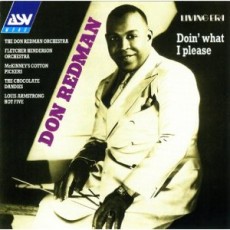
Donald Matthew Redman was born into a musical family on July 29, 1900 in Piedmont, West Virginia. He started playing the trumpet at age 3, joined his first band at 6 and by twelve was proficient on all wind instruments ranging from trumpet to oboe and piano. After studying at Storer’s College in Harper’s Ferry and at the Boston Conservatory, he joined Billy Page’s Broadway Syncopaters in New York.
1922 saw Don joining Fletcher Henderson’s orchestra, mostly playing clarinet and saxophones. He soon began writing the bulk of the orchestra’s arrangements, contributing much to formulate the sound that was to become big band swing. The chief trademark of Redman’s arrangements was that he harmonized melody lines and pseudo-solos within separate sections; for example, clarinet, sax, or brass trios. He played these sections off each other, having one section punctuate the figures of another, or moving the melody around different orchestral sections and soloists. His use of this technique was sophisticated, highly innovative, and formed the basis of much big band jazz writing in the following decades.
By 1927 he joined McKinney’s Cotton Pickers in Detroit as their musical director and leader but by 1931 Redman formed his own band and took up residency at Connie’s Inn in Manhattan. Redman’s band recorded for Brunswick Records, provided music for the Betty Boop series, employed singer Harland Lattimore, known as “The Colored Bing Crosby” and wrote arrangements for musicians and bandleaders like Paul Whiteman, Isham Jones and Bing Crosby. By 1940 Redman had disbanded his orchestra, began freelancing writing arrangements that became hits for Jimmy Dorsey, Count Basie and Harry James. In 1949 he appeared on CBS’s Uptown Jubilee and in the Fifties became musical director for Pearl Bailey.
Don Redman died in New York City at age 64 on November 30, 1964. His family legacy left us two more generations of jazz musicians, as he was the uncle of saxophonist Dewey Redman, and thus great-uncle of saxophonist Joshua Redman and trumpeter Carlos Redman.

Daily Dose Of Jazz…
Eric Allan Dolphy was born on June 20, 1928 in Los Angeles, California and received his musical education at Los Angeles City College. Performing locally in the big bands of Gerald Wilson and Roy Porter, he played soprano clarinet, baritone saxophone and his main instrument, the alto, on early recordings. But his big break came when he joined Chico Hamilton’s quintet, gaining wider audience recognition.
By 1959 Dolphy had moved to New York City and his early association with then established John Coltrane brought him acclaim amongst jazz lovers. During this period, Dolphy also played in a number of challenging settings, notably in key recordings by Ornette Coleman’s Free Jazz: A Collective Improvisation; Oliver Nelson’s The Blues and the Abstract Truth; and George Russell’s Ezz-thetics. He also worked with Max Roach, Gunther Schuller, Ron Carter, Ken McIntyre and Abbey Lincoln among others.
His first two albums as leader produced Outward Bound and Out There that were deeply rooted in hard bop with trumpeter Freddie Hubbard. This was followed with Far Cry with Booker Little, with whom he would record a series of legendary sets at the Five Spot before Little’s death at 23. In 1964, Dolphy signed with Blue Note and recorded Out To Lunch! with Hubbard, Bobby Hutcherson, Richard Davis and Tony Williams. This record was rooted in the avant-garde, his solos unpredictable and is considered his magnum opus.
Eric Dolphy died in Berlin while touring with Charles Mingus on June 29, 1964. The circumstances are sketchy as to where he died and the cause, though he was a diabetic. Whatever the cause, the jazz world lost an alto saxophonist, flautist, clarinetist who contributed profusely to the genre of jazz during his short-lived 36 years.