Daily Dose Of Jazz…
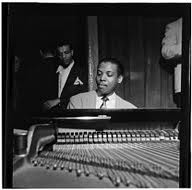
Kenny Kersey was born on April 3, 1916 in Harrow, Ontario into a musical family and studied piano and trumpet while attending the Detroit Institute of Musical Arts. In 1936, Kersey moved to New York City where he played with Lucky Millinder, Billy Hicks, Frankie Newton, Billie Holiday, Roy Eldridge, Red Allen and Cootie Williams.
In 1942 he replaced Mary Lou Williams as Andy Kirk’s pianist and Kirk recorded his composition “Boogie Woogie Cocktail”. He joined the Army from 1943 to 1945, where he occasionally played trumpet in military bands, then played from 1946 to 1949 with the Jazz at the Philharmonic touring ensembles. He continued to play with noted musicians through the 1950s, including Eldridge and Allen again, as well as Buck Clayton, Edmond Hall, Sol Yaged, and Charlie Shavers.
Kersey retired from music late in the 1950s after being diagnosed with a bone ailment. He recorded twelve tunes as a bandleader – four for Savoy in 1946, two for Clef in 1949, two for Circle in 1950, and four for Foxy in 1951 which featured Hot Lips Page and Paul Quinichette and as sidemen. Kenny Kersey passed away on April 1, 1983 in New York City.

More Posts: piano

Daily Dose Of Jazz…
In the jazz world his moniker was Duke Jordan but he was born Irving Sidney Jordan on April 1, 1922 in Brooklyn, New York. The gifted and imaginative pianist was well known for his work with Charlie Parker during his classic quintet years with Miles Davis. From the 50’s on he had a long solo career performing in trio format after playing for periods with Sonny Stitt and Stan Getz. His most notable composition Jordu became a jazz standard when Clifford Brown adopted it into his repertoire.
He married the talented jazz singer Sheila Jordan in 1952 and the union lasted for a decade. He continuously performed throughout the sixties although he faded from the public eye until he began recording an extensive sequence of albums for Steeplechase in 1973 producing some of his best live recordings.
In 1978 he moved his residence to Copenhagen, Denmark where he lived until his death on August 8, 2006. His music always reflected the inherently melodic style that was enlivened by his delightful crisp touch and unexpected turns of phrase. Duke Jordan’s recordings can be found on Prestige, Savoy, Blue Note, Charlie Parker Records, Muse, Spotlite and Steeplechase.

More Posts: piano
Daily Dose Of Jazz…
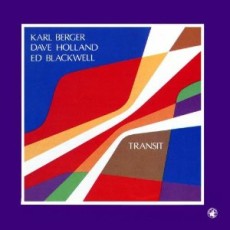
Karl Hanns Berger was born March 30, 1935 in Heidelberg, Germany and began playing piano when he was ten. By the time he reached young adulthood he had landed a job at Club 54 in his hometown as the house pianist and accompanied visiting American musicians such as Leo Wright, Lex Humphries and Don Ellis. During their stays he was able to learn the complexities of modern jazz.
Berger eventually picked up the vibraphone and in the early sixties became intrigued with free jazz. By 1965 he was a part of Don Cherry’s Paris-based quintet and the next year they came to New York to record Symphony For Improvisers on Blue Note. Staying in the U.S. Berger recorded his first album the following year.
Most of his output has been experimental in the free jazz circles playing with the likes of Carla Bley, Lee Konitz, John McLaughlin, Dave Holland, Sam Rivers, Pharoah Sanders, The Mingus Epitaph Orchestra and many others. From 1969 to 1975 Karl Berger continuously won the Down Beat critics poll for best jazz vibraphone player of the year.
In 1972 along with his friend and mentor Ornette Coleman, he founded the Creative Music Studio in Woodstock, New York, which was geared toward encouraging young students to explore their own creative ideas instead of imposing traditional concepts upon them. With visiting educators like Jack DeJohnette, Sam Rivers, and Anthony Braxton amongst other prominent musicians the school flourished until the mid eighties when Berger decided to venture back into performing.
From 1985 on Berger has led a 28-piece big band, played festivals worldwide, recorded as a leader and sideman, extending his educator talents to teaching jazz and ensemble playing in Frankfurt, and chaired the Music Department at U Mass-Dartmouth.
The musicologist, composer, pianist and vibraphonist was directly influenced by Ornette Coleman and his playing eschews four-mallet technique with an understanding and ability to play any meter from standard time signatures to odd meters and polyrhythms based on core elements of swing and coherent melody. Karl Berger continues to pursue the range of his instrument through recording, performing and touring.

More Posts: piano,vibraphone

Daily Dose Of Jazz…
Johnny Guarnieri, born March 23, 1917 in New York City was a virtuoso jazz and stride pianist best known for his stints with the big bands of Benny Goodman and Artie Shaw in the 1940s. Guarnieri is also noted for his embellishment and juxtaposition of jazz with classical piano, such as Scarlatti and Beethoven.
Throughout the 1940s Guarnieri was a busy sideman, recording with artists such as Charlie Christian, Cozy Cole, Ike Quebec, Charlie Kennedy, Hank D’Amico and Ben Webster. He also led his own group called the “Johnny Guarnieri Swing Men” and recorded with them on the Savoy label, a group that included Lester Young, Hank D’Amico, Billy Butterfield and Cozy Cole. He also led a trio in the 1940s composed of himself, Slam Stewart and Sammy Weiss.
In 1949 Guarnieri recorded an album with June Christy and recorded with numerous other artists over his career. In his later years he shifted more toward jazz education. In commemoration of his reputation as a teacher, Guarnieri’s students financed a label for him called “Taz Jazz Records” and in the ‘70s he recorded numerous albums on his new label, and until 1982 worked the “Tail of the Cock” nightclub in Studio City, California.
Pianist Johnny Guarnieri died doing what he loved to do, play jazz, onstage during a performance with Dick Sudhalter on January 7, 1985.

More Posts: piano
Daily Dose Of Jazz…
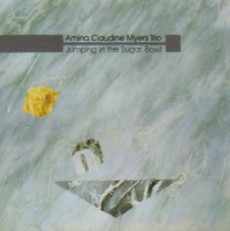
Amina Claudine Myers was born March 21, 1942 in Blackwell, Arkansas. The pianist, organist, vocalist, composer and musical arranger began singing and playing the piano and organ as a child in church choirs in the Dallas/Ft. Worth area where she grew up. She directed choirs at an early age and graduated in concert music and music education from Philander Smith College.
In the early sixties Amina moved to Chicago, teaching and attending classes at Roosevelt University. It was in Chicago that she began working with Sonny Stitt and Gene Ammons, joined the AAMC, focused on vocal compositions and recorded her debut album with Kalaparusha Maurice McIntyre in 1969. .
In 1976 Myers relocated to New York City, where she intensified her compositional work and expanded it into the realm of Off-Broadway productions. She also continued performing and recording as a pianist and organist with Lester Bowie and Muhal Richard Abrams into the early eighties. In 1985 she joined Charlie Haden’s Liberation Music Orchestra and had notable collaborations on recordings with artists like Marian McPartland, the Art Ensemble of Chicago, Archie Shepp, David Murray, Arthur Blytheand Ray Anderson to name a few.
Amina Claudine Myers, a virtuoso pianist and organist whose work is presented internationally and appears on scores of recordings, draws upon her backgrounds in classical music and the music of the black church of her native rural South to create a recombinant sensibility within improvisation-imbued extended compositions. Her work is insistently post-genre at a moment when re-inscriptive collage pretends to postmodern transgression.