

Hollywood on 52nd Street
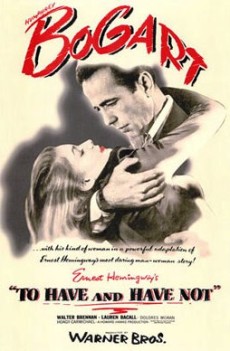
How Little We Know was originally written as a waltz. It was composed by Hoagy Carmichael for Lauren Bacall in her film debut to sing in the 1942 film To Have and Have Not, also starring Humphrey Bogart and Walter Brennan. Although it was nominally based on the novel of the same name written by Ernest Hemingway. The story was extensively altered for the film.
The Story: Harry Morgan and his alcoholic sidekick, Eddie, are based on the island of Martinique and crew a boat available for hire. However, since the second world war is happening around them business is not what it could be and after a customer who owes them a large sum fails to pay they are forced against their better judgment to violate their preferred neutrality and to take a job for the resistance transporting a fugitive on the run from the Nazis to Martinique. Through all this runs the stormy relationship between Morgan and Marie “Slim” Browning, a resistance sympathizer and the sassy singer in the club where Morgan spends most of his days.
Sponsored By

www.whatissuitetabu.com

Daily Dose Of Jazz…
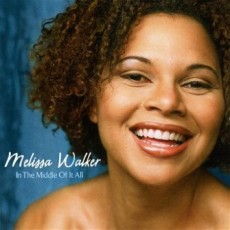
Melissa Walker was born the youngest of three sisters on July 3, 1964 in Edmonton, Alberta, Canada. She attended Brown University considering a career in law but instead after graduation local performance and out-of-town dates led her to launch a career as a vocalist in Washington, D.C., in 1990. She produced her own debut album in 1993 titled Little Wishes, which she sold at her performances.
Moving to New York she studied with pianist and master vocal accompanist Norman Simmons. In 1997, Walker signed to Enja Records and recorded May I Feel and released in Germany. She expanded her performing range with her rich, multi-octave textures and impeccable phrasing, formed her own group and appeared with the Lincoln Center Jazz Orchestra, directed by Wynton Marsalis. Her 1999 release of Moment of Truth marked her commercial U.S. album debut and two years later came I Saw The Sky.
She has been nominated for a Juno Award, won the U.S. Indie Award for Vocal Jazz, has created new material unrivaled in the American jazz tradition, and has appeared on a number of television networks and magazines. Melissa has performed across continents, working and/or recording with such talents as Hank Jones, Gary Bartz, Kenny Barron, Ray Brown, Christian McBride, Stefon Harris, Mokoto Ozone Phil Woods, Buster Williams, Russell Malone, Beny Green, Geoff Keezer, Steve Wilson, Ron Blake, Lenny White, Paul Bollenback, Steve Turre and Geri Allen. Vocalist Melissa Walker continues to perform, compose, record and tour.

Give A Gift Of Jazz – Share
More Posts: vocal
Daily Dose Of Jazz…
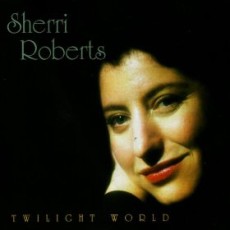
Sherri Roberts was born on June 28, 1957 in Greenville, South Carolina and raised in Atlanta. She graduated from college in 1979 with a theater degree and moved to San Francisco. That same year she began exploring both jazz and classic pop, studying with Jeri Southern and working locally.
She began recording for Brownstone, starting with her 1994 Twilight World and continuing with Dreamsville in 1997. She moved to the Blue House/Pacific Jazz label in 2006 with The Sky Could Send You followed by Lovely Day in 2013.
She has worked with Phil Woods, Chris Potter, Lew Soloff, Mark Soskin, Danny Gottlieb, Harvie S and Carmen McRae. Sherri Roberts, vocalist with the warm voice continues to perform, record and tour.
Jazz Is Global – Share
More Posts: vocal
Daily Dose Of Jazz…
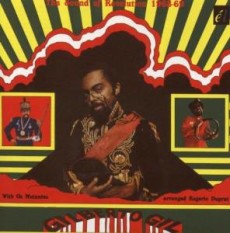
Gilberto Passos Gil Moreira was born June 26, 1942 in Salvador do Bahia, Brazil though he spent much of his childhood in the countryside of Ituaca. The offspring of a doctor and a schoolteacher, he attended the Marist Brothers school until he was nine and then returned to Salvador for secondary school.
Gil’s interest in music began when he was two and grew up listening to the forro music and the street performers of Salvador. Early on, he began to play the drums and the trumpet, and then took up the accordion before attending music school. He first played classical music, but grew more interested in the folk and popular music of Brazil, influenced by accordionist Luiz Gonzaga. He discovered the samba music of Dorival Caymmi, American big band jazz and tango.
In 1950 while still in high school he joined his first band, Os Desafinados (The Out of Tunes), playing accordion and vibraphone and singing. Soon afterwards he settled on the guitar as his instrument after hearing Joao Gilberto and started playing bossa nova. Gil met guitarist and singer Caetano Veloso at the Universidade Federal da Bahia in 1963 and immediately they began collaborating and performing together, releasing a single and EP soon afterwards. Along with Maria Bethania, Gal Costa and Tom Ze, they opened the Vila Velha Theatre with a night of bossa nova and traditional Brazilian songs in 1964.
Gilberto would go on to become musical director of the theatre’s concert series, sold bananas, composed jingles for tv ads and work for Unilever before moving to Sao Paulo in in 1965. Though he had a hit single with Louvação that was later recorded by Elis Regina, his first solo hit was the 1969 song Aquele Abraco. Arrested with Veloso he spent seven months in jail and house arrest and then instructed to leave the country. After a concert in Salvador in ’69 they left for Portugal, Paris and London where he listened to Bob Marley, Jimmy Cliff and Burning Spear. He performed with Yes, Pink Floyd and the Incredible String Band. It was in London that he recorded Gilberto Gil Nega and attended Miles Davis and Sun Ra concerts.
Over the course of his career he participated in the Aids benefit album Red, Hot + Rio, win Grammy awards, receive the Legion d’honneur from France, and was the first Latin American recipient of the Polar Music Prize in Stockholm. In between performances he turned to politics becoming the Salvador Secretary of Culture, founded the environmental protection organization Onda Azul (Blue Wave), was a Good will Ambassador for the Food and Agriculture Organization of the United Nations, became Brazil’s Minister of Culture and then retired due to a vocal cord polyp.
Tenor, baritone and falsetto vocalist, guitarist, lyricist and composer Gilberto Gil who is one of the pioneers of tropicália, and became increasing interested in the welfare of Black culture and focused on Afro-Brazilian culture. He continues to transcend the eras of dance and music trends emerging on the other side with a blend of music styles that stay true to his traditional Bahian roots while engaging with commercial markets.
Inspire A Young Mind
Daily Dose Of Jazz…
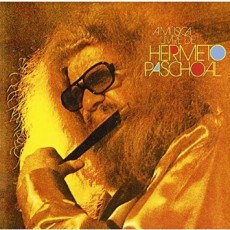
Hermeto Pascoal was born an albino on June 22, 1936 in Lagoa da Canoa, Alagoas, Brazil at a time when there was no electricity. He learned the accordion from his father and practiced for hours as his condition of birth did not allow him to work the fields.
Hermeto’s career began in 1964 with appearances on several Brazilian recordings alongside relatively unknown groups that included Edu Lobo, Elis Regina and Cesar Camargo Mariano, establishing widely influential new directions in post-bossa Brazilian jazz.
By 1966 he was playing in the Sambrasa Trio with Airto Moriera and Humberto Clayber releasing one album Em Som Maior. Then he and Airto joined Trio Novo and in 1967 renamed the group Quarteto Novo and released an album that launched the careers of Pascoal and Moreira. Pascoal would then go on to join the multi-faceted group Brazilian Octopus.
Pascoal initially caught the international public’s attention with an appearance on Miles Davis’s 1971 album Live-Evil, which featured him on three pieces he composed. Later collaborations involved fellow Brazilian musicians Airto and Flora Purim. From the late 1970s onward he has mostly led his own groups, that have included bassist Itibere Zwarg, pianist Jvino Santos-Neto and percussionists Nene, Pernambuco and Zabele.
Known as o Bruxo (the Sorcerer), Hermeto often makes music with unconventional objects such as teapots, children’s toys, and animals, as well as keyboards, button accordion, melodica, saxophone, guitar, flute, voice, various brass and folkloric instruments. Folk music from rural Brazil is another important influence in his work.
Between 1996 and 1997, Pascoal worked on a book project called the Calendário do Som, that contains a song for every day of the year, including 29 February, so that everyone would have a song for his or her birthday. He continues to perform, record and tour.
Jazz Is Global – Share
More Posts: accordion,flute,guitar,keyboard,melodica,saxophone,vocal