

Daily Dose Of Jazz…
Jane Monheit was born November 3, 1977 in Oakdale, New York on Long Island. As a child, Jane spent her summers as a student at the Usdan Center For the Creative and Performing Arts, and is a recipient of their distinguished alumna award.
She began singing professionally while attending Connetquot High School in Bohemia, N.Y. from which she graduated in 1995. As a student at the Manhattan School of Music she studied voice under Peter Eldridge, graduated with honors. Monheit was the first runner up to Teri Thornton in the 1998 Thelonious Monk Jazz Institute’s vocal competition.
An international artist, Jane has performed at most of the major concert halls, cabarets and jazz venues around the globe. She has released seven albums and two DVDs, and has appeared as a guest artist on many others, as well as soundtracks for the movie “Sky Captain and the World of Tomorrow” singing Over The Rainbow.
Monheit has appeared on numerous television shows and also been a featured performer in the nationally televised Christmas at the White House, the Capitol Fourth of July Celebration, and The National Memorial Day Celebration.
Vocalist Jane Monheit has collaborated with artists such as Kenny Barron, Ron Carter, Lewis Nash, David “Fathead” Newman, Michael Bublé, Geoffrey Keezer, Donald Harrison, Romero Lubambo, Terence Blanchard, Ron Carter, Christian McBride, and Tom Harrell and has been nominated twice for her recordings. She spends most of the year on tour with her band but also performs with the major symphonic orchestras throughout the country.
More Posts: vocal
Daily Dose Of Jazz…
Phil Woods was born Philip Wells Woods on November 2, 1931 in Springfield, Massachusetts. He studied music with his great influence Lennie Tristano, at the Manhattan School of Music and at The Julliard School.
After moving to France in 1968, Phil led the avant-garde jazz group The European Rhythm Machine, and then returned to the United States in 1972 and unsuccessfully attempting to establish an electronic group formed a quintet, which is still performing with some changes of personnel.
Although Woods is primarily a saxophonist he is also a fine clarinet player and solos can be found scattered through his recordings. His pop credits include the alto solos on Billy Joel’s Just The Way You Are, Steely Dan’s Doctor Wu and Paul Simon’s Have A Good Time.
Phil has worked with the likes of Kenny Burrell, Mundell Lowe, Red Garland, Palle Danielsson, Pony Poindexter, Jaki Byard, Richard Davis, Steve Kuhn , Donald Byrd, Kenny Dorham, Art Farmer, , Dizzy Gillespie, Julius Watkins, Louis Hayes, Hal Galper, Milt Jackson, Quincy Jones, Michel Legrand, Tommy Flanagan, Stephane Grappelli, Modern Jazz Quartet, Oliver Nelson, Ron Carter, Lalo Schifrin, Shirley Scott, Carmen McRae, Lew Tabackin and Jimmy Rowles among others.
He has amassed 34 sessions as a sideman and nearly four-dozen albums as a leader and has been nominated for seven Grammy Awards and won one for Images: “Best Large Jazz Ensemble Performance”, and three for “Best Instrumental Jazz Performance, Individual or Group” for Live from the Show Boat, More Live, and At the Vanguard.
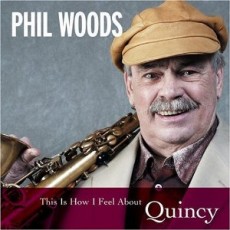
His 2005 documentary film “A Life in E Flat” – Portrait of a Jazz Legend” offers an intimate portrait of Woods during a recording session of the Jazzed Media album This is How I Feel About Quincy. In 2007, Phil received a “Jazz Master” award from the National Endowment of the Arts. Saxophonist, clarinetist and composer Phil Woods was married to Chan Parker, the widow of Charlie Parker, until her death in 1999. He continued to perform, record and tour until his passing on September 29, 2015 in East Stroudsburg, Pennsylvania.
Requisites
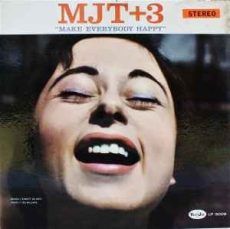
Make Everybody Happy ~ MJT + 3 | By Eddie Carter
Submitted for your approval from my library this morning is one of the tightest, most underrated hard bop groups to emerge out of Chicago, Illinois, at the beginning of the sixties. MJT+3 (short for Modern Jazz Two + Three) was co-founded by drummer Walter Perkins and bassist Bob Cranshaw, who solidified the lineup by recruiting three young Memphis musicians: trumpeter Willie Thomas, alto saxophonist Frank Strozier and pianist Harold Mabern. “Make Everybody Happy” (Vee-Jay VJLP 3008/VJSR 3008) was the second of four albums the quintet made together and captures the ensemble delivering a distinct Midwestern brand of hard bop and firing on all cylinders. I own the 1960 U.S. Stereo misprint reissue (a stereo label on both sides listing the mono catalog number).
The title track, Make Everybody Happy by Harold Mabern, opens the album with sanctified blues and gospel overtones in a marching melody by the quintet. Frank enters first with a biting tone and imaginative ideas. Willie follows with a superbly constructed reading, and Harold cooks consistently into the theme’s reprise and close. The Trolley Song by Hugh Martin and Ralph Blane was introduced by Judy Garland in the 1944 film “Meet Me in St. Louis.” Perkins and the rhythm section mimic a train coming down the track toward the ensemble’s theme. On this twelve-minute trip, Willie, Frank, and Harold each take turns at the controls ahead of the quintet’s closing melody and Perkins’s fade-out.
Sweet Silver by Booker Little is a bluesy tribute to pianist Horace Silver, and the group’s opening chorus gets into a good groove right out the gate. Frank’s opening solo will have the listener popping their fingers, then Willie impresses on the following statement with solid assurance. Harold delivers a final, concise reading that swings comfortably before leading the quintet into the reprise. Don’t Get Around Much Anymore by Duke Ellington and Bob Russell opens Side Two, with the ensemble’s melody giving this old favorite fresh clothes. Willie and Frank both take short solos, with Walter and Bob offering a concise comment before the closing chorus.
Up next is My Buddy by Walter Donaldson and Gus Kahn. After the front line’s introduction, Frank takes the lead on the melody, and Willie switches to a mute to join him. Frank shapes the first solo with a touch of the blues. Willie follows with an exquisite reading, smooth as glass. Harold then delivers an impressive statement before the climax. Harold Mabern’s original, Richie’s Dilemma, kicks the energy level up for the quintet’s medium melody. Willie goes first with a laid-back solo, then Bob takes a short walk in the following interpretation. Frank works his magic next, followed by Harold, who provides a delightfully constructed reading. Willie and Frank share an impressive offering with Walter, leading to the group’s climax.
The quintet eases back on the throttle one final time for Love Letters by Edward Heyman and Victor Young. The opening ensemble begins with Willie’s elegant mid-tempo bounce. Frank’s opening statement is warm and compassionate. Then Walter has his say next and gives a short, deeply satisfying moment. Willie puts an exclamation point on the song with a mellow performance, before the group reconvenes for the closing chorus. The session was supervised by Sid McCoy, but the recording engineer is not known. The album’s sound quality is excellent, with a soundstage that’s warm, engaging and musical.
Make Everybody Happy by MJT + 3 is an overlooked gem with a well-balanced lineup and thoughtful repertoire. Willie Thomas and Frank Strozier create a compelling two-horn conversation, while Harold Mabern adds harmonic richness and rhythmic drive. Bob Cranshaw and Walter Perkins anchor the ensemble with steady, assured support. Together, MJT + 3 offers the listener a prime example of soulful, bluesy jazz that, as the title suggests, is sure to Make Everybody Happy every time it’s on the turntable. I highly recommend it for your library, and I hope you’ll check it out the next time you visit your favorite record store!
~ Don’t Get Around Much Anymore – Source: JazzStandards.com ~ Love Letters, The Trolley Song – Source: Wikipedia.org © 2026 by Edward Thomas Carter

Daily Dose Of Jazz…
Carmen Lundy was born November 1, 1954 in Miami, Florida and at the age of six began to study the piano. After joining her church junior choir, she decided to become a singer when she was 12 years old. While an opera major at the University of Miami she sang with a jazz band and her decision to sing vocal jazz was cemented.
Moving to New York in 1978 Carmen was hired by the Mel Lewis/Thad Jones Big Band and performed her first engagement at the Village Vanguard in Greenwich Village. Two years later she formed her own trio, performing with pianists John Hicks and Onaje Allan Gumbs. She has also performed with Walter Bishop Jr. Don Pullen, Mulgrew Miller, Geri Allen, Terri Lyne Carrington, Courtney Pine, Bill O’Connell, Steve Berrios, Marian McPartland, Kenny Kirkland and numerous others.
Lundy recorded her first album of original compositions Good Morning Kiss in 1985 followed by her sophomore project Night and Day the next year featuring musicians Kenny Kirkland, Alex Blake, her brother Curtis Lundy, Victor Lewis, Rodney Jones and Ricky Ford.
Carmen played the lead role in the European tour of Duke Ellington’s Broadway musical, Sophisticated Ladies. Off-Broadway she portrayed Billie Holiday in Lawrence Holder’s They Were All Gardenias. She made her television debut in 1990 as the star of the CBS pilot-special Shangri-La Plaza in the role of Geneva.
A composer, arranger, producer, actress, painter, and sophisticated vocalist well known for her progressive bop and post-bop styling’s, Lundy has composed and published forty songs with favorites such as Quiet Times, Forgive Me, The Out Crowd, and Never Gonna Let You Go that have been recorded by Kenny Barron, Ernie Watts and Straight Ahead. With thirteen albums to her credit Carmen Lundy continues to focus on original material as she moves her three-decade career forward.