

Daily Dose Of Jazz…
Bud Scott was born Arthur Budd Scott on January 11, 1890 in New Orleans, Louisiana. He played guitar and violin as a child and performed professionally from an early age. His first job was with New Orleans dance band leader John Robichaux in 1904 and as a teenager he played with Buddy Bolden. In 1911 he was playing guitar with Freddie Keppard’s Olympia Orchestra. In 1912 he left New Orleans with a large travelling show.
As a violinist he performed with James Reese Europe’s Clef Club Orchestra at a historic 1912 concert at Carnegie Hall, and the following year worked with Europe’s ensemble on the first jazz recordings on the Victor label.He would go on to play on a number of Victor Talking Machine Company ragtime recordings with James Reese Europe’s Society Orchestra in 1913.
A graduate of the Peabody School of Music, he was a notable rhythm guitarist in Chicago, Illinois’s Jazz Age nightclubs of the 1920s. Moving there in 1923, he became a member of King Oliver’s Creole Jazz Band, originating the now traditional shout, Oh, play that thing!, on Oliver’s recording of Dippermouth Blues. He also worked with Johnny Dodds and Jimmy Blythe, Erskine Tate, Jelly Roll Morton’s Red Hot Peppers and Richard M. Jones’ Jazz Wizards.
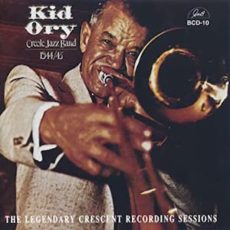
Scott was the first person to use a guitar in a modern dance orchestra, in Dave Peyton’s group accompanying Ethel Waters at Chicago’s Cafe de Paris. After performing and recording with Jimmie Noone’s Apex Club Orchestra in 1928 he moved to California. Making a living as a professional musician through the 1930s, when traditional jazz was eclipsed by big-band swing music, he formed his own trio. In 1944 Scott joined an all-star combination that evolved into Kid Ory’s Creole Jazz Band. This was an important force in reviving interest in New Orleans-style jazz in the 1940s, and he wrote the majority of the band’s arrangements.
In 1944 Bud joined an all-star traditional New Orleans band that was a leader of the West Coast revival, put together for the CBS Radio series The Orson Welles Almanac. He arranged most of the songs for Kid Ory’s band, of which he was a part. His talent for arranging earned him the title of The Master.
A stroke in 1948 forced his retireent from music. Guitarist, banjoist, violinist and vocalist Bud Scott, whose obituary ran on the front page of the Los Angeles Sentinel, transitioned in Los Angeles, California on July 2, 1949, aged 59.
More Posts: arranger,banjo,buitar,history,instrumental,jazz,music,violin,vocal
Daily Dose Of Jazz…
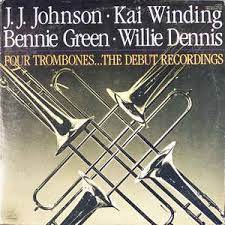
Willie Dennis wsa born William DeBerardinis on January 10, 1926 in Philadelphia, Pennsylvania. After working with Elliot Lawrence, Claude Thornhill, and Sam Donahue, he went to work with Charles Mingus, appearing on two of Mingus’s albums in 1959, Blues & Roots and Mingus Ah Um. In 1953, due to his relationship with Mingus he recorded Four Trombones (on the bassist’s Debut Records label and was released in 1957. The other three trombones were J. J. Johnson, Kai Winding and Bennie Green.
In 1951, Dennis began studying with Lennie Tristano. To make ends meet, he worked as an attendant at the Museum of Modern Art. The fullest recorded example of Dennis’s solo work is on a little-known 1956 Savoy disc by English pianist Ronnie Ball, who was also a Tristano student. The album was titled All About Ronnie, and included Ted Brown and Kenny Clarke.
He toured with Mingus in 1956, published an essay, The History of the Trombone, in Metronome. By the late 1950s Willie had returned to his big band roots and joined Buddy Rich in 1959 after stints with Benny Goodman and Woody Herman. During the 1960s, he often performed with Gerry Mulligan.
He had an extremely fast articulation on the trombone, which he obtained by means of varying the natural harmonics of the instrument with minimal recourse to the slide, a technique known as crossing the grain. He recorded with Cannonball Adderley, Manny Albam, Al Cohn, Mundell Lowe, Gary McFarland, Gerry Mulligan, Oliver Nelson, Anita O’Day, Shirley Scott, Zoot Sims and Phil Woods.
Known for his big band musicianship but who could also execute as an excellent bebop soloist, trombonist Willie Dennis, who was married to Morgana King in 1961, transitioned due to an automobile accident in Central Park on July 8, 1965 in New York City.
More Posts: bandleader,history,instrumental,jazz,music,trombone
Review: The Pugilist ~ Bernie Dresel
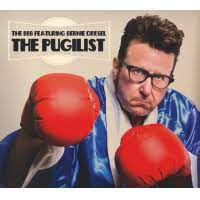
I wasn’t sure where this album was going when I looked at the cover art. It took me to the boxing rings before they became Vegas events, reminiscent of the radio era of my parents with Joe Louis, Rocky Marciano, Sugar Ray Robinson and Jack Dempsey. This is what big band should sound like. Bernie has brought the heat to this aptly titled recording. He is truly a pugilist as each song makes you feel the punch and excitement of the music. Listening I envisioned people pouring into the arena dressed to kill with all the swagger and sway that a championship fight brings. He definitely does not disappoint with his arrangements of classic tunes and new compositions. Closing out with a vocal is a unique approach and definitely wasn’t expected, but nicely done. It’s a refreshing approach to big band!
carl anthony | notorious jazz | january 10, 2022
Give A Gift Of Jazz ~ Share 
#preserving genius
More Posts: bandleader,history,instrumental,jazz,music,review,vocal
Requisites
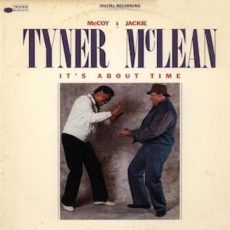
It’s About Time ~ McCoy Tyner and Jackie McLean | By Eddie Carter
This morning’s discussion brings two jazz giants together for their only collaborative album. It’s About Time (Blue Note BT 85102) is a 1985 release by pianist McCoy Tyner and alto saxophonist Jackie McLean (tracks: A1 to A3, B1) that rekindles a sixties Hard-Bop or Post-Bop date and is one of the best kept secrets in both musician’s discographies. The supporting cast is a stellar one, Jon Faddis (tracks: A1, B1) on trumpet, Ron Carter (tracks: A1, B1, B2) on acoustic bass, Marcus Miller (tracks: A2, A3, B3) on electric bass, Al Foster on drums, and Steve Thornton (tracks: A2, A3, B3) on percussion. My copy used in this report is the 1985 US Stereo Full Digital Recording.
Side One opens with the first of five tunes from Tyner’s pen, Spur of The Moment begins with a lively opening chorus in unison. Jon opens the opening solo with tremendous fire and spirit, followed by Jackie who produces some commanding choruses on the second performance. McCoy cooks confidently on the finale with inexhaustible energy into the climax. You Taught My Heart To Sing is a beautiful ballad that’s a showcase for McLean who gives the melody and first solo a warm and moving treatment. Tyner is up next with a delicately gentle reading shadowed by Miller, Foster, and Thornton who anchor both soloists with gorgeous groundwork preceding McLean’s return for the reprise and Tyner’s quiet ending.
It’s About Time begins with a tropical flavor in its blood on a delightfully, feisty midtempo theme led by Jackie who also leads the solos this time with an effective groove, then McCoy follows with a perfectly crafted closing statement. Marcus and Steve provide the spicy compliment that keeps our fingers popping and toes tapping into the group’s soft fadeout. Side Two opens with Hip Toe, a mid~tempo swinger that starts with the front-line and Tyner cruising comfortably into the infectious opening chorus. McLean is up first and comes out swinging on a peppy reading. Faddis answers him with a sharp, zesty statement that builds to a satisfying conclusion. Tyner provides the exclamation point on an extremely happy closing solo before the theme’s return and disappearance.
No Flowers Please by Ron Carter is a trio performance of tranquil beauty that the bassist introduces thoughtfully. McCoy takes the first solo and paints an intimate portrait. Ron closes with a polite, considerate reading executed with fingertip delicacy leading to a tender climax. Travelin’ invites us to take a mid~tempo trip without leaving the comfort of our sweet spot. Miller is the highlight here and demonstrates some stellar bass playing on the opening solo after Tyner’s opening chorus propelled by the rhythm section and Thornton’s percussion. Tyner makes a very personal statement on the closing reading with a grand delivery that brings us safely home after this six-song journey into a gentle culmination.
It’s About Time was produced by Jeffrey Weber and was digitally recorded by Ron Saint German. The sound quality is superb with an outstanding soundstage and excellent stereo separation matching the exceptional interaction between the musicians. The music also flows smoothly and is reminiscent of a classic Blue Note recording of the late fifties or early sixties. If you’re a fan of McCoy Tyner and Jackie McLean, I invite you to audition It’s About Time at your earliest opportunity. It’s an album of wonderful jazz music deserving further investigation for a spot in your library!
© 2021 by Edward Thomas Carter
More Posts: choice,classic,collectible,collector,history,instrumental,jazz,music,piano,saxophone
Daily Dose Of Jazz…
Abbey “Chinee Bébé” Foster was born on January 9, 1902 in New Orleans, Louisiana. A self-taught jazz drummer, he played in Storyville with William Ridgley’s Tuxedo Orchestra, and with Buddie Petit in the Eagle Band.
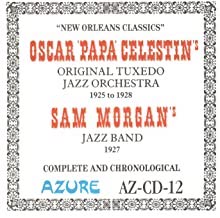
He recorded with Celestin’s Original Tuxedo Jazz Orchestra in 1927. After years of retirement, he made a comeback with Punch Miller’s Band at Preservation Hall in 1961.
On September 12, 1962 drummer Abbey Foster transitioned in his hometown.
More Posts: drums,history,instrumental,jazz,music