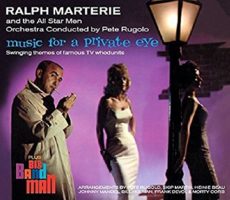
Daily Dose Of Jazz…
Ralph Marterie was born on December 24, 1914 in Acerra, near Naples, Italy and first played professionally at age 14 in Chicago, Illinois. In the 1940s, he played trumpet for various bands. His first job as a bandleader was courtesy of the US Navy during World War II, after which he was hired by the ABC Radio network. With his reputation built from these broadcasts, he secured a recording contract with Mercury Records.
In 1953 his big band recorded a version of Bill Haley’s Crazy, Man, Crazy, which reached #13 on the Billboard jockey chart and #11 on Cashbox in June, 1953. His recordings of Pretend and Caravan also made the Top 10 with the latter selling over a million copies and was awarded a gold disc. His biggest success on the U.S. charts was a cover of Skokiaan in 1954. In 1957, he had success with Tricky and Shish-Kebab.
Big band leader Ralph Marterie, who composed Dancing Trumpet, Dry Marterie, and Carla, passed away on October 10, 1978, in Dayton, Ohio.

More Posts: trumpet
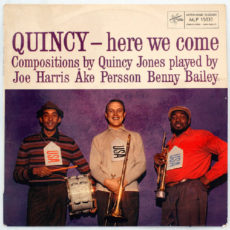
Daily Dose Of Jazz…
Joseph Alison Harris was born on December 23, 1926 in Pittsburgh, Pennsylvania and took lessons at an early age from Pittsburgh native Bill Hammond, an acclaimed master of traditional rudimental drumming. The training gave him the ability to sit in with a band or orchestra and quickly sight-read almost any style of music. While still in his teens he hit the road playing in big-band ensembles for a globe-trotting career as one of the most versatile jazz drummers of his time, one of the last survivors of the golden era of bebop.
A former Pittsburgh band mate, bassist Ray Brown who had joined Dizzy Gillespie’s pioneering bebop band, arranged for Joe to audition for the drum chair, leading to be a member of the group. Fired for demanding overtime pay for a rehearsal, they later reconciled.
Remaining in high demand throughout his career, he married, lived and played in Sweden for five years during the Fifties, welcoming the contrast from the racial prejudices of the United States. Harris toured Europe with a band led by Quincy Jones, joined a state-run band at Radio Free Berlin and accompanied Charlie Parker, Ella Fitzgerald, Sarah Vaughan, Sonny Rollins, Stan Getz, Billie Holiday and many other greats.
He spent his last decades at his Manchester home, teaching jazz history and drums for years at the University of Pittsburgh, tapered back his performing schedule and mentored younger jazz musicians. Drummer and educator Joe Harris passed away on January 27, 2016 at age of 89.

More Posts: drums

The Jazz Voyager
Flying the friendly skies the Jazz Voyager is heading for the urban setting of the Far East to experience first hand, the high-end jazz venue, the most expensive in Aoyama, Tokyo, Japan, the Blue Note Tokyo.
Described as city’s best venue for live jazz and seating about 300 people, it is cousin to the famous Blue Note New York club and was established in 1988 by two wealthy New York sisters. It has become a symbol of the globalization of jazz aesthetics, featuring a veritable who’s-who of American jazzmen along with local talent, such as the superb Toshiko Akiyoshi.
Made my reservation for tonight at +81 3-5485-0088 and arriving in Japan, at 〒107-0062 Tokyo, Minato, Minamiaoyama, 6 Chome−3−16, ライカビル for the 2nd set, this Jazz Voyager will be enchanted by the wonderfully talented Patti Austin as she sings Ella Fitzgerald. The price of admission is 9,000 Yen ($80.00) and doors open at 8:20pm with the show at 9:00pm. #wannabewhereyouare

More Posts: adventure,club,genius,jazz,museum,music,preserving,restaurant,travel,voyager

Daily Dose Of Jazz…
Ronald “Ronnie” Ball was born December 22, 1927 in Birmingham, England. He moved to London in 1948, and in the early Fifties worked both as a bandleader and under Ronnie Scott, Tony Kinsey, Victor Feldman and Harry Klein.
1952 saw a move to New York City where he studied with Lennie Tristano. In the 1950s and in the Sixties he worked extensively around the jazz scene with Chuck Wayne, Dizzy Gillespie, Lee Konitz, Kenny Clarke, Hank Mobley, Art Pepper, J.J. Johnson, Kai Winding, Warne Marsh, Buddy Rich, Gene Krupa, Roy Eldridge and Chris Connor among others.
By the 1960s he relatively disappeared from music. Pianist, composer and arranger Ronnie Ball passed away in October,1984.

More Posts: piano
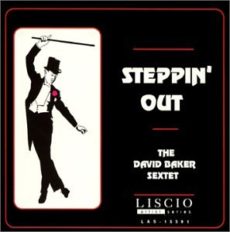
Daily Dose Of Jazz…
David Nathaniel Baker Jr. was born on December 21, 1931 in Indianapolis, Indiana and took up the trombone attending Crispus Attucks High School. He went on to matriculate through Indiana University, earning his Bachelor and Master degrees in Music, having studied with J. J. Johnson, János Starker, and George Russell.
His first teaching position was at Lincoln University in Jefferson, Missouri in 1955, a historic black institution, but Baker had to resign his position under threats of violence after he had eloped to Chicago, Illinois to marry white opera singer Eugenia (“Jeanne”) Marie Jones. Thriving in the Indianapolis jazz scene of the time, he was as a mentor of sorts to Indianapolis-born trumpeter Freddie Hubbard. Forced to abandon the trombone due to a jaw injury that left him unable to play, he subsequently learned to play cello.
The shift to cello largely ended his performing career but began his life as a composer and pedagogue. Among the first and most important people to begin to codify the then largely aural tradition of jazz he wrote several seminal books on jazz, including Jazz Improvisation in 1988. Baker taught in the Jazz Studies Department at Indiana University and made the school a highly regarded destination for students of jazz. His students included Michael Brecker, Randy Brecker, Peter Erskine, Jim Beard, Chris Botti, Jeff Hamilton, and Jamey Aebersold.
Baker’s compositions range from Third Stream to traditional to symphonic works. He composed some 2000 compositions, has been commissioned by over 500 individuals and ensembles, nominated for a Pulitzer and a Grammy award, honored three times by Down Beat magazine, and was the third inductee to their jazz Education Hall of Fame, as well as several other jazz awards.
Trombonist, cellist, composer and pedagogue David Baker, who performed with his second wife Lida, a flautist, since the Nineties and has more than 65 recordings, 70 books, and 400 articles to his credit, passed away on March 26, 2016, at age 84 at his Bloomington, Indiana home.