

Daily Dose Of Jazz…
Nick Paul was born on April 5, 1939 and raised in London, England. Growing up while playing a host of woodwind instruments his influences were George Lewis and John Handy.
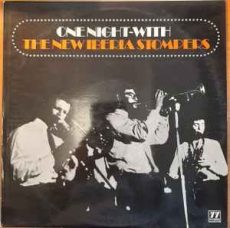
Very active during the 60s, 70s and 80s in the south of England, in Europe he also played New Orleans Jazz. Paul played with many bands including The Barry Martin Ragtime Band, Malc Murphy’s Storyville Stompers, Bill Brunskil, The New Iberia Stompers, The New Revival Jazz Band. He spent time in New Orleans listening to the masters and improving his knowledge of the music.
Leaving England in 1987 for sunnier climes, Nick lived aboard his sailing boat Storyville in Cyprus for ten years playing in hotels and clubs. His musical tastes broadened and for the last twelve years he has been playing mainly small group swing and mainstream jazz of the 50s era.
Woodwind master Nick Paul, who now lives in Thailand, is still playing and has established a small recording studio.
More Posts: history,instrumental,jazz,music,woodwinds

Daily Dose Of Jazz…
Tony Vella was born on April 4, 1937 in Terrasini, a Sicily commune in the metropolitan city of Palermo, Itlay. In 1957 he gained immense experience working with big and small configurations. In Italyhe was the main arranger, for numerous important record houses.
From 1972 he dedicated his efforts to cultural activities and the formation of young talents holding theory courses, and practical instrumental and ensemble music applied to jazz music. By 1975 Tony participated in the Pescara the Jazz Festival with the New Jazz Society of Palermo, the only Italian group invited to perform along with the Zoot Sims Quartet, Antony Braxton, Elvin Jones Quintet, Red Norvo Trio, Chet Baker Quartet, Charles Mingus Group, Roland Kirk Quintet and Don Cherry Organic Music Theatre.
Three years later he formed and directed L’Orchestra in collaboration with the Reinhardt Center for their concert season. Organized by the Associazione Siciliana Amici della Musica and introduced to Auditorium SS. Salvatore of Palermo.
In the Eighties Vella was a partr of the Messina Jazz Meeting with the Brass Group Big Band, as orchestra director and arranger. With the band he has collaborated with international musicians Archie Shepp, Hernie Wilkins, Mel Lewis, Sam Rivers, Toshiko Akiyoshi, Paolo Lepore, Franco Cerri, and Danilo Terenzi.
The next decade he established The Tony Vella Fusion Jazz Band entirely composed from young Sicialian musicians. A big band, modeled on some of the great American orchestras like Quincy Jones. The Fusion Jazz Band presented remarkable arrangements of a repertoire that includes Brazilian and popular jazz. They accompanied singers Beppe Vella, Gaetano Riccobono, and Tony Piscopo, as well as numerous musicians such asCalderone Ignazio, Aldo Oliveri, Benedetto Modica, Giovanni Mazzarino, Sergio Munafò, Aldo Messina, and Sebastiano Alioto, among others.
Pianist, organist, composer, arranger and orchestra director Tony Vella continues to perform, conduct and record.
More Posts: arranger,composer,director,history,instrumental,jazz,music,organ,piano
Daily Dose Of Jazz…
William Orie Potts was born April 3, 1928 in Arlington, Virginia. As a child he played Hawaiian slide-lap steel guitar and the accordion in his teens. At 15 he won an accordion competition with a performance of Twilight Time. After hearing Count Basie on the radio he started studying the piano in high school. He went on to attend Catholic University of America in 1946–1947, then formed his own group under the name Bill Parks, which toured in Massachusetts and Florida.
While serving in the Army from 1949 to 1955 he transcribed charts for Army bands. During this time Bill composed and arranged for Joe Timer and Willis Conover’s ensemble, The Orchestra, which was broadcasted on Voice of America radio. He wrote four of the songs on The Orchestra’s 1954 Brunswick Records LP, and recorded some of their live shows, which occasionally featured guest appearances from Charlie Parker and Dizzy Gillespie.
By 1956 he was leading a house band at Olivia Davis’ Patio Lounge in Washington, D.C. and Lester Young booked an engagement there. Potts convinced Young to record with him on two of the evenings. These recordings were later released as the Lester Young in Washington, D.C. sessions.
The following year he worked extensively as a composer, arranger, and performer for Freddy Merkle’s Jazz Under the Dome album which featured Earl and Rob Swope. Soon after this he suffered a crushed vertebra in a car crash and ended up in a body cast for three months. During his recuperation Bill began working on charts and arrangements for an album consisting of jazz reinterpretations of many songs from George Gershwin’s opera Porgy & Bess.
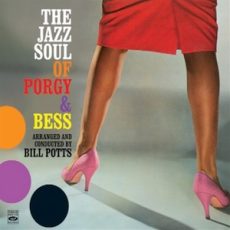
Fully recovered by 1959, he released a session under his own name titled The Jazz Soul of Porgy and Bess for United Artists Records. It featured a nineteen-piece band whose members included Al Cohn, Harry Edison, Art Farmer, Bill Evans, Bob Brookmeyer, Marky Markowitz, Zoot Sims, Charlie Shavers, Earl Swope, and Phil Woods. The album received a five out of five star rating from Down Beat magazine upon its release.
Following this, Potts spent several years working in New York City before returning to the D.C. area, where he worked locally in addition to touring with and/or arranging for Paul Anka, Eddie Fisher, Ella Fitzgerald, Stan Getz, Woody Herman, Quincy Jones, Stan Kenton, Ralph Marterie, Buddy Rich, Jeri Southern, Clark Terry, and Bobby Vinton.
In 1967 he released an album on Decca Records, How Insensitive, with a studio group called Brasilia Nueve. This group included Markowitz and Sims from the Porgy and Bess session , as well as Tito Puente, Chino Pozo, Mel Lewis, Barry Galbraith, and Louie Ramirez.
As an educator Bill taught music theory at Montgomery College from 1974 to 1990 and was the leader of the student jazz band. He also led a big band for occasional performances at Washington’s Blues Alley nightclub in the 1980s.
Retiring to Fort Lauderdale, Florida in 1995, pianist and arranger Bill Potts died of cardiac arrest on February 16, 2005 in Plantation, Florida.
More Posts: arranger,bandleader,history,instrumental,jazz,music,piano
Daily Dose Of Jazz…
Cag Cagnolatti was born Ernie Joseph Cagnolatti on April 2, 1911 in Madisonville, Louisiana. He was one of six children sharing Italian and African American parentage and raised Catholic.
Cagnolatti began on trumpet around 1929 and played with Herbert Leary from 1933 to 1942, as well as off and on with Sidney Desvigne and Papa Celestin. He was a recurring member of many of the major New Orleans brass bands; he worked in the bands of George Williams in the 1940s and 1950s, and with Alphonse Picou in the early 1950s.
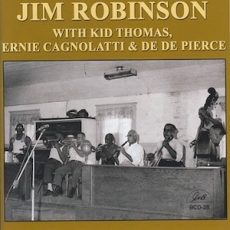
He recorded with Paul Barbarin repeatedly over the course of the 1950s and 1960s. He and Jim Robinson collaborated in the early 1960s, and he also recorded with Harold Dejan in 1962 and with the Onward Brass Band in 1968. From 1974 to 1980 Cagnolatti was a mainstay at Preservation Hall.
He suffered a stroke in 1980 and did not play afterwards. Trumpeter Cag Cagnolatti, affectionately known as Little Cag, died in New Orleans, Louisiana on April 7, 1983.
More Posts: history,instrumental,jazz,music,trumpet
Daily Dose Of Jazz…
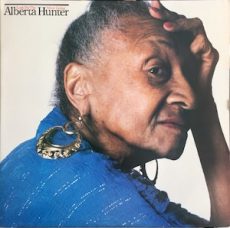
Alberta Hunter was born on April 1, 1895 in Memphis, Tennessee to Laura Peterson, who worked as a maid in a Memphis brothel, and Charles Hunter, a Pullman porter, a father she never knew. She attended Grant Elementary School and attended school until around age 15.
Hunter had a difficult childhood and left for Chicago, Illinois, around the age of 11 in the hopes of becoming a paid singer hearing that it paid ten dollars per week. Instead of finding a job as a singer she worked at a boarding house for six dollars a week with room and board.
Her singing career started in a bordello and soon moved to Saloons, bars and clubs that appealed to men, black and white alike. By 1914 Alberta was receiving lessons from jazz pianist, Tony Jackson, who helped her to expand her repertoire and compose her own songs. Her big break came when she was booked at Dreamland Cafe, singing with King Oliver and his band.
Sheeventually rose from the city’s lowest dives to headlining the most prestigious venue for black entertainers, the Dreamland ballroom. She had a five-year residency with the venue in 1917 for $35 a week. She first toured Europe in 1917, performing in Paris and London. The Europeans treated her as an artist, showing her respect and even reverence, which made a great impression on her.
Hunter flourished in the 1920s and 1930s on both sides of the Atlantic. She recorded prolifically during the 1920s, starting with sessions for Black Swan in 1921, Paramount in 1922–1924, Gennett in 1924, OKeh in 1925–1926, Victor in 1927 and Columbia in 1929. While still working for Paramount, she also recorded for Harmograph Records. By the early 1940s she was performing at home and eventually moved to New York City where she performed with Bricktop and recorded with Louis Armstrong and Sidney Bechet.
Continuing to perform on both sides of the Atlantic she was the head of the U.S.O.’s first black show. In 1944, she took a U.S.O. troupe to Casablanca, in both theatres of World War II, then to Korea until her mother’s death in 1957. She retired from music and went into healthcare, becoming a nurse for 20 years at Roosevelt Island’s Goldwater Memorial Hospital. Aged out of the hospital because they believed she was 70, at 82 she returned to singing. With a two week residency at a Greenwich Village club, that turned into a six year attraction until her death on October 17, 1984 in Roosevelt Island, New York at the age of 89.