

Daily Dose Of Jazz…
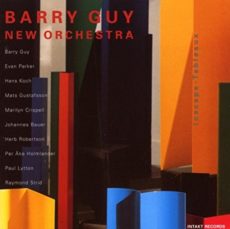
Barry John Guy was born April 22, 1947 in London, England and came to the fore as an improvising bassist as a member of a trio with pianist Howard Riley and drummer Tony Oxley in 1969. He also became an occasional member of John Stevens’ ensembles in the 1960s and 1970s, including the Spontaneous Music Ensemble.
By the early 1970s, he was a member of the influential free improvisation group Iskra 1903 with Derek Bailey and trombonist Paul Rutherford and in the late Seventies was revived with violinist Philipp Wachsmann, replacing Bailey. Guy, saxophonist Evan Parker, and drummer Paul Lytton became one of the best-known and most widely travelled free-improvising trios of the 1980s and 1990s.For a brief time he was a member of the Michael Nyman Band in the 1980s, performing on the soundtrack of The Draughtsman’s Contract.
Guy’s improvisation and formal composition interests led him to the London Jazz Composers Orchestra, originally formed to perform his composition Ode in 1972. The orchestra became one of the great large-scale European improvising ensembles. Though documentation is sketchy early on, in the late 1980s the Swiss label Intakt set out to document the band more thoroughly, resulting in several recordings.
He has also written for other large improvising ensembles, such as the NOW Orchestra and ROVA. Having taught at Guildhall School of Music, double bassist Barry Guy is currently improvising in piano trios with Marilyn Crispell and Agusti Fernandez, recorded several albums for ECM, continues to venture into the pop field with his session work, and along with his wife, run the small label Maya, which releases a variety of records in the genres of free improvisation, baroque music and contemporary composition.
Sponsored By


#preserving genius
More Posts: bass
Daily Dose Of Jazz…
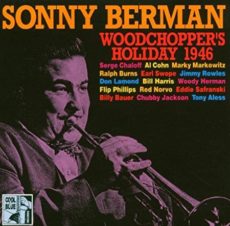
Saul “Sonny” Berman was born on April 21, 1925 in New Haven, Connecticut. He began touring at age sixteen and went on to work with Louis Prima, Harry James and Benny Goodman but is perhaps best known for his later work with Woody Herman.
Berman was distinguished by his passionate and innovative soloing and his versatility of tone, ranging from bold and emotional to sweetly muted. He also had a sense of humor which often made its way into a playfulness and joyfulness found in his solo work.
Trumpeter Sonny Berman died at the age of 21 in New York City from a drug overdose on January 16, 1947.
Sponsored By

#preserving genius
More Posts: trumpet
Daily Dose Of Jazz…
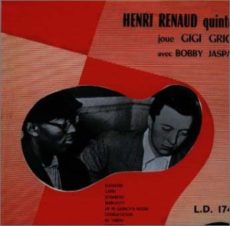
Henri Renaud was born April 20, 1925 in Villedieu-sur-Indre, France. His styles was evolutionary over the decades he was musically active and represented the swing, bebop and cool styles. His international renown came when he served as an ensemble-organizing point-man for visiting jazz performers from the United States.
Moving to Paris in 1946, Renaud established a career as a jazz pianist and joined tenor-saxophonist Jean-Claude Fohrenbach’s combo. During 1949 and 1950 he accompanied Don Byas, James Moody and Roy Eldridge. In 1952 he performed at various times with Lester Young, Sarah Vaughan and Clifford Brown.
Henri would go on to record several times with Brown as well as with Milt Jackson, J. J. Johnson, Al Cohn, Oscar Pettiford, Max Roach, Frank Foster and Bob Brookmeyer. In 1954, he visited the United States and recorded during that time.
He became an executive for French CBS’ jazz division in 1964 and for the most part stopped performing, though he occasionally worked as a film composer. Pianist Henri Renaud passed away in Paris, France on October 17, 2002.
Sponsored By
#preserving genius
More Posts: piano
Daily Dose Of Jazz…
Glauco Masetti was born on April 19, 1922 in Milan, Italy and was an autodidact on reed instruments as well as a classically trained violinist, attending the Milan and Turin conservatories.
In the late 1940s he worked with Gil Cuppini for the first time, an association that would continue well into the latter part of the 1960s. He worked often as a session musician in the first half of the 1950s, with Gianni Basso and Oscar Valdambrini among others.
He led his own ensemble from 1955, and played with Eraldo Volonté and Chet Baker. In the Sixties, he also played with Giorgio Gaslini during that decade. Clarinetist and alto saxophonist Glauco Masetti passed away on May 27, 2001 in Milan.
Sponsored By

#preserving genius
Daily Dose Of Jazz…
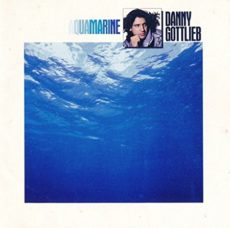
Daniel Richard Gottlieb was born in New York City on April 18, 1953. Taking lessons from Mel Lewis and Joe Morello, he graduated from the University of Miami in 1975. He became a member of the Gary Burton Quartet in 1976 with Pat Metheny, and then was one of the original members of The Pat Metheny Group from 1977–1983. Bassist Mark Egan, who was also in Metheny’s first group, teamed with Gottlieb and formed the band Elements. In 1984 he was a member of the Mahavishnu Orchestra led by guitarist John McLaughlin.
Gottlieb performed or recorded with dozens of musicians not limited to Bill Evans, Branford Marsalis, Jacqui Naylor, Chick Corea, Randy Brecker, Stan Getz, Clark Terry, Ernie Wilkins, Gerry Mulligan, Joanne Brackeen, Herbie Hancock, Hiram Bullock, Booker T and the MG’s, Hubert Laws, Lew Soloff, Jim Hall, Jimmy Haslip, Nnenna Freelon, John Scofield, Bobby McFerrin, Kenny Barron, Larry Coryell, Eddie Gómez, Mark Murphy, Miroslav Vitous, Naná Vasconcelos, Ali Ryerson, Nguyên Lê, Rufus Reid, Sting and Wayne Shorter, as well as the Carnegie Hall Jazz Orchestra, NDR Big Band, Trio, Vanguard Jazz Orchestra, Gil Evans Orchestra and WDR Big Band.
In 2004 he became the drummer for Gary Sinise’s Lt. Dan Band. He has performed on over 400 albums, earned nine Grammy Award nominations and four wins, is on the faculty of the University of North Florida as a full-time Professor of Jazz Studies. Drummer Danny Gottlieb has made over ten instructional DVDs, wrote the textbook The Evolution of Jazz Drumming, and continues to perform and record.

#preserving genius
More Posts: drums