

Daily Dose Of Jazz…
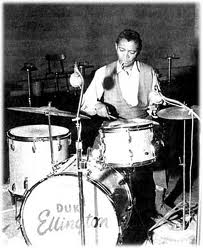
Sam Woodyard was born January 7, 1925 in Elizabeth, New Jersey. He learned to play the drums by teaching himself, with no instruction. He began playing locally around Newark, New Jersey area in the 1940s. Sam gigged with Paul Gayten in an R&B group, moving on in the early 50s to play with Joe Holiday, Roy Eldridge, and Milt Buckner. It was in 1955 that Woodyard would join Duke Ellington’s orchestra, remaining the ensemble’s drummer until 1966.
After his time with Ellington, Sam played behind Ella Fitzgerald prior to moving to Los Angeles, California. In the 1970s he played less due to health problems, but recorded with Buddy Rich and toured with Claude Bolling. In 1983 he played in a band with Teddy Wilson, Buddy Tate and Slam Stewart. His last recording was on Steve Lacy’s 1988 album “The Door”.
A little more than a month after this recording was completed, drummer Sam Woodyard passed away on September 20, 1988 in Paris, France.
More Posts: drums
Daily Dose Of Jazz…
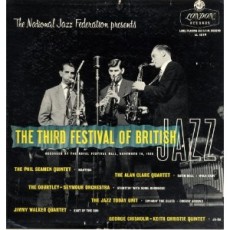
Keith Ronald Christie was born January 6, 1931 in Blackpool, England and began playing trombone at 14 while attending the Guildhall School of Music and Drama. He formed a band with his brother Ian in the late 1940s, and soon after the pair joined the band of Humphrey Lyttleton, recording copiously.
Keith served in the military early in the 1950s, reconvening to lead an ensemble with his brother in 1951 that lasted until 1953. He went on to work with other jazz musicians like John Dankworth, Cleo Laine, George Chisholm, Vic Ash and others in the mid 50s. He worked with Ted Heath as well as Allan Ganley in the Jazzmakers from the late 50s to early 60s, with brief stints in other bands through the end of the decade.
During this period he joined Benny Goodman on a European tour, also playing with Tubby Hayes, Paul Gonsalves, Kenny Wheeler, Ronnie Ross, and Bobby Lamb among others. In the mid-1970s Keith Christie suffered and recovered from a fall but his continuing battles with alcoholism eventually resulted in the trombonist’s early death on December 16, 1980 in London, England.
More Posts: bandleader,trombone
Daily Dose Of Jazz…
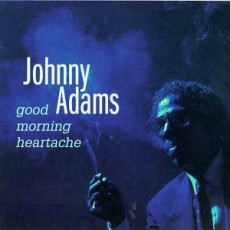
Laten John Adams was born in New Orleans, Louisiana on January 5, 1932 the oldest of ten children and became a professional musician after leaving school. He began his career-singing gospel with the Soul Revivers and Bessie Griffin’s Consolators, but crossed over to secular music in 1959. He recorded Dorothy LaBostrie’s “I Won’t Cry” on the RIC label and produced by teenager Mac Rebennack a.k.a. Dr. John who would later give him a #27 hit in 1962 with “A Losing Battle”.
In 1963, Adams went on to record for Modern Records and Watch Records with limited success until he signed with SSS International. Having three hits on the billboard charts and an album “Heart and Soul” he moved unsuccessfully to other labels like Atlantic and Ariola. During this period he held down a regular gig at Dorothy’s Medallion Lounge in New Orleans and toured the southern nightclub circuit.
In 1983 signing with Rounder Records, Johnny recorded a series of nine critically acclaimed albums beginning with “From the Heart” in 1984, encompassing a wide range of jazz, blues and R&B styles while highlighting Adams’ voice. By 1991 “The Real Me” album brought him a number of accolades, including a W.C. Handy Award. He began touring internationally, working and recording with such musicians as Aaron Neville, Harry Connick Jr. Lonnie Smith and Dr. John.
Johnny Adams, jazz, blues and gospel singer, passed away on September 14, 1998 in Baton Rouge, Louisiana after a long battle with prostate cancer.
More Posts: vocal
Daily Dose Of Jazz…
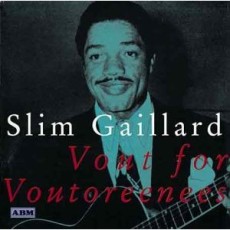
Bulee “Slim” Gaillard was born on January 4, 1916 in Santa Clara, Cuba. His childhood in Cuba was spent cutting sugarcane and picking bananas, as well as occasionally going to sea with his father. At age 12, he made his way to America settling in Detroit. A move to New York City in the late 1930s saw Gaillard’s rise to prominence as part of Slim & Slam, a jazz novelty act he formed with bassist Slam Stewart. Their hits included “Flat Foot Floogie”, “Cement Mixer” and the hipster anthem, “The Groove Juice Special”.
Gaillard’s appeal was that he presented a hip style with broad appeal, was a master improviser whose stream of consciousness vocals ranged far afield from the original lyrics along with wild interpolations of nonsense syllables. Gaillard could play several instruments, such as guitar and piano and always managed to turn the performance from hip jazz to comedy.
In the late forties and early fifties, Gaillard frequently opened at Birdland for such greats as Charlie Parker, Flip Phillips and Coleman Hawkins. Slim composed theme songs for radio shows, appeared in several shows in the 1960s and 1970s, such as Charlie’s Angels, Mission Impossible, Along Came Bronson and Roots: The Next Generation. By the early 1980s he was touring the European jazz festival circuit, playing with such musicians as Arnett Cobb.
Slim Gaillard, singer, songwriter, pianist, guitarist and actor noted for his vocalese, spoke 9 languages including “Vout”, a language he constructed out of word play and created a dictionary, passed away on February 26, 1991 in London, England at the age of 75.
Daily Dose Of Jazz…
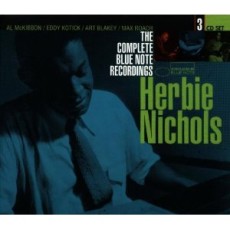
Herbie Nichols was born in San Juan Hill, Manhattan, New York City on January 3, 1919. His first known work was with the Royal Barons in 1937, a few years later performing at Minton’s Playhouse but he did not find a very happy experience due to a competitive atmosphere that did not suit his personality.
Nichols was drafted into the Infantry in 1941. After the war he worked in various setting, beginning to achieve some recognition when Mary Lou Williams recorded some of his songs in 1952. He befriended Thelonious Monk and from about 1947 persisted in trying to persuade Alfred Lion at Blue Note to sign him. Lion finally acquiesced and between 1955 and 1956 Herbie recorded less than half his 170 compositions that produced three albums, with other tracks from these sessions not being issued until the 1980s.
As a player he was capable not only of dark lyricism but also of writing melodies so harmonically adventurous that placed his music in a rhythmic league of its own. Nichols was indeed fortunate in the drummers with whom he worked Art Blakey and Max Roach. As a composer he penned such notable standards as “Serenade” that had lyrics added as well as “Lady Sings The Blues” that became synonymous with Billie Holiday, to which she set lyrics and adopted the title for her autobiography.
Jazz pianist and composer Herbie Nichols died from leukemia at the age of 44 on April 12, 1963 in New York City. Although he lived most of his life in relative obscurity, he is now highly regarded by many musicians and critics.