

Daily Dose Of Jazz…
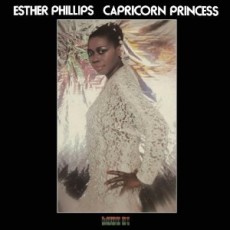
Esther Phillips was born Esther Mae Jones on December 23, 1935 in Galveston, Texas. He parents divorced when she was young and she shared her childhood between Houston and Los Angeles and brought up singing in church. At age fourteen she entered and won a local L.A. amateur talent contest that culminated in a recording with Johnny Otis for Modern Records and added her to his traveling revue, billed as Little Esther Phillips, a name she reportedly took from a gas station sign.
Her first hit record was “Double Crossing Blues” in 1950 for Savoy Records and after several hit records with Savoy that went to number one or hit the Billboard charts in the top ten, she was counted as one of the very few female artists that enjoyed such success in their debut year. She left Otis and Savoy for Federal Records but just a quickly as the hits came, they stopped, in part because she no longer worked with Otis and her increasing drug use that had her addicted by the middle of the decade.
By 1954, she was back home in Houston recuperating with her father, working small nightclubs around the South, punctuated by periodic hospital stays in Lexington, Kentucky, stemming from her addiction. In 1962, Kenny Rogers re-discovered her while singing at a Houston club and got her signed to his brother Lenox label, which assisted in her comeback. From Lenox she went to Atlantic Records, dropped “Little” from her name, and covered the Beatles’ “And I Love Him” and they flew her to the UK for her first overseas performance.
With the ushering in of 1972 she realized one of her biggest with her first album “From A Whisper To A Scream” for Creed Taylor’s Kudu Records with an account of drug use on the lead track in Gil Scott-Heron’s “Home Is Where The Hatred Is”. The song went on to be nominated for a Grammy Award but when Phillips lost to Aretha Franklin, the latter presented the trophy to Phillips, saying she should have won it instead.
While at Kudu she scored her biggest hit single with a disco-style update single of Dinah Washington’s “What A Difference A Day Makes” that reached the U.S. Top 20 and the UK Top 10. The subsequent album had her working with the Brecker Brothers, Joe Beck, David Sanborn, Steve Khan and Don Grolnick. She continued to record and perform throughout the 1970s and early 1980s, completing a total of seven albums on Kudu and four with Mercury Records.
At age 48, Esther Phillips died in Carson, California on August 7, 1984 from kidney and liver failure due to her on-going battle she waged with heroin dependency.
More Posts: vocal
Daily Dose Of Jazz…
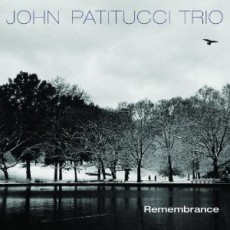
John Patitucci was born December 22, 1959 in Brooklyn, New York and began playing electric bass at ten, composing and performing at 12, playing the acoustic bass at 15 and a year later the piano. A family move to the West Coast allowed him to study classical music at San Francisco State and Long Beach State universities.
By 1980 John’s career moved him to Los Angeles where he began a successful career as a studio musician and jazz artist. His long list of credits include twelve albums as a leader and a sideman for the likes of B.B. King, Chick Corea, Joanne Brackeen, Wayne Shorter, Herbie Hancock, Dizzy Gillespie, George Benson, Natalie Cole, Queen Latifah, Sting, Stan Getz, Astrud and Joao Gilberto, Henry Mancini, Danilo Perez, Wynton Marsalis, McCoy Tyner and the list goes on and on.
In 1986 he was voted by the National Academy of Recording Arts and Sciences as the Most Valuable Player on acoustic bass, he has won two Grammy Awards, he has reached number one on the Billboard Jazz charts and has won the reader’s polls: Best Jazz Bassist in Guitar Player Magazine’s and Best Jazz Bassist in Bass Player Magazine’s.
Patitucci has taught at music schools in several countries, was the Artistic Director of the Bass Collective, a school for bassists in New York City, is involved with the Thelonious Monk Institute of Jazz, the Betty Carter Jazz Ahead program and was appointed Associate Professor of Jazz Studies at City College of New York.

More Posts: bass
Daily Dose Of Jazz…
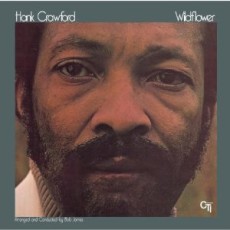
Hank Crawford was born Bennie Ross Crawford, Jr. on December 21, 1934 in Memphis, Tennessee. He began formal piano studies at age nine and was soon playing for his church choir. His father had brought an alto saxophone home from the service and when Crawford entered Manassas High School, he took it up in order to join the band, hanging out with George Coleman, Booker Little, Harold Mabern and Frank Strozier. At eighteen he appeared on an early 1952 Memphis recording for B. B. King playing alongside Ben Branch and Ike Turner.
In 1958 Crawford attended Tennessee State University, majored in music studying theory and composition, played alto and baritone saxophone in the Tennessee State Jazz Collegians and led his own rock ‘n’ roll quartet, “Little Hank and the Rhythm Kings”. It was during this period that he met Ray Charles and got his nickname “Hank” because he looked and sounded like local legendary saxophonist Hank O’Day.
Charles hired Crawford originally as a baritone saxophonist but he switched to alto in ’59 and became musical director until ’63 when he left to form his own septet, having already established himself with several albums on Atlantic Records, recording a dozen albums between 1960 and 1970. He also arranged for Etta James, Lou Rawls and others, although much of his career has been in R&B. However, in the Seventies, Hank had several successes on the jazz and pop charts.
In 1983 a move to Milestone Records gave him the opportunity to become a premier arranger, soloist, and composer, writing for small bands—that include guitarist Melvin Sparks, Dr. John and organist Jimmy McGriff, the later with whom he toured extensively and co-led dates for Milestone’s “Soul Survivor”, Steppin’ Up”, “On The Blue Side” and Road Tested”. The new century found Crawford pursuing a more mainstream jazz sound with the “World of Hank Crawford”, covering Ellington and Tadd Dameron compositions.
Hank Crawford, alto and baritone saxophonist in the hard bop, R&B, jazz-funk and soul jazz genres, credits Charlie Parker, Louis Jordan, Earl Bostic and Johnny Hodges as early influences. His piercing full-bodied signature sanctified church sound, easily recognizable, will live on through his music since his passing on January 29, 2009 at 74.
Daily Dose Of Jazz…
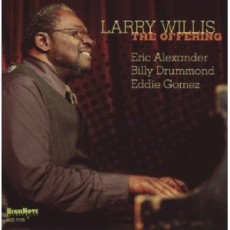
Lawrence Elliott Willis was born December 20, 1942 in Harlem, New York. He first got into music as a voice major at New York’s High School of Music and Art for gifted students and in his senior year he recorded an opera with the Music and Arts Chorale Ensemble under the direction of Leonard Bernstein.
Due to the barriers presented to Blacks in finding work in the classical arena, Willis changed directions, replacing voice with piano and concentrating on jazz. He taught himself to play piano and by the end of the winter was playing in a jazz trio with two of his classmates, Al Foster and Eddie Gomez.
He then entered and studied music theory at the Manhattan School of Music, was heard by Hugh Masekela and sent to John Mehegan for his first piano lessons ever, and by 19 began gigging regularly with altoist Jackie McLean and after graduating made his jazz recording debut on McLean’s “Right Now!” for Blue Note that featured two of Larry’s compositions.
Throughout his illustrious career pianist Larry Willis has performed and recorded as a leader and sideman on more than 300 recordings of bebop, avant-garde, jazz-fusion and rock with a wide range of musicians, Dizzy Gillespie, Lee Morgan, Carmen McRae, Clifford Jordan, Art Taylor, Shirley Horn, Stan Getz, Cannonball Adderley, Art Blakey, Woody Shaw and a stint of seven years beginning in 1972 as the keyboardist for Blood, Sweat & Tears.
He has composed and arranged for orchestras, big bands and symphonies for the Brooklyn Symphony with the Grammy-nominated Fort Apache Band, Roy Hargrove’s Grammy-winning Crisol Band, Vanessa Rubin and Joe Ford among others. He received the Don Redman award in 2011, and the Benny Golson Jazz Master Award at Howard University in 2012. He is currently still recording and touring around the world.
Daily Dose Of Jazz…
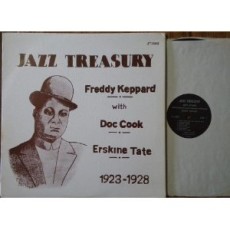
Erskine Tate born on December 19, 1895 in Memphis, Tennessee played violin and studied music at Lane College in Jackson, Tennessee. He moved to Chicago in 1912, studied at the American Conservatory and took his first professional gig at 17. By 1918 he was an early figure in the jazz scene and leading his band the Vendome Orchestra providing music during intermission and for the silent films that were shown in the Vendome Theatre at 31st and State streets.
The band was originally a nine-piece outfit but by the mid 20s had grown to 15. Among the members were Louis Armstrong, Freddie Keppard, Stomp Evans, Buster Bailey, Fats Waller and Teddy Wilson. They recorded during the period for Okeh and Vocalion Record labels.
By 1928 Erskine left the orchestra and led a band at the Metropolitan Theatre and then the Michigan Theatre. He had a long residency at the Cotton Club and continued to lead orchestras and play for dance marathons throughout the 1930s. In 1945 he retired from active performance, opened his own studio, began teaching music and became one of the city’s top instructors throughout the 50s and 60s.
Violinist, composer, conductor and bandleader Erskine Tate passed away on December 17, 1975 in Chicago, Illinois.
More Posts: bandleader,composer,conductor,violin