

Daily Dose Of Jazz…
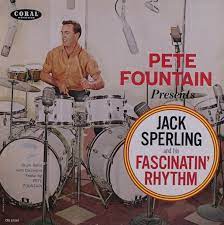
Jack Sperling was born on August 17, 1922 in Trenton, New Jersey. In 1941 he played with trumpeter Bunny Berigan. After World War II, he and Henry Mancini joined the Glenn Miller band when it was led by Tex Beneke. Drawing attention with his performance on the song St. Louis Blues in 1948, he then joined Les Brown and His Band of Renown, which played regularly for the Bob Hope radio program.
Sperling and other members of Brown’s band joined Dave Pell’s octet in 1953, recorded with the octet on Plays Irving Berlin and The Original Reunion of the Glenn Miller Orchestra. From 1954 to 1957 he was a member of Bob Crosby’s Bobcats. During the rest of his career, he worked in bands led by Charlie Barnet, Page Cavanaugh, Pete Fountain, and Benny Goodman.
He was among the studio musicians who accompanied Henry Mancini on the television show Peter Gunn. Jack recorded with him on the film soundtracks Charade and Days of Wine and Roses. He was the featured solo drummer on the theme song for the TV show Hogan’s Heroes and from 1959 to 1972 he was under contract with the NBC Orchestra. He worked on The Tonight Show Band, Rowan & Martin’s Laugh-In, and TV variety shows hosted by Bob Hope, Dean Martin, and Andy Williams.
In the music world, he recorded with Rosemary Clooney, Bobby Darin, Sammy Davis Jr., Doris Day, Ella Fitzgerald, The Four Freshmen, Lena Horne, Peggy Lee, Elvis Presley, Frank Sinatra, and Mel Tormé.
Drummer Jack Sperling, who was a big band and studio musician, transitioned on February 26, 2004.

More Posts: drums,history,instrumental,jazz,music
Daily Dose Of Jazz…
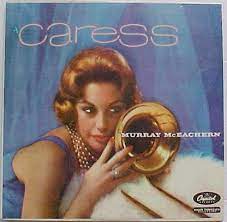
Murray McEachern was born in Toronto, Ontario, Canada on August 16, 1915 and studied the violin at the Toronto Conservatory of Music as a boy, and played his first concert recital at Massey Hall at age 12. As a teenager he studied both the saxophone and clarinet, playing with Lucio Agostini and also appearing on CRBC with Percy Faith. Over time he became proficient on several instruments, including the trombone, bass and trumpet.
In 1936, he went to Chicago, Illinois in search of work and got a break as soloist on trombone for Benny Goodman’s big band. He also worked with the Jack Hylton orchestra and then with the Casa Loma Orchestra led by Glen Gray from 1937-41. In 1941, McEachern joined the Paul Whiteman orchestra and shortly after began entertaining U.S. troops during World War II. Two years after the end of the war he went to work with the Phil Moore orchestra.
Murray did studio work in his later career for Hollywood films, including solo performances in The Glenn Miller Story, Paris Blues and The Benny Goodman Story. In the 1960s he was in the Morey Amsterdam Orchestra for the Morey Amsterdam Show on Television Station KTLA in Los Angeles.
A successful recording artist as leader, McEachern toured Europe in 1972 and briefly worked with the Duke Ellington orchestra the following year. He was owner/director of the Tommy Dorsey orchestra from 1974-77.
Trombonist and alto saxophonist Murray McEachern transitioned on April 28, 1982.
More Posts: bandleader,history,instrumental,jazz,music,saxophone,trombone

Daily Dose Of Jazz…
George Morrow was born on August 15, 1925 in Pasadena, California. After leaving the military he played with Charlie Parker, Sonny Criss, Teddy Edwards, Hampton Hawes and other musicians who were in Los Anegles, California. He then spent five years from 1948 to 1953 in San Francisco, California often appearing at the Bop City jazz club and working with Dexter Gordon, Wardell Gray, Billie Holiday and Sonny Clark, among others.
During the mid~1950s he recorded five albums with Sonny Rollins and at the end of the decade two with Sonny Stitt. He had been free-lancing around San Francisco clubs when Max Roach and Clifford Brown hired him to play with them after having rejected two other bassists. He appeared on all of the studio albums made by the Clifford Brown-Max Roach Quintet.
After the band dissolved due to the deaths of Brown and Richie Powell in a car accident, Morrow continued recording with Max Roach’s band. He also worked with Anita O’Day in the 1970s before joining the Disney World house band in 1976.
Bassist George Morrow, who never led his own recording date, transitioned on May 26, 1992 in Orlando, Florida.
More Posts: bass,history,instrumental,jazz,music
Daily Dose Of Jazz…
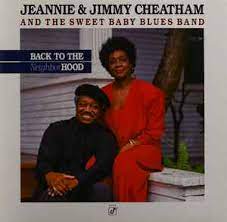
Jeannie Cheatham was born Jean E. Evans on August 14, 1927 and grew up in Akron, Ohio. At the age of five, she started having lessons on her aunt’s newly-acquired piano, which was soon moved to her home when it transpired that she had a talent for music her aunt lacked. Not long after, she began playing for services at the church her family attended. Throughout her school years, her piano teacher also took her to play at weddings and social events, as well as giving recitals
She first played jazz music at age 14 when she was requested to join a local 15-piece rehearsal orchestra. Still in high school Jeannie began playing in smaller groups and found herself in demand professionally as most younger male musicians were drafted into the US Army during World War II. In 1944, she was accepted as a student at the University of Akron but was unable to complete more than one year for financial reasons.
She met and married Jimmy Cheatham, with whom she formed the Sweet Baby Blues Band in 1984. Her autobiography, Meet Me With Your Black Drawers On: My Life In Music, was published in 2006, the same year they received a lifetime achievement award at the San Diego Music Awards, and in 2022, were inducted into the San Diego Music Hall of Fame.
It was noted by Los Angeles Times contributor Dirk Sutro that Jeannie Cheatham remains one of the under-appreciated greats of jazz and blues, both for her spare, tasteful piano playing, which ranges from boogie-woogie to Monk‑ish surprises, and for her earthy but sensuous voice.
More Posts: bandleader,history,instrumental,jazz,music,piano,vocal
Requisites
SURF RIDE | ART PEPPER
Saxophonist Art Pepper made his debut recording session of Surf Ride in Los Angeles, California on March 4, 1952, when he recorded tracks 4-6 on the album. Subsequent recording sessions took place on March 29, 1953 when he recorded tracks 1-3 and then on August 25, 1954 recording tracks 7-12. The three sessions resulted in the completion of the twelve takes that ultimately made it to the album.
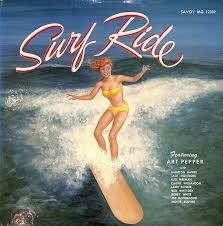
The album was produced by Ozzie Cadena and originally released as a 12 inch LP on the Savoy label in 1956. The liner notes were written by Yasukuni Terashima and the cover offers a clear though slightly too wholesome California motif to be considered for an addition to the cheesy Fifties Batchelor Collection of “girls on covers “, though the redhead in bikini helps.
TRACKLIST | 37:25 All compositions by Art Pepper except where noted.-
- Tickle Toe (Lester Young) – 2:55
- Chili Pepper – 3:00
- Susie the Poodle – 3:14
- Brown Gold – 2:26
- Holiday Flight – 3:1
- Surf Ride – 2:54
- Straight Life – 2:52
- Cinnamon – 3:11
- Thyme Time – 3:30
- The Way You Look Tonight (Dorothy Fields, Jerome Kern) – 3:48
- Nutmeg – 3:15
- Art’s Oregano – 3:08
- Art Pepper – alto saxophone
- Jack Montrose – tenor saxophone (tracks 7-12)
- Russ Freeman (tracks 1-3), Hampton Hawes (tracks 4-6), Claude Williamson (tracks 7-12) – piano
- Monty Budwig (tracks 7-12), Joe Mondragon (tracks 4-6), Bob Whitlock (tracks 1-3) – bass
- Larry Bunker (tracks 4-12), Bobby White (tracks 1-3) – drums

More Posts: choice,classic,collectible,collector,history,instrumental,jazz,music,saxophone