

Daily Dose Of jazz…
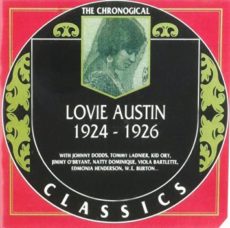
Lovie Austin was born Cora Calhoun on September 19, 1887 in Chattanooga, Tennessee and grew up with eight brothers and sisters. She studied music theory at Roger Williams University and Knoxville College which was uncommon for African American woman and jazz musicians alike during the time.
In 1923, Lovie Austin decided to make Chicago, Illinois her home, living and working there for the rest of her life. She was often seen elegantly dressed, racing around town in her Stutz Bearcat with leopard skin upholstery. Her early career was in vaudeville, playing piano and performing in variety acts. Accompanying blues singers was Lovie’s specialty, and can be heard on recordings by Ma Rainey – Moonshine Blues, Ida Cox – Wild Women Don’t Have the Blues, Ethel Waters – Craving Blues, and Alberta Hunter – Sad ‘n’ Lonely Blues.
She led her own band, the Blues Serenaders, which usually included trumpeters Tommy Ladnier, Bob Shoffner, Natty Dominique, or Shirley Clay on cornet, Kid Ory or Albert Wynn on trombone, and Jimmy O’Bryant or Johnny Dodds on clarinet, along with banjo and occasional drums. The Blues Serenaders developed their own unique sound within the jazz genre, straying away from the typical jazz band paradigm.
Austin worked with many other top jazz musicians of the 1920s, including Louis Armstrong. They worked on a song together that was called Heebie Jeebies. Her skills as songwriter can be heard in the classic Down Hearted Blues, co-written with Alberta Hunter. Singer Bessie Smith turned the song into a hit in 1923. She was also a session musician for Paramount Records and recorded with the Blues Serenaders in 1923.
When the classic blues craze waned in the early 1930s, Lovie became the musical director for the Monogram Theater in Chicago where all the T.O.B.A. acts played. She worked there for 20 years and during wartime, she was reported to be working as a security guard at a defense plant to support herself.
After World War II she became a pianist at Jimmy Payne’s Dancing School at Penthouse Studios, and performed and recorded occasionally.
In 1961, nearly forty years after participating in her first recordings, Lovie recorded Alberta Hunter with Lovie Austin’s Blues Serenaders, as part of Riverside Records’ “Living Legends” series, produced by radio WHAT-FM disc jockey and jazz critic Chris Albertson. Austin’s songs included Sweet Georgia Brown, C Jam Blues and Gallon Stomp.
Pianist Lovie Austin, who is cited as Mary Lou Williams greatest influence and one of the best pianists during the Harlem Renaissance, retired in 1962 and passed away on July 10, 1972 in Chicago.

More Posts: piano

Daily Dose Of Jazz…
Teddi King was born Theodora King on September 18, 1929 in Boston, Massachusetts. She won a singing competition hosted by Dinah Shore at Boston’s Tributary Theatre and later began performing in a touring revue involved with cheering up the military troops in the lull between the Second World War and the Korean conflict.
Improving her vocal and piano technique during this time, she first recorded with Nat Pierce in 1949, later recorded with the Beryl Booker Trio and three albums with several other small groups recorded between 1954 and 1955 for the Storyville label. She then toured with George Shearing for two years in the summer of 1952, and for a time was managed by George Wein. King went on to perform for a time in Las Vegas.
Teddi landed a contract with RCA and recorded three albums for the label, beginning with 1956’s Bidin’ My Time. She also had some minor chart success with the singles Mr. Wonderful, Married I Can Always Get and Say It Isn’t So. Her critically acclaimed 1959 album All the Kings’ Songs found her interpreting the signature songs of contemporary male singers like Frank Sinatra and Nat King Cole.
In the 1960s, she opened the Playboy Club, where she often performed, however, after developing lupus, she managed to make a brief comeback with a 1977 album featuring Dave McKenna. She recorded two more albums for Audiophile that were released posthumously. She also recorded for the Coral, Inner City and Flare labels as well as having a compilation released on the Baldwin Street Music label. Jazz and pop standard vocalist Teddi King, who was influenced by Lee Wiley, Mildred Bailey and Mabel Mercer, passed away from lupus on November 18, 1977.

Uplift Someone’s World

More Posts: vocal

Daily Dose Of Jazz…
Leon Merian was born Vahan Leon Megerdichian on September 17, 1923 in Braintree, Massachusetts to Armenian immigrants and raised in Boston’s struggling Roxbury district. Showing an early interest in music, his first trumpet was a Christmas present at age 10 that led to taking lessons and by sixteen he was playing with the school band. Before long he was sitting in with musicians in local Boston clubs while still in high school in the late Thirties. He passed on a physics scholarship to pursue his music.
Early in his career, a record producer persuaded him to legally shorten his last name to Merian and he had already stopped using his first name as a child to avoid being teased. One of the first white musicians to play with a black band in the 1940s, he was hired by Lucky Millinder in 1942 at the age of 19 Charlie Shavers and Sonny Stitt and Gene Krupa and as the band toured the South got his initial introduction to racial discrimination. Leon recorded and performed with Frank Sinatra, Ella Fitzgerald, Elvis Presley, Dizzy Gillespie and other notable singers and jazz bands during a career of big bands, recording studios, major network orchestras, Broadway orchestra pits and nightclubs.
Merian played on the soundtracks of the Oscar-winning movies The Godfather and Ben-Hur, performed in Cole Porter’s Broadway musical Silk Stockings starring Rosalind Russell, and worked with the studio orchestras at ABC, CBS and NBC.
After serving as department chairman of foreign languages at New Rochelle High School in New York and at Endicott College in Beverly, Massachusetts, Merian went into the Milton, Massachusetts public schools, where he was chairman of the foreign languages department until he retired in 1982 to concentrate on music. Moving south to Florida in the late Eighties he led a 14-piece Leon Merian Big Band and his smaller Leon Merian Quintet in clubs and concert performing one his last at the age of 80.
Trumpeter, bandleader and educator Leon Merian, whose career spanned some sixty years, passed away on August 15, 2007 due to complications from diabetes.
Jazz Is Global – Share
More Posts: trumpet
Daily Dose Of Jazz…
Lisle Arthur Atkinson was born on September 16, 1940 in New York City and his mother played piano, his father played bass. He began his music lessons on the violin and later switched to bass, attended the High School of Music and Art and the Manhattan School of Music .
Lisle began his career working with Freddy Cole, from 1959 to 1961. From 1962 to 1966 he accompanied Nina Simone and contributed to several of their albums with such Broadway Blues Ballads . The late Sixties saw him performing alongside Norman Simmons and Al Harewood backing Betty Carter and joined with her in 1970 at the Village Vanguard. He has performed and recorded with Michael Fleming, Milt Hinton, Richard Davis, Ron Carter, Sam Jones and with Bill Lee’s New York Bass Violin Choir.
In the early 1970s he worked with Stanley Turrentine, Wynton Kelly, Billy Taylor, Kenny Burrell, Dakota Staton, Frank Foster, Horace Parlan, Grady Tate, Howard McGhee, Johnny Hartman and Joe Williams.
In 1976 he played with Walt Dickerson and Andrew Cyrille. In the early 1980s he worked with Charles Sullivan, Nancy Wilson, Eddie Harris and played 1985 in the formation of Neo Brass Ensemble. In the second half of the 80s he played with Benny Carter in which Grover Mitchell Big Band, with Lee Konitz and in the quintet of Ernie Wilkins and Joe Newman . In 1995 he worked in a trio with Cyrille and James Newton on Good to Go with a Tribute to Bu.
Since 1971, Atkinson taught in the Jazz Mobile project. He also participated in recordings of Richard Wyands, George Coleman , Helen Humes and Hal Singer. In 1979 he recorded as a leader on Storyville Records album Bass Contrabass with Wyands and Al Harewood. Bassist Lisle Atkinson continued to perform and record until he passed away on March 25, 2019, at the age of 78.
Sponsored By

Voices From The Community
More Posts: bass
Daily Dose Of Jazz…
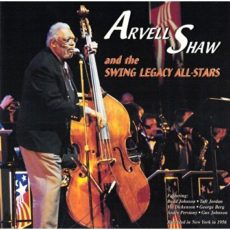
Arvell Shaw was born on September 15, 1923 in St. Louis, Missouri and learned to play tuba in high school, but switched to bass soon after. In 1942 he worked with Fate Marable on the Mississippi riverboats, then served in the Navy from 1942 to 1945.
After his discharge Arvell played with Louis Armstrong’s last big band, from 1945 to 1947. He and Sid Catlettthen joined the Louis Armstrong All-Stars until 1950, when he left to study music. He returned to play with Armstrong from 1952 to 1956, and performed in the 1956 musical High Society.
Following this he worked at CBS with Russ Case, did a stint in the Teddy Wilson Trio, recorded with Red Allen in 1957 and played with Benny Goodman at the 1958 Brussels World’s Fair. After a few years living and performing in Europe, he played again with Goodman on a tour of Central America in 1962. From 1962–64 Shaw played again with Armstrong, and occasionally accompanied him through the end of the 1960s.
After the Sixties he mostly freelanced in New York and kept playing until his death. He recorded only once as a leader, a live concert from 1991 of his Satchmo Legacy Band. Double-bassist Arvell Shaw, who recorded with Armstrong and Wilson, passed away on December 5, 2002 in Roosevelt, New York.
Give A Gift Of Jazz – Share
More Posts: bass