

Daily Dose Of Jazz…
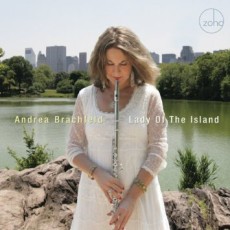
Andrea Brachfeld was born on May 3, 1955 and grew up in a household where it was mandatory to take the piano. She began her study at age six for seven years but at age 10 she discovered she could I found out of class if she took flute. Adding the instrument to her lessons she entered the High School of Music and Art in 1969, majoring in the flute. There she met and played with, Noel Pointer, Nat Adderley Jr., Dave Valentín, as well as Angie Bofill, Kenny Kirkland, Fred Hersch and Rodney Jones among many other musicians. But it was Noel who taught her how to write music down.
She went on to attend the Manhattan School of Music and study with Hubert Laws, Jimmy Heath, George Coleman, and Mike Longo, who helped her develop her own improvisational style. She began her professional career as a musician at age 16, composing music for the quartet she put together. Her breakthrough moment came in performance as the flutist for the popular Latin band Charanga ’76, catapulted her into Salsa history and fame as the first female flutist to play this music in the United States.
Andrea has performed and recorded jazz, Latin jazz, Charanga, funk, country western, and devotional music. She received the Louis Armstrong Award, Chico O’Farrill Lifetime Achievement Award, the Pionero Award, and the Tribute to the Charanga Flutes. She has six CDs out as a leader, another 17 as a side woman and is a member of the Wallace Roney, “Universe” Orchestra playing Wayne Shorter’s long lost music originally written for Miles Davis.
She has presented her flute and composition workshops and has performed with Hubert Laws, Rufus Reid, Winard Harper, Paquito D’Rivera, Tito Puente, Ray Barretto, Nestor Torres, Wallace Roney, Dave Valentín, Wycliffe Gordon, Hilton Ruiz, Steve Turre and Wayne Wallace. Flutist, piccolo player, composer and educator Andrea Brachfeld continues to perform and record.

Dose A Day – Blues Away
More Posts: flute
Daily Dose Of Jazz..
Matso Limtiaco was born May 2, 1963 and majored in music education as an undergraduate. After a brief period teaching public school music, he earned his MA in music theory/composition at Washington State University in 1990. After spending six years teaching music at all levels from junior high band to university jazz ensembles, arranging music for groups he led and for a variety of local performers.
Limtiaco gained his first notoriety as a marching band arranger for Washington State University, and then for the University of Washington. Matso quit teaching music full-time and is active as a freelance composer, arranger, and performer in the Seattle area. His baritone saxophone work has anchored the Emerald City Jazz Orchestra saxophone section since 1994, and the band’s two recordings “Alive and Swinging” and “Come Rain or Come Shine” feature his charts.
After spending several years in music education, he left teaching and now works as an independent composer/arranger, with a “day job” as a technical writer for a large manufacturing company. Among jazz arrangers and composers Matso is not the most well-known nor the most prolific but he rapidly established himself as one of the most polished and professional writers anywhere.
Inspire A Young Mind
Daily Dose Of Jazz…
Ambrose Akinmusire was born May 1, 1982 and raised in Oakland, California. A member of the Berkeley High School Jazz Ensemble, he caught the attention of saxophonist Steve Coleman who was visiting the school to give a workshop. Coleman hired him as a member of his Five Elements band for a European tour and the young trumpeter was also a member of the Monterey Jazz Festival’s Next Generation Jazz Orchestra.
Ambrose studied at the Manhattan School of Music before returning to the West Coast to obtain a master’s degree at the University of Southern California and attend the Thelonious Monk Institute of Jazz in Los Angeles. In 2007, he won the Thelonious Monk International Jazz Competition, the Carmine Caruso International Jazz Trumpet Solo Competition and released his debut recording Prelude…To Cora on the Fresh Sound New Talent label.
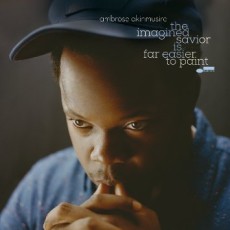
Moving back to New York City he began performing with Vijay Iyer, Aaron Parks, Esperanza Spalding and Jason Moran, taking part in Moran’s innovative multimedia concert event In My Mind: Monk At Town Hall, 1957. It was also during this time that he caught the attention of Bruce Lundvall, President of Blue Note Records. Akinmusire released his sophomore album as a debut on the Blue Note label in 2011 titled When The Heart Emerges Glistening, featuring his quintet of tenor saxophonist Walter Smith III, pianist Gerald Clayton, bassist Harish Raghavan and drummer Justin Brown. His third album, The Imagined Savior Is Far Easier To Paint was released in 2014.
Trumpeter Ambrose Akinmusire has won the North Sea Jazz festival Paul Acket award and has worked with Kendrick Lamar, Aaron Parks, Sara Gazarek, Alan Pasqua, Mike Ladd, Josh Roseman, David Binney, John Escreet, Le Boeuf Brothers, Vince Mendoza, Jack DeJohnette and Dana Stephens. He continues the tradition of performing and recording.
Inspire A Young Mind
More Posts: trumpet
Daily Dose Of Jazz…
Abdul Wadud was born Ronald DeVaughn on April 30, 1947 in Cleveland, Ohio. The son of R&B singer Raheem DeVaughn, he took up the cello and concentrated solely on the instrument from the age of nine, and never decided to double on bass.
Abdul studied at Youngstown State and Oberlin in the late ’60s and early ’70s. He played in the Black Unity Trio at Oberlin, met Julius Hemphill and the two subsequently worked together well through the Eighties. He has performed with the New Jersey Symphony Orchestra in the ’70s, earned his master’s degree in 1972, and then in 1976 played with Arthur Blythe for the first time and has maintain a working relationship.
He also worked and recorded with Frank Lowe, George Lewis, Oliver Lake, Sam Rivers, Cecil Taylor, David Murray, Chico Freeman, Anthony Davis and James Newton. Along with Newton and Davis they performed as a trio and were also a part of the octet Episteme from 1982 to 1984. Abdul recorded and in a duo with Jenkins for Red in the ’70s and as a leader for Bishara and Gramavision in the ’70s and ’80s. He has been a member of the Black Swan Quartet, Human Arts Ensemble, Julius Hemphill Quartet and Muhal Richard Abrams Orchestra.
His plucking and bowed solos have been featured in jazz and symphonic/classical settings, he is easily considered the finest cellist to emerge from the ’60s and ’70s generation, playing in both jazz and classical settings. Cellist Abdul Wadud transitioned on August 10, 2022 in Cleveland, Ohio at the age of 75.
Dose A Day – Blues Away
More Posts: cello

Daily Dose Of Jazz…
George Rufus Adams was born on April 29, 1940 in Covington, Georgia and his musical style is deeply rooted in the blues and in primarily that of African-American popular music. The tenor’s greatest influences seem to have been Rahsaan Roland Kirk and the adventurous edginess of John Coltrane and Albert Ayler.
George played with tremendous intensity and passion, as well as lyricism and subtlety. At times he bent over backwards when playing, almost ending up on his back. He and Don Pullen shared a musical vision and their quartet straddled the range from R&B to the avant-garde.
One of Adams’ last recordings was America for Blue Note Records consisting of classic American songs like Tennessee Waltz, You Are My Sunshine and Take Me Out To The Ballgame as well as a few original songs that articulate his positive view of his country and the gifts it had given him. It also includes The Star Spangled Banner and America The Beautiful.
Tenor saxophonist, flautist and bass clarinetist George Adams, best known for his work with Charles Mingus, Gil Evans, Roy Haynes, and in the quartet he co-led with pianist Don Pullen, passed away on November 14, 1992 in New York City.
He was also known for his idiosyncratic singing he left for posterity two-dozen albums as a leader and another 25 as a sideman over the course of his sort career.
Take A Dose On The Road