

Daily Dose Of Jazz…
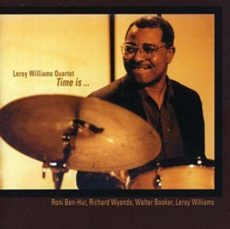
Leroy Williams was born in Chicago, Illinois on February 3, 1939 and first began playing drums as a teenager in the 1950s. From 1959 to the middle of the 1960s he played with Judy Roberts, and following this stint he moved to New York City and played with Booker Ervin in 1967.
1968 found him playing with Sonny Rollins, Archie Shepp, and Clifford Jordan; in 1969 he first began playing and collaboration with Barry Harris. 1970 saw him playing with Hank Mobley, Wilbur Ware, and Thelonious Monk, the latter of which he went with on a tour of Japan.
Later in the 1970s he played and recorded with Hank Mobley, Yusef Lateef, Ray Bryant, Charles McPherson, Stan Getz, Andrew Hill, Sonny Stitt, Junior Cook, Al Cohn, Buddy Tate, Ted Dunbar, Slide Hampton, Red Rodney and Bob Wilber, among others.
In the 1980s Williams played with Talk Talk, Level 42, Art Davis, Barry Harris, Tommy Flanagan, Steve Turre, and recorded with Pepper Adams, Bill Hardman. In the 1990s he performed and recorded with Frank Morgan, with Anthony Braxton, Lee Konitz, Ralph Lalama, and Pete Malinverni. Most recently, he was a member of El Mollenium with Roni Ben-Hur, Bertha Hope, and Walter Booker.
He was a member of the cast in the music documentary Bird Now and played one of the Angels of Mercy in the Steve Martin film spoof Leap Of Faith about fake faith healers. At the turn of the decade, Williams was a member of the cooperative band el Mollenium, which also included guitarist Roni Ben-hur, pianist Bertha Hope, and bassist Walter Booker. The band is devoted largely to interpreting the music of the late pianist Elmo Hope. Drummer Leroy Williams continues to be active.
More Posts: bandleader,drums,history,instrumental,jazz,music
Requisites
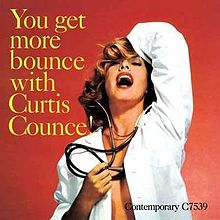
You Get More Bounce with Curtis Counce! is a studio album by bassist Curtis Counce recorded on October 8 & 15, 1956, April 27, May 13 and September 3, 1957, at Contemporary Studios in Los Angeles, California and subsequently released on the Contemporary Records label. The music falls somewhere between hard bop and cool jazz and Counce contributed two original compositions to the recording, Complete and Counceltation. The producer for the sessions was Lester Koenig.
Track Listing | 44:39 All compositions by Curtis Counce except as indicated
- Complete ~ 5:51
- How Deep Is the Ocean? (Irving Berlin) ~ 6:35
- Too Close for Comfort (Jerry Bock, Larry Holofcener, George David Weiss) ~ 5:36
- Mean to Me (Fred E. Ahlert, Roy Turk) ~ 4:31
- Stranger in Paradise (Alexander Borodin, George Forrest, Robert Wright) ~ 7:03
- Counceltation ~ 6:01
- Big Foot (Charlie Parker) ~ 9:02
- Curtis Counce ~ bass
- Jack Sheldon ~ trumpet
- Harold Land ~ tenor saxophone
- Carl Perkins ~ piano
- Frank Butler ~ drums
You Get More Bounce With Curtis Counce | by Eddie Carter
Simply stated, this is a superb album by bassist Curtis Counce and his quintet. Counce’s group was one of the better and more resilient bands on the West Coast during the late fifties. As a cohesive unit, the quintet’s interaction throughout the album delivers handsomely on the seven selections that make up this enjoyable set. The album opener is Counce’s Complete which begins with an impressive discussion between the rhythm section ahead of the melody. How Deep Is The Ocean? Is the ageless 1932 standard by Irving Berlin is a perfect vehicle for an affectionate performance by Land who adapts the song as easily as if it was originally created for jazz with a breathtakingly beautiful tenor sax reading of the melody and lead solo, anchored by Sheldon’s imaginative lyricism in support. Too Close For Comfort, the 1956 popular song by Jerry Bock, Larry Holofcener and George Weiss began life on Broadway in the musical production of Mr. Wonderful that year and has been recorded by an A-list of musicians and vocalists too numerous to mention. The 1929 popular song, Mean To Me by Fred Ahlert and Roy Turk has long been praised by critics as a “head of the class” standard for jazz musicians and vocalists to improvise.
Side Two opens with a bop-flavored midtempo rendition of Stranger In Paradise, the popular song from the 1953 musical, Kismet, written by Alexander Borodin, George Forrest, and Robert Wright. Counceltation, the second original by Counce and the title of the 1972 reissue of this album, due in part to the “original cheesecake cover” which enough people found offensive enough for Contemporary Records to replace it with a photo of the artist and his bass in an outdoor setting. The quintet returns to hard-bop on the album’s closer, Big Foot by Charlie Parker which gives everyone a chance to speak their piece on a lively joyride.
If you already own this album you know what to do. If you’re adding it to your collection, place the record on the turntable, drop the stylus, or slide the cd in the drive, crack open your favorite beverage, sit back and settle in to enjoy seven of the best sounding jazz cuts by The Curtis Counce Group that are spontaneous, soulful swinging at its best!
Source: Jazztracks by Eddie Carter | Excerpt: 1/2019 | atlantaaudioclub.org

More Posts: bass,choice,classic,collectible,collector,history,instrumental,jazz,music
Daily Dose Of Jazz…
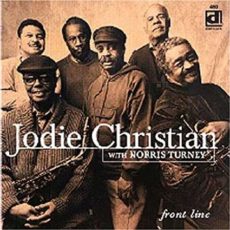
Jodie Christian was born on February 2, 1932 on 44th Street and Prairie Avenue in Chicago, Illinois. His grandfather sold his livestock and sent the family there once he realized the futility of raising a family as share-croppers. His mother was a church pianist, who helped him with music. The young Jodie attended Wendell Phillips High in Chicago. When his mother became director of the church choir, he took over on the piano; sometimes they played organ and piano duets in the church. His father sang and played the blues on the piano in speakeasies and rent parties, but ultimately stopped performing and followed his wife into the church.
Christian was one of the founders of the Association for the Advancement of Creative Musicians (AACM) with pianist Muhal Richard Abrams, drummer Steve McCall, and composer Phil Cohran. He and Abrams were also part of the Experimental Band. He worked at the Jazz Showcase club in Chicago and performed with Eddie Harris, Stan Getz, Dexter Gordon, Gene Ammons, Roscoe Mitchell, Buddy Montgomery, and John Klemmer.
He led his own group and recorded six albums, and another fifteen as a sideman with Von Freeman, Eric Alexander, Gene Amons, Lin Halliday, Les McCann, and Ira Sullivan to name a few. Pianist and bandleader Jodie Christian, noted for bebop and free jazz, passed away on February 13, 2012, aged 80, in Chicago.
More Posts: bandleader,history,instrumental,jazz,music,piano
Daily Dose Of Jazz…
On January 31, 1928 Keshav Sathe was born in Bombay, India where he began his professional career in 1951, working with a local Indian vocalist by the name of Kelkar. He moved to the United Kingdom in 1956 and joined the Asian Music Circle, a pool of London-based Indian musicians run by former political activist Ayana Deva Angadi. He worked with visiting Indian sitarist Bhaskar Chandavarkar, and in 1961 they played together with the harmonica virtuoso Larry Adler. This was his initial contact with jazz.
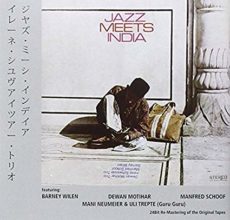
In 1965 Sathe began his Indo Jazz Fusion performances and recordings with John Mayer and Joe Harriott, a musical relationship that lasted until 1970. In 1967 his trio was invited with Diwan Motihar on sitar, and Kasan Thakur playing the tamboura, to join the trio of jazz pianist Irène Schweizer together with Barney Willen, Mani Neumeier, Uli Trepte and Manfred Schoof. They appeared at the Donaueschingen Festival and Berlin Jazz Tage and recorded Jazz Meets India in Villingen, the Black Forest.
In the Seventies, he worked and toured with Julie Felix and Danny Thompson, joined the John Renbourn Group, toured the UK, Europe and the US, and produced records, including A Maid in Bedlam, Enchanted Garden and Live in America.
In the 1980s, Sathe formed a group with Tony Roberts which included the dancer Shobhana Jeyasingh, touring UK and Northern Ireland. With the singer Alisha Sufit and group, he made the record “Magic Carpet”. From 1965 to 1993 he regularly accompanied the late singer/dancer Surya Kumari in recitals and teaching workshops. He appears on Suns of Arqa’s live album Musical Revue which was recorded in Manchester in 1982.
Apart from these, Keshav has made numerous incidental recordings, worked for television, radio, and taught tabla until 2003. Indian tabla player Keshav Sathe, best known for his contributions to the Indo-jazz fusion genre passed away on January 18, 2012.

More Posts: bandleader,history,instrumental,jazz,music,tabla
Daily Dose Of Jazz…
Bernie Leighton, born on January 30, 1921 in West Haven, Connecticut, first played piano professionally at the end of the 1930s. In the early Forties, he played with Bud Freeman, Leo Reisman, Raymond Scott and Benny Goodman before serving in the Army.
Following his discharge, he found work as a studio sideman through the Sixties with Dave Tough, Billie Holiday, Neal Hefti, Goodman again, Artie Shaw, John Serry, Sr., James Moody and Bob Wilber. He toured a year with Tony Bennett from 1972 to 1973.
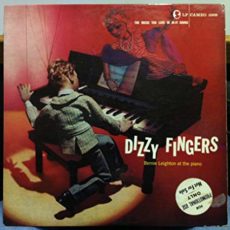
While Leighton was best known as a sideman, he also recorded extensively as a leader, releasing albums on Keynote Records, Mercury Records, Columbia Records, Brunswick, Disneyland and Capitol. He also recorded a tribute to Duke Ellington released in 1974. He has a cameo role in the 1986 film Hannah and Her Sisters. Pianist Bernie Leighton passed away on September 16, 1994 in Coconut Creek, Florida.
More Posts: bandleader,history,instrumental,jazz,music,piano