

Hollywood On 52nd Street
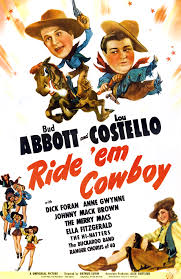
I’ll Remember April is a jazz standard with music written by Gene de Paul, and lyrics by Patricia Johnston and Don Raye. The song made its debut in the 1942 Abbott and Costello comedy Ride ‘Em Cowboy starring the comedy team along with Dick Foran, Anne Gwynne, Johnny Mack Brown, Ella Fitzgerald, Samuel S. Hinds, Douglas Dumbrille, and Morris Ankrum. The film was directed by Arthur Lubin, the song was sung by Foran. Musical numbers were staged by Nick Castle.
The song’s story is about a romantic relationship ending. The lyric uses the seasons of the year metaphorically to illustrate the growth and death of a romance. The lyric also uses the ideas of the hours in a day and the flames of a fire to illustrate a relationship growing stronger and subsequently losing strength.
The Story: The author of best-selling western novels, Bronco Bob Mitchell (Dick Foran), has never set foot in the west. A newspaper article has exposed this fact to his fans, and his image is suffering because of it. He decides to make an appearance at a Long Island charity rodeo to bolster his image. When a steer escapes while he is riding a horse nearby, he is thrown. Not knowing what to do, a cowgirl, Anne Shaw (Anne Gwynne), comes to his rescue and saves his life by bulldogging the steer. Shaw gets hurt, retreats to her father’s dude ranch followed by Mitchell who eventually becomes a decent cowboy.
Cast Fact: This is Ella Fitzgerald’s first screen role, where she plays Ruby, who fills several roles as one of the employees of the ranch. At the opening rodeo, she is dressed as a rodeo clown and comes to Anne’s side when she is hurt. Later in the film, she can be seen removing an apron before singing. Ella sings A-Tisket, A-Tasket on the bus, as the ranch crew drives from the railway station to the ranch. Ruby and the other employees interact playfully during the song.


Daily Dose Of Jazz…
Jan Leder was born in Queens, New York on May 20, 1944 and showed musical talent from an early age, tapping out melodies on the family piano at the age of three. Quickly surpassing her older siblings, at the age of five, she began six years of piano lessons with her classically trained mother. It was not until junior high school that she first picked up the flute. Formally she studied classical flute but in her free time, she taught herself to improvise rock & roll and pop/R&B tunes alongside local guitarists in New York’s Central Park.
At 17 years old Leder began studying with jazz pianist Lennie Tristano, with whom she continued until his death in 1978. Although crediting Tristano with helping her come into her own as a musician, real recognition and commercial success eluded her until the late 1990s. Her first big break came when Buddy Scott and colleagues from Monad records heard her playing in 1994 at The Dockside in Tarrytown, New York. Her tape of a live date with Art Lillard and others at the Five Spot in New York so impressed Scott, that he signed her to a Monad Records contract and released the live recording intact as the CD Passage to Freedom.
Unfortunately, Passage to Freedom, which includes some really nice work by drummer Lillard, pianist Jon Davis, bassist Yosuke Inoue, and guitarist Mark McCarron, was released just as Monad Records met its demise, leaving Leder’s debut effort largely unavailable and unnoticed for close to two years. In 1998 and 1999, exposure via the internet brought her to the attention of a wider audience and earned her very favorable reviews for Passage to Freedom.
1998 saw A-Records vocalist Diane Hubka recorded Leder’s original composition “Thinking of You” on her own debut CD, Haven’t We Met, which was nominated for a Jazz Award in the Best Debut CD category. Her contribution to Hubka’s CD ultimately led to her signing a recording contract with A-Records, a division of the Dutch label, Challenge Records. The following year she released her second CD, Nonchalant, on which she added the talents of bassist Sean Smith, percussionist Daniel Moreno, and vocalists Angela DeNiro, Mary Foster Conklin, and Cleve Douglass to the already strong instrumental talents of Passage to Freedom collaborators Lillard, McCarron, and Davis. Flutist Jan Leder continues to perform and record.

More Posts: bandleader,composer,flute,history,instrumental,jazz,music
Three Wishes
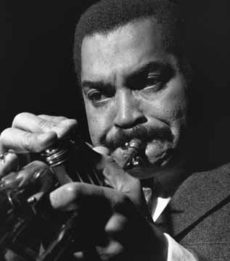
Art Farmer had but one response to Pannonica’s inquiry of three wishes:
-
-
“There is only one: to like myself.”
-
*Excerpt from Three Wishes: An Intimate Look at Jazz Greats ~ Compiled and Photographed by Pannonica de Koenigswarter

More Posts: baroness,history,instrumental,jazz,music,pannonica,three,trumpet,wishes
Daily Dose Of Jazz…
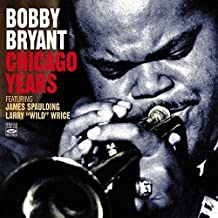
Bobby Bryant was born on May 19, 1934 in Hattiesburg, Mississippi, and played saxophone in his youth before moving on to the trumpet and then the flugelhorn. A move to Chicago, Illinois in 1952, where he studied at the Cosmopolitan School of Music until 1957. Remaining until 1960, he played with Red Saunders, Billy Williams, and other ensembles.
He relocated to New York City in 1960 and then Los Angeles, California in 1961, and became a fixture on the West Coast jazz scene. Leading his own groups, in addition, Bobby played with Vic Damone, Charles Mingus, Oliver Nelson, Gerald Wilson, Frank Capp/Nat Pierce, and the Clayton-Hamilton Jazz Orchestra. He also worked as a studio musician and a music educator.
His most famous solo was in the song “L.O.V.E” recorded with Nat King Cole in 1964. He recorded five albums as a leader, arranged two albums for Peggy Lee in 1969 and Gene Ammons in 1971, and more than two-dozen with Brass Fever, Earth, Wind & Fire, Clare Fischer, Benny Golson, Eddie Harris Richard “Groove” Holmes, Quincy Jones, Stan Kenton, B. B. King, Blue Mitchell, Oliver Nelson, Lalo Schifrin, Horace Silver, The Three Sounds, Gerald Wilson, and Jimmy Witherspoon.
Having sustained health problems which reduced his activity to part-time, trumpeter and flugelhornist Bobby Bryant passed away in Los Angeles of a heart attack at the age of 64 on June 10, 1998.
More Posts: bandleader,flugelhorn,history,instrumental,jazz,music,trumpet
Daily Dose Of Jazz…
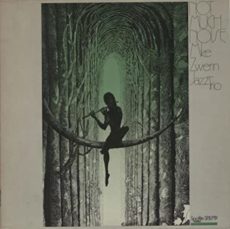
Mike Zwerin was born in New York City on May 18, 1930, where he studied at the High School of Music and Art. He began leading bands in his teens, employing several up-and-coming musicians. He went on to attend the Univerity of Miami and after graduation, he went into his father’s business, the Capitol Steel Corporation.
At the age of 18, while on his summer holidays from the University of Miami, he was spotted by Miles Davis at Minton’s in Harlem, while sitting in with Art Blakey. He was immediately drafted into the rehearsal band for what would become immortalized as Birth of the Cool, while the regular trombonist Kai Winding was indisposed. Also present were Gerry Mulligan, Max Roach, and Lee Konitz. His contribution, in particular, his solo on the track Move, can be heard on The Complete Birth of the Cool. A few muddy recordings exist of radio broadcasts by the band during Zwerin’s time in it, which gave him a lifelong reputation as a jazz musician lucky enough to have been at the cutting edge of a new movement.
Abandoning his musical life for much of the 1950s and after a spell in France, he returned to New York in 1958 and played the trombone in several big bands. Among his other recordings are Getting Xperimental over U, and Mack the Knife, an album of Kurt Weill songs that he produced and arranged himself. He also appears on Archie Shepp’s 1968 album The Magic of Ju-Ju.
Before moving permanently to Europe in 1969, he was a jazz critic for the Village Voice and focusing on journalism, writing for Down Beat, Rolling Stone, and Penthouse before joining the Herald Tribune. Zwerin’s move to London, England in 1969 and then to Paris, France in 1972, would be his home for the rest of his life. Nevertheless, he kept his hand in as a trombonist throughout the 1980s, working with his fellow expatriate Hal Singer and with the guitarist Christian Escoudé. In 1988 he toured with the Charles Mingus Big Band, having played briefly with the Swiss bandleader George Gruntz and played with the French fusion band Telephone.
Zwerin’s lasting claim to fame, however, is, perhaps, not his trombone playing but his book La Tristesse de Saint Louis: Swing Under the Nazis (1985). He spent two years researching it, traveling across France, Austria, Poland and Germany to interview survivors and unearthing the story of how jazz was banned by the Nazis as degenerate music, and yet somehow survived as what Zwerin called a metaphor for freedom.
Cool and progressive jazz trombonist and bass trumpeter Mike Zwerin passed away on April 2, 2010 after a long illness in Paris at the age of 79.
More Posts: bandleader,critic,history,instrumental,jazz,music,trombone,trumpet