

The Jazz Voyager
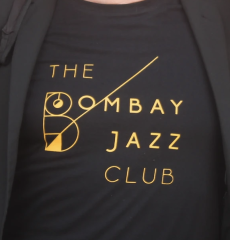
Leaving the African continent for India the next layover for the Jazz Voyager is the Bombay Jazz Club. It is a one of its kind music venture hosting performances at its cozy Bandra space quite regularly. With fairy lights, framed artworks on the back wall and luminous red lamp shades typify this narrow space’s aesthetic.
Founded in 2012 by D. Wood nd Rajesh Punjab, they have consistently produced weekly programming of live jazz at the Bandra Base. They are dedicated to keeping jazz as a central part of the city and country’s music scene. With a self-titled house band performing, in addition to collaborations between Spanish, Japanese and American musicians, they continue to bring extraordinary musicians together, transforming any environment into an authentic jazz experience.
The adventure continues as this will be a new visit to the venue located in Mumbai at Baitush Saraf Building, Off Waterfield Road, TPS 3, 29th Rd, Bandra West. For more information they can be reached at +91-98211-21048.

More Posts: adventure,club,festival,genius,jazz,music,preserving,travel
Daily Dose Of Jazz…
Arnold Fishkind was born July 20, 1919 in Bayonne, New Jersey, and grew up in Freeport, Long Island, New York where he met and began a lifelong friendship with Chubby Jackson. At age 7 Fishkind began learning violin, and played in The Musical Aces, a local band of budding musicians. By age 14 he was playing bass.
Fishkind had his first professional gig with Bunny Berigan in 1937. Following this he played with Jack Teagarden, Van Alexander, and Les Brown in the early Forties. After serving three years in the armed forces during World War II he met and played with pianist Lennie Tristano in New York, but by the fall he left to go to Hollywood to play with Charlie Barnet. During this experience he played alongside Stan Getz.
Returning to New York City from 1947 to 1949 he played with Tristano, then at the end of the decade recorded with Lee Konitz and on Johnny Smith’s Moonlight in Vermont. He also continued to play with Barnet, and played with Benny Goodman.
By the 1950s he found much work as a session musician, for radio, television and pop musicians including Frankie Laine. His career at ABC lasted fifteen years and included appearances in the Andy Williams Show in 1961. Fishkind became well known enough during this time to be mentioned by Jack Kerouac in his novel Visions of Cody.
Rock and Roll having decimated the market for jazz musicians in New York City, Fishkind moved from New York City back to California. In California he found work with the Dean Martin and Bob Hope television shows and some substitution engagements on the Tonight and Merv Griffin television shows, as well as some recording and film work.
He toured with Les Brown and Lena Horne, while continuing to record into the 1980s, playing with Frank Scott. Ultimately he moved to Palm Desert, California, where he was able to join the celebration of his friend Chubby Jackson’s 80th birthday. In his latter years, Fishkind became an ordained minister at Family Life Church in Palm Desert.
During his career he performed swing and bebop jazz, television, jingles, and even western themed music. He worked with Ella Fitzgerald, Stan Hasselgard, Peanuts Hucko, Charlie Parker, Shorty Rogers, Butch Stone and Jerry Wald. Bassist Arnold Fishkind, sometimes credited as Arnold Fishkin and who appeared on over 100 albums, transitioned on September 6, 1999 in Palm Desert, California.
More Posts: bass,history,instrumental,jazz,music
Daily Dose Of jazz…
Ernest Shepard, Jr. on July 19, 1916 in Beaumont, Texas and played in territory bands in Texas in the 1930s and soon after worked in California in the bands of Phil Moore and Gerald Wilson.
For a short time he played in a quintet with Charlie Parker and Dizzy Gillespie in 1945. Later that year he recorded as a vocalist with Lem Davis and worked with Eddie Heywood in 1945-1946.
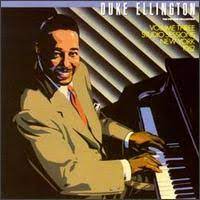
In the Fifties he worked with Slim Gaillard, Gene Ammons, Sonny Stitt, and Johnny Hodges, but played little in the latter half of the decade. In 1962 he became a member of Duke Ellington’s band and accompanied him on tours of Europe through 1964.
He worked with Paul Gonsalves in 1963 and Johnny Hodges in 1964 then moved to Germany in 1964. He took up work as a session musician for studio recordings, radio, and television.
Double-bassist and vocalist Ernest Shepard transitioned on November 23, 1965 in Hamburg, West Germany.
More Posts: bass,history,instrumental,jazz,music
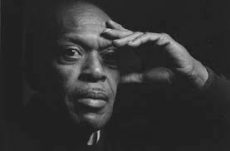
Three Wishes
While hanging out with Nica the three wishes inquiry was broached and Kenny Drew gave her his three wishes as follows:
- “To play.”
- “To play.”
- “To make love.”
*Excerpt from Three Wishes: An Intimate Look at Jazz Greats ~ Compiled and Photographed by Pannonica de Koenigswarter

More Posts: baroness,history,instrumental,jazz,music,pannonica,piano,three,wishes
Daily Dose Of Jazz…
Charlie LaVere was born Charles LaVere Johnson on July 18, 1910 in Salina, Kansas to a Union Pacific Railroad blacksmith and where he first acquired an interest in music. His first musical instrument was a cornet, then later acquired an upright baritone horn, on which he learned to play many popular songs of the day. Studying piano in the 4th grade was the turning point in his decision to make it his instrument of choice.
At age twelve, after attending a Willard Robison and his Deep River Orchestra he gained an interest in jazz. He studied piano throughout high school and performed in various recitals and assemblies. At the age of eighteen he visited Oklahoma City, Oklahoma where he was introduced to Jack Teagarden, his brother Charlie Teagarden and where he studied Music at the University of Oklahoma at Norman. He performed with Frank William’s Oklahomans on campus and in local venues. He would go on to tour in 1929 during the Wall Street Crash, with brief stints in various bands including Louis Armstrong.
Relocating to Chicago, Illinois in 1932 he shared an apartment with the Teagarden’s and their spouses. He began playing regularly with Joe and Marty Marsala, Floyd Towne, Jim Barnes, Ray Biondi, Shorty Cherock, Larry Russel, Clark Galehouse, Carl Bean and Wingy Manone. He would perform his first recorded sessions supporting Wingy Manone and Teagarden in addition to leading his own bands.
After touring Texas and the mid-west with Eddie Neibauer and Dell Coon in 1934, he returned to local Chicago venues, working regularly with Joe Marsala. He assembled a multiracial group of musicians, befriended writer and jazz critic Helen Oakley, and recorded for Brunswick Records and Columbia Records. LaVere then found steady work in radio, performing on the Fibber McGee and Molly show for NBC. He also sang and arranged songs for a vocal group. Charlie briefly relocated to Fort Worth, Texas to perform in Paul Whiteman’s group and later touring throughout Texas, Oklahoma, and Kansas, before heading West.
He worked as a recording artist for Decca Records at their studios on Melrose Avenue with The Andrew Sisters, Victor Young, John Scott Trotter, and Gordon Jenkins, and under his own name.
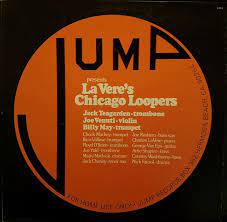
In 1944 he formed the LaVere’s Chicago Loopers featuring Billy May, Artie Shapiro, Floyd O’Brien, Joe Venuti, Matty Matlock, Nick Fatool, and George Van Eps. He would go on to perform for Walt Disney, Gordon Jenkins, George Burns, Bobby Darin, Bob Crosby and Wingy Manone.
As rock music became more popular his work became more sporadic and in 1964 LaVere accepted a position as assistant conductor at the Melodyland Theater. He performed piano and accordion on cruise ships, arranged and performed with Russ Morgan in Las Vegas, Nevada and continued to work with Gordon Jenkins, performing on Harry Nilsson’s album of jazz standards. From the 1960s onward he ran his own piano repair shop in the San Diego, California area, in addition to performing solo residencies at resorts in California, Oregon, and Colorado.
Pianist, vocalist, bandleader, and composer Charlie LaVere transitioned on April 28, 1983 in Ramona, California.
More Posts: bandleader,composer,history,instrumental,jazz,music,piano,vocal