Daily Dose Of Jazz…
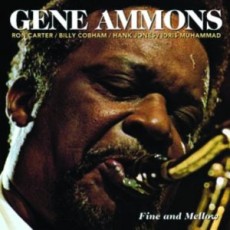
Eugene Ammons was born in Chicago, Illinois on April 14, 1925 to one of the greatest boogie-woogie pianist, Albert Ammons. At the age of 18 he left Chicago to go on the road with King Kolax for a year and in 1944 and ‘49 he worked as a featured soloist with Billy Eckstine and Woody Herman respectively. By 1950 he formed a duet with Sonny Stitt and recorded as a leader from 1947 to 1953 for the Mercury, Aristocrat, Chess, Decca, United and for the rest of his career he was affiliated with Prestige.
Known as “Jug” and “The Boss”, Gene’s playing showed influences from Lester Young and Ben Webster and both helped develop higher levels of expressiveness with from the tenor. Along with Dexter Gordon and Sonny Stitt, he integrated those developments into the emerging vernacular of bebop. His adeptness with technical aspects did not abandon the commercial blues and R&B sounds and he became an important part of the soul jazz movement in the mid-50s combining the tenor with the Hammond B3.
Using a thinner drier tone Ammons exploited a vast textural range that would later influence Stanley Turrentine, Houston Person and Archie Shepp and much later Joshua Redman. Yet he had little interest in the modal jazz of Coltrane, Henderson or Shorter. His ballads are classic, a testament to his sense of intonation, melodic symmetry and lyrical expressiveness.
Along with Von Freeman, they founded the Chicago School of Tenor Saxophone. On August 6, 1974 Gene Ammons passed away after a battle with cancer.

More Posts: saxophone

From Broadway To 52nd Street
On October 19, 1938 the musical Knickerbocker Holiday opened at the Ethel Barrymore Theatre starring Walter Huston, Ray Middleton, Richard Kollmer and Jeanne Madden. The play ran for 168 performances with music composed by Kurt Weill and Maxwell Anderson. From the musical came the jazz standard September Song.
The Story: As he is writing the history of New York, Washington Irving seems to wander back to the 17th century just as New Amsterdam is awaiting the arrival of Peter Stuyvesant. The town council seeks to divert the new governor from its corruption and ineptitude by staging a hanging of a rebellious young man named Brom.
Brom has brashly asked for the hand in marriage of Tina, one of the councilor’s daughters. Stuyvesant pardons Brom but refuses him marriage to Tina. Stuyvesant decides to marry Tina, prompting Brom to rouse the citizens against the governor. Sensing the way the political winds are blowing, the governor backs down, his decision aided by Irving’s warning for him to consider his place in history.
Broadway History: While Broadway is experiencing both success and failure, Hitler takes control of the army and marches into Austria; Joe Louis takes the heavyweight championship title from Nathan Mann followed by a first round KO of Max Schmeling; the first play is telecast with the original cast of Susan and God; the Yankee Clipper completes its first cross Atlantic flight; Howard Hughes flies around the world in 91 hours; and instant coffee is invented.
Sponsored By

www.whatissuitetabu.com
More Posts: vocal
Daily Dose Of Jazz…
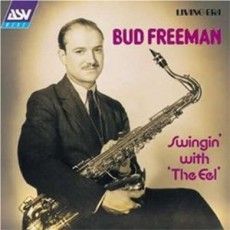
Lawrence “Bud” Freeman was born on April 13, 1906 in Chicago, Illinois and became one of the most influential and important jazz tenor saxophonists of the Big Band era. During high school in 1922 he became one of the original Austin High School Gang playing the C-melody saxophone alongside Jimmy McPartland and Frank Teschemacher. Two years later he switched to tenor and influenced by the New Orleans Rhythm Kings and Louis Armstrong the Gang would formulate their own style that would become part of the emerging Chicago jazz sound.
In 1927 Freeman moved to New York and worked as a session player and band member with Red Nichols, Roger Wolfe Kahn, Ben Pollack Joe Venuti and Eddie Condon in 1933 producing one of his most notable performances on the recording of “The Eel” which would later become Bud’s nickname for his long snake-like improvisations.
Bud’s smooth and full-tenor sax style with a heavy robust swing was the signature that got him gigs with the Tommy Dorsey and Benny Goodman orchestras along with leading his own Summa Cum Laude Orchestra. During WWII he joined the Army and led the band in the Aleutian Islands. Returning to New York after his discharge, for the next couple of decades he led his own groups, worked with Eddie Condon, Buck Clayton, ruby Braff, Vic Dickerson and Jo Jones. He was a member of the World’s Greatest Jazz Band off and on, moved to England in 1974, performing, touring and recording throughout Europe. He returned to Chicago and continued to work well into his eighties.
Tenor saxophonist, clarinetist, composer and bandleader Bud Freeman passed away on March 15, 1991 in his hometown of Chicago. He was posthumously inducted into the Big Band and Jazz Hall Of Fame in 1992.

Daily Dose Of Jazz…
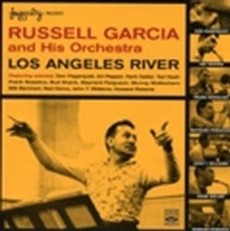
Russell Garcia was born April 12 1916 in Oakland, California but for most of his life has resided in New Zealand. The self-taught musician with only a few lessons in high school could read music from a very young age. He began his career at age five when one of his brothers bought him a $5 cornet. In school he started up a jazz band so he could play his horn and it became an outlet for his compositions and arrangements.
When Garcia was eleven the Oakland Symphony Orchestra performed his arrangement of Stardust and by high school was playing five nights a week. After a year at San Francisco State University he dropped out and went on the road with several big bands. Finding no satisfaction in his progress he went to Hollywood and studied composition, harmony, orchestration, counterpoint and form with the best teachers and took lessons on every instrument so he could write for each with a deeper awareness. During that time while still in his twenties he conducted the West Hollywood Symphony Orchestra, preparing him for things to come.
Russell’s big break came in 1939 when he took the job of composer/conductor for “This Is Our America” and impressed then director Ronald Reagan, who in turn, recommended him to NBC. From that point on worked poured in. He worked with Henry Mancini on the Glenn Miller Story, Charlie Chaplin, Universal Studios, arranged and conducted Louis Armstrong and Ella Fitzgerald’s “Porgy & Bess”, then followed up with three more albums with Armstrong.
Always the innovator Garcia left Hollywood for jazz and using experimental frameworks assembled his groundbreaking four-trombone band with famed brass players Frank Rosolino, Tommy Pederson, Maynard Ferguson and Herbie Harper and Marty Paich. He recorded over sixty albums under his own name, as well as composing for Stan Kenton’s cutting edge Neophonic Orchestra. He collaborated with Frances Faye, Anita O’Day, Mel Torme, Andy Williams, Judy Garland, Orson Welles, Julie London and Oscar Peterson.
In 1966 he walked away from his success in music to advocate world peace, a promise he made to himself after surviving World War II’s Battle of the Bulge. He continues to lecture and record around the globe and has authored what is considered the definitive textbooks on composition, “The Professional Arranger Composer Books I and II” used in universities and conservatories worldwide. Composer and arranger Russell Garcia passed away on November 19, 2011.

Daily Dose Of Jazz…
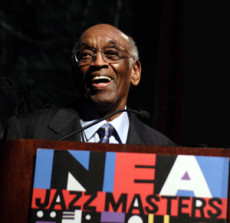
Double bassist John Levy was born April 11, 1912 in New Orleans but was raised in Chicago, Illinois. In 1944 he left Chicago for the bright lights of New York and played bass with Ben Webster, Erroll Garner, Milt Jackson and Billie Holiday. In ’49 he became the original bassist for the George Shearing Quintet and took on the responsibility as his road manager.
1951 saw him turning to business and opening John Levy Enterprises, Inc. becoming the first black personal manager in pop and jazz. By the sixties his roster was boasting clients including Nancy Wilson, Cannonball Adderley, George Shearing, Joe Williams, Shirley Horn and Ramsey Lewis.
In 1997, John Levy was inducted into the International Jazz Hall Of Fame and in 2006 was named a Jazz Master by the National Endowment for the Arts. Bassist and personal manager John Levy passed away on January 20, 2012 at age 99 in Altadena, California.