

Daily Dose Of Jazz…
Joe Harris was born on December 23, 1926 in Pittsburgh, Pennsylvania, growing up in the Manchester neighborhood. He learned to play the drums by taking lessons at an early age from Pittsburgh’s Bill Hammond, who taught his the rudiments of drumming. His musical education included symphonic percussion such as tympani and xylophone and by age 18 he was playing in big bands and touring the country.
As a young man in 1946 he moved to New York City, where he played with Dizzy Gillespie over the next two years, helped pioneer Latin jazz, and anchored the house band at the famed Apollo Theater. Balancing jazz with the heavier R&B sounds of tenor saxophonist Arnett Cobb in the late ’40s, Harris gigged with singer Billy Eckstine in 1950, and worked with Erroll Garner, Jimmy Heath, Ella Fitzgerald, Sarah Vaughan, Sonny Rollins, Stan Getz, Billie Holiday and James Moody.
Following a decade as one of the early bebop drummers, Joe took off for Sweden with his first tour in the summer of 1956 with trumpeter Rolf Ericson. His subsequent expatriate status put him in the company of other transplanted instrumentalists including trumpeter Benny Bailey, with whom he recorded from 1957 – 59, and pianist Freddie Redd. He taught himself to speak Swedish fluently and learned a fair amount of German and Japanese, eventually moved to Sweden, married and had a daughter before living in Germany and Japan for a time.
Harris eventually returned to the States for TV work in Los Angeles, California among other things. The drummer would later study music in the Far East, Egypt, Africa and Latin America prior to settling back in his native Manchester, scaling back his performance schedule with local musicians. He continued to practice daily, mentor students and teaching jazz history and drums for years at the University of Pittsburgh until his death on January 27, 2016 at age 89.

More Posts: drums

The Jazz Voyager
The Jazz Voyager is jet setting down to Brazil to Beco das Garrafas (Alley of the Bottles) at Rua Duvivier 37, Lojas J, K e L, Rio de Janeiro. Seating sixty with standing room for twenty additional patrons or 150 standing, the club lays claim to being the birthplace of the revolutionary sound of Bossa Nova in the 50s and 60s, a blend of jazz and samba. Sergio Mendes, Elis Regina, Jorge Ben and Baden Powell all performed on its stage, though the crowd used to be a little less appreciative of these new sounds, hurling bottles at the young upstarts, hence the name.
The venue lay abandoned for almost thirty years Amanda Bravo, Sergio De Martino and Mauricio De Martino decided to join forces and bring back the music to the Bottle ‘s Bar and the Little Club. Now hosting new talents as well as Brazilian greats playing in the genres of bossa nova, samba, as well as jazz.
This trip the Jazz Voyager will catch a set of composer and singer Marcio Aguinaga at 8:30pm for 40.00 Real or approximately $10.00. For reservations and more information the number is 21 96800-8683 or 2543-2962.

More Posts: adventure,club,genius,jazz,museum,music,preserving,restaurant,travel,voyager
Three Wishes
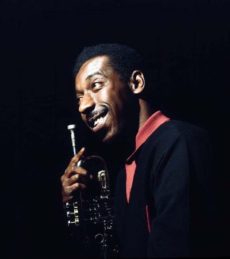
Blue Mitchell told Pannonica only two of the three wishes to her question were:- “That I can play simply and understandably, and know what I doing musically.”
- “To have enough to live comfortably. Sorry, Nica, but this cat’s waiting for me.”

More Posts: baroness,history,instrumental,jazz,musician,pannonica,three,trumpet,wishes
Hollywood On 52nd Street
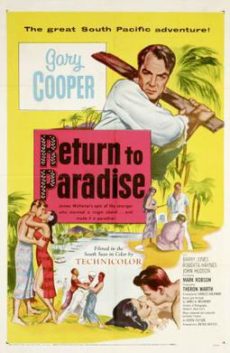
Return to Paradise is a jazz standard that was written by Dimitri Tiomkin and Ned Washington for the movie of the same name. The film was set and principal photography was shot in Samoa and released by United Artists in 1953. It starred Gary Cooper, Barry Jones and Roberta Haynes and the screenplay by Charles Kaufman was based on the 1951 short story Mr. Morgan by James Michener in his short story collection Return to Paradise, his sequel to Tales of the South Pacific.
The Story
During the 1920s, itinerant American beachcomber Mr. Morgan (Cooper) is deposited on the island of Matareva in the South Pacific. Deciding to stay, he is confronted by Pastor Cobbett (Jones), who lost both his father and his wife as a young missionary on the island and rules the island as a Puritanical despot, using local bullies as wardens to enforce his rules. Morgan wins the support of the natives after defeating the wardens with the aid of an empty shotgun.
Morgan has an illegitimate child with an island girl who dies in childbirth. Leaving his daughter with her grandmother he leaves the island, only to return during World War II. Cobbett has changed, his daughter Turia is now grown and in love with a stranded Navy pilot and Morgan now has to face the inevitable possibility of a repeat of his indiscretion with his daughter. Forcing the split by making the pilot and his crew leave the island, Turia is upset but reconciles with her father who decides to stay on with her on the island.


Requisites
2-3-4 is an album by drummer Shelly Manne features performances that were recorded in 1962 for the Impulse! Label. The name of the album is derived from its inclusion of a duet (“2”), two trio performances (“3”), and three tunes played by a quartet (“4”). Unusually, the standards “Take the “A” Train” and “Cherokee” were played in two tempos simultaneously, with Manne playing in double time consistently throughout “Cherokee”.
Not a typical album for the drummer, then primarily associated with West Coast jazz, he flew from Los Angeles to New York City on February 5, 1962, arranged by producer Bob Thiele. He was reunited with pioneering tenor saxophonist Coleman Hawkins and pianist Hank Jones, both of whom he had recorded with at different times in the 1940s.
The recording sessions took place at the Fine Recording Ballroom Studio A recording tracks 1, 3, 5, 6 & 8 on February 5 and tracks 2, 4 & 7 on February 8, 1962. In an unusual session lasting through the wee hours of the morning, he ended by recording one tune as a duet with Hawkins, who for the first time in his career was recorded also playing the piano.
The album also includes a second recording session at the same studio a few days later. Bassist George Duvivier stayed on with Manne, and they were joined by rising star Eddie Costa for two trio tracks. “The Sicks of Us” has Costa on vibes for a largely spontaneous trio number; on “Lean on Me”, Costa switches to piano.
The tracks on the original release are: Take the “A” Train, The Sicks of Us, Slowly, Lean on Me, Cherokee, and Me and Some Drums.
A fourth tune recorded by the quartet at the first session, “Avalon“, was released at first only in the Impulse! collection The Definitive Jazz Scene, Volume 1. Some thirty years later, it was included along with an alternative version of Lean On Me on the first CD reissue of 2-3-4 as bonus tracks.
Personnel: tenor saxophonist Coleman Hawkins on tracks 1, 3, 5, 6 & 8, pianist Hank Jones on tracks 1, 3, 5 & 8, pianist and vibraphonist Eddie Costa on tracks 2, 4 & 7, bassist George Duvivier on tracks 1–5, 7 & 8 and drummer Shelly Manne.
The cover design was created by Robert Flynn and the photograph was taken by Bob Gomel.

More Posts: choice,classic,collectible,collector,drums,history,instrumental,jazz,music