


Daily Dose Of Jazz…
Neil Richard Ardley was born in Wallington, Surrey, England on May 26, 1937. He attended Wallington County Grammar School and at the age of thirteen started learning the piano and later the saxophone. He studied chemistry at Bristol University, also playing both piano and saxophone in jazz groups, graduating in 1959 with a BSc.
Moving to London, England the next year he studied arranging and composing with Ray Premru and Bill Russo. He joined the John Williams Big Band as pianist, arranger and composer, and from 1964 to 1970 was the director of the New Jazz Orchestra. The band employed some of the best young musicians in London, including Ian Carr, Jon Hiseman, Barbara Thompson, Dave Gelly, Mike Gibbs, Don Rendell, and Trevor Tomkins.
The late 1960s saw Ardley begin composing, combining classical and jazz methods. The New Jazz Orchestra 1969 album Le Déjeuner sur l’Herbe is considered a classic of British jazz. It includes arrangements of Nardis by Miles Davis and Naima by John Coltrane, and compositions by young writers associated with the orchestra – including Ardley, Michael Garrick, Mike Gibbs, Howard Riley and Mike Taylor.
His rich orchestrations were augmented in the 1970s by the addition of synthesisers. He began work on an all-electronic album in 1980 which fell through when his recording contract was suddenly terminated, but continued to play and compose, especially with Zyklus, the electronic jazz group he formed with composer John L. Walters, Warren Greveson and Ian Carr.
Neil went on to sing in local choirs in the later 1990s led him to start composing choral music, and to gig and record again with a slimmed down Zyklus consisting of himself, Warren Greaveson, and Nick Robinson
Composer and pianist Neil Ardley, who was an author of popular books on music, died in Bakewell, Derbyshire, England on February 23, 2004.

More Posts: author,composer,history,instrumental,jazz,music,piano
Daily Dose Of Jazz…
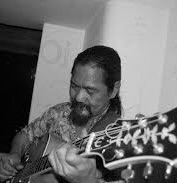
Edgar Avenir was born on May 25, 1950 in Diliman, Quezon City, Philippines. As a child he grew up in the University of the Philippines and lived in Area One of the campus. As a young guitarist, Avenir played with the renowned jazz pianist and composer Bong Peñera, and the Sangkatutak Band, whose members included Cariño, Ivy Violan and Richard Merk. His neighbors included Ed “Sarge” Cariño and John Lesaca, both of whom would later play with Avenir in various bands.
While he sessioned for pop acts like the Apo Hiking Society, his associations with fellow jazz musicians allowed him to explore the more eclectic side of his music. His move to jazz had him rubbing shoulders and exchanging notes with Pinoy jazzmen like Sandra Lim Viray, Jun Viray, Romy Posadas and Roger Herrera.
An excellent musician who could play with anyone, Avenir regularly performed with singer Zenaida Celdran and De la Calzada at La Cuisine Francaise in Makati. Celdran took care of Avenir in the last few months of his life. He was always willing to help fellow artists who wanted to learn more about music.
Still playing until August even though he was ill, guitarist Edgar Avenir, affectionately known as Koyang, died on Saturday, September 17, 2017 of pneumonia arising from lung cancer. He was 61.
More Posts: guitar,history,instrumental,jazz,music
Daily Dose Of Jazz…
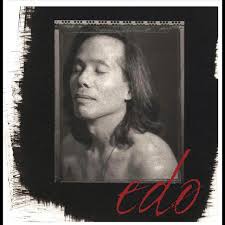
Edo Castro was born on May 24, 1957 in San Francisco, California to mother Aida Saberi, the only child from her first marriage. He attended Grattan Elementary, Herbert Hoover Junior High and J. Eugene McAteer High School, all in the city by the bay. Growing up during the tumultuous 1960s, where from an early age he was exposed to a myriad of musical styles, listening not only to rock and roll, R&B, but classical music, folk and jazz.
The first jazz albums came to him via his uncle, a recording engineer pioneer Reice Hamel. From these, Edo was first exposed to and enthralled by the sounds of Vince Guaraldi, Hugh Masekela, Ahmad Jamal, Bill Evans, Ramsey Lewis and Paul Desmond. He initially studied piano and violin, but when a friend suggested he try the electric bass, he knew he had found his instrument.
Castro attended Humboldt State University in northern California. Nearly three years later he bought an acoustic bass and auditioned for the music department at San Jose State University. So inspired by the musicians he met and their sound, he moved to Chicago, Illinois in 1982, and studied at DePaul University for a year, then completed his studies at the American Conservatory of Music, earning a Bachelor of Arts in 1987 with a focus on jazz studies and electric bass.
Returning to the Bay Area in 1990, Edo has performed and recorded with among others David Amram, Roy Haynes, Fareed Haque, David Onderdonk, Ed Thigpen, Johnny Griffin, Joel Harrison, Deborah Winters, Jill Knight, Bethany Pickens, Armando Peraza, Caren Armstrong, Percy Howard, Mark Egan, Yves Carbonne, and David Friesen.
Bassist Edo Castro has performed across Europe, Asia and South America. He continues to perform and record.
More Posts: bandleader,bass,history,instrumental,jazz,music
Daily Dose Of Jazz…
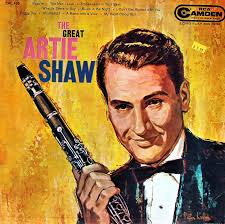
Artie Shaw was born Arthur Jacob Arshawsky on May 23, 1910 in New York City to Austrian and Russian Jewish parents Sarah and Harold Arshawsky, a dressmaker and photographer. He grew up in New Haven, Connecticut, where his natural introversion was deepened by local antisemitism. Buying a saxophone by working in a grocery store and began learning the saxophone at 13. At 16, he switched to the clarinet and left home to tour with a band.
From 1925 to 1936 Shaw performed with many bands and orchestras, working in Cleveland, Ohio and establishing a lasting reputation as music director and arranger for an orchestra led by violinist Austin Wylie. Exposed to symphonic music while playing with Irving Aaronson’s Commanders, which he later incorporated in his arrangements. In 1932 he joined the Roger Wolfe Kahn Orchestra and made several recordings. Three years later he gained attention with his “Interlude in B-flat” at a swing concert at the Imperial Theater in New York. During the swing era, his big bands had numerous popular hits with Begin the Beguine, Stardust and others.
In addition to hiring Buddy Rich, he signed Billie Holiday as his band’s vocalist in 1938, becoming the first white band leader to hire a full-time black female singer to tour the segregated South. However, after recording Any Old Time, Holiday left the band due to hostility from Southern audiences, as well as from music company executives who wanted a more mainstream singer.
He fashioned a smaller band within the orchestra in 1940, naming it Artie Shaw and the Gramercy Five after his home telephone exchange. Over time members of the band were pianist Johnny Guarnieri, electric guitarist Al Hendrickson, trumpeter Roy Eldridge succeeded Billy Butterfield, Oran “Hot Lips” Page, Max Kaminsky, Georgie Auld, Dave Tough, Jack Jenney, and Ray Conniff. In 1940, the original Gramercy Five cut eight sides, then Shaw dissolved the band in early 1941.
The long series of musical groups Shaw subsequently formed included Lena Horne, Helen Forrest, Mel Tormé, Buddy Rich, Dave Tough, Barney Kessel, Jimmy Raney, Tal Farlow, Dodo Marmarosa, and Ray Conniff.
Throughout his career, Shaw formed big bands for his radio broadcasts, made several musical shorts for Vitaphone and Paramount Pictures, and played with Navy personnel during World War II. Active until 1954, his music was used in several films, he had numerous talk show appearances, came out of retirement in 1983 and put together one last band.
Clarinetist Artie Shaw, who received a Lifetime Grammy Award in 2004, died on December 30, 2004, aged 94.
More Posts: bandleader,clarinet,history,instrumental,jazz,music
Daily Dose Of Jazz…
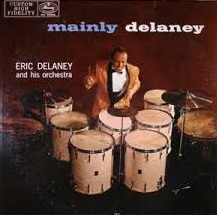
Eric Delaney was born on May 22, 1924 in Acton, London, England. Learning to play early in life by age sixteen, he won the Best Swing Drummer award and later joined the Bert Ambrose Octet which featured George Shearing on piano.
Between 1947 to 1954 he appeared with the Geraldo Orchestra and filled his time with regular session work in recording studios and on film, TV and radio. In 1954 he formed his own band and later signed with the new Pye Records label. Two years later he made three appearances on the Royal Variety Show, the first in 1956.
Specializing in up-tempo dance hall music, often carrying a rock and roll label due to the rise of The Beatles. However, Delaney was able to remain active touring in the UK in holiday resorts. He was held in high regard by his musical peers, drummer Louie Bellson with whom he recorded on the 1967 album Repercussion. Originally released in high quality stereo on the Studio2Stereo label, it was re-released on the Vocalion label in 2011.
Although best known as a swing drummer, Eric was a multi-percussionist. Classically trained as a timpanist, his unique approach turned the ‘timps’ into a lead & solo instrument. He also played xylophone, glockenspiel, military snare drum, tubular bells, Chinese and orchestral gongs, which is exhibited in his showmanship routines, such as Persian Market.
Apart from his showmanship, Delaney could be occasionally found behind a minimal kit, sitting in with a jazz quartet, and letting others take the spotlight. 1990s onward, he would also make guest appearances with bands across the UK. Another facet of his work was his playing on the soundtrack of The Longest Day, where his snare opens the movie.
Drummer and bandleader Eric Delaney, who was popular in the Fifties and early 1960s, died of a brain haemorrhage on July 14, 2011 at 87.
More Posts: drums,history,instrumental,jazz,music