

Daily Dose Of Jazz…
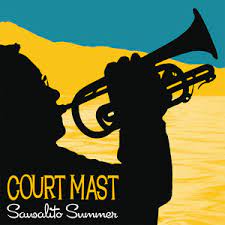
Court Mast was born Corky Miller on August 24, 1951 in Sunnyvale, California, where he took up the accordion and then trumpet in grade school. He went to Fremont High School, graduating in 1969. He traveled to Europe on tour with 120 high school and college musicians. Trumpet great Raphael Mendez was on board as guest artist, and Corky took six weeks of private lessons from the master. Returning to the Bay Area, he began performing in big bands around the South Bay and Peninsula and performed with the earliest version of the band that went on to fame as Tower of Power.
While taking performance and composition courses at De Anza College, Corky stayed active in a wide variety of bands, playing rock, jazz, Latin and Mexican music that kept this young working trumpeter onstage. By 1977 he moved to San Francisco, California where he led quartet and quintet jazz groups active on the North Beach music scene and in funky venues like the Hotel Utah.
Disillusioned with the direction that popular music, and jazz in particular, was moving in, in 1983 Miller stepped away from the music world. He became a surfer, changed his name to Court Mast, got into photography and became one of San Francisco’s leading commercial photographers. Then in the first decade of the new century his love of music returned and in 2008 he recorded his debut album Sausalito Summer
Composer and cornetist Court Mast, whose influences have been Henry Mancini, Chuck Mangione, Maurice Ravel, Duke Ellington, the Beatles, Steely Dan, Clifford Brown and Thad Jones, continues to compose and perform as well as maintain his photography.
More Posts: bandleader,cornet,history,instrumental,jazz,music
Daily Dose Of Jazz…
Terje Rypdal was born on August 23, 1947 in Oslo, Norway, the son of a composer and orchestra leader. He studied classical piano and trumpet as a child, and then taught himself to play guitar as he entered his teens.
Starting out as a Hank Marvin-influenced rock guitarist with The Vanguards, Rypdal turned towards jazz in 1968. He joined Jan Garbarek’s group and then George Russell’s sextet and orchestra. An important step towards international attention was his participation in the 1969 free jazz festival in Baden-Baden, Germany, where he was part of a band led by Lester Bowie. During his musical studies at Oslo University and conservatory, he led the orchestra of the Norwegian version of the musical Hair.
He has recorded on the ECM record label, both jazz-oriented material and classical compositions. His compositions Last Nite and Mystery Man were featured in the Michael Mann film Heat, and included on the soundtrack. Terje has performed in concerts with guitarists Ronni Le Tekrø and Mads Eriksen as N3.
Guitarist and composer Terje Rypdal, an important member in the Norwegian jazz community, continues to compose, perform and record.

More Posts: bandleader,guitar,history,instrumental,jazz,music

Daily Dose Of Jazz…
Lou Colombo was born on August 22, 1927 and raised in Brockton, Massachusetts. He began playing trumpet in the 1940s, at age 12. Aftere serving in the Army band in World War II he had hopes of playing professional baseball, saw him signed to the Brooklyn Dodgers, but a broken ankle forced him to curtail that dream. He then formed his own band in the 1950s and toured with Buddy Morrow, Perez Prado, Dick Johnson and the Artie Shaw Orchestra. He also played with Dizzy Gillespie and Louis Armstrong during his career.
So he dove into music and his trumpet. His career included stints with the Charlie Spivak and Perez Prado bands and the Artie Shaw Orchestra. On Cape Cod, Lou’s gigs with Dick Johnson and Dave McKenna were legendary, as is their superb Concord album, I Remember Bobby, a tribute to Bobby Hackett.
Known for his one-handed trumpet style, he was a mainstay in the Cape Cod, Massachusetts jazz scene for more than six decades and maintained a home in Fort Myers, Florida. Trumpeter Lou Columbo, who also played flugelhorn, baritone horn and pocket trumpet, transitioned unexpectedly at 84 on March 4, 2019 in a car crash in Fort Myers after making a turn and his vehicle was struck by another.
More Posts: bandleader,history,instrumental,jazz,trumpet
Daily Dose Of Jazz…
Christiane Legrand was born on August 21, 1930 in Paris, France. Her father Raymond Legrand was a conductor and composer renowned for hits such as Irma la douce. She studied piano and classical music from the time she was four and was discovered by jazz critic and composer André Hodeir in 1957. She became the lead singer in the most notable French jazz vocal groups of the 1960s, including Les Double Six.
She was the original lead soprano of The Swingle Singers and was the vocalist who dubbed the part of Madame Emery in Les parapluies de Cherbourg, the music was composed by her brother Michel Legrand. She also sang the part of Judith in his Les demoiselles de Rochefort. Christiane had several commercial recordings over the course of her career.
Legrand sang the lead role on the French Disney recording of the score to the film Mary Poppins in 1964 and lent her talents to numerous other film projects. She was the featured soprano on the track “Fires (Which Burn Brightly)” on the 1973 Procol Harum album Grand Hotel.
Soprano vocalist Christiane Legrand transitioned on November 1, 2011.
More Posts: bandleader,history,instrumental,jazz,music,vocal
Daily Dose Of Jazz…
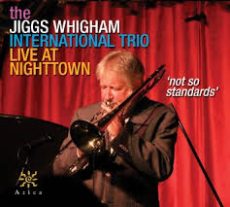
Jiggs Whigham was born Oliver Haydn Whigham III on August 20, 1943 in Cleveland, Ohio and began his professional career at the age of 17, joining the Glenn Miller/Ray McKinley orchestra in 1961. He left that band for Stan Kenton, where he played in the touring mellophonium band in 1963 before settling in New York City to play commercially.
Finding commercial playing frustrating, Whigham migrated to Germany where he still lives. He played for many years in the big band of Kurt Edelhagen, was a featured soloist in the Bert Kaempfert orchestra, and was also a member of the Peter Herbolzheimer band.
He has produced an extensive discography as a leader, including work with Bill Holman, Niels-Henning Ørsted Pedersen, Carl Fontana, and many others.
Recent years have seen Jiggs as musical director of the RIAS Big Band in Berlin, Germany. He is formerly conductor of the BBC Big Band in Great Britain and currently co-director of the Berlin Jazz Orchestra with singer Marc Secara.
As an educator he has taught at the Hochschule für Musik in Berlin, been a visiting tutor and artist at the Guildhall School of Music and Drama in London, England and the Royal Northern College of Music in Manchester and KUG in Graz, Austria
He is featured on the Berlin Jazz Orchestra albums Update, You’re Everything, Songs of Berlin and music DVD Strangers In Night – The Music Of Bert Kaempfert. He is artist-in-residence for the Conn-Selmer company, maker of the King Jiggs Whigham model trombone.
Trombonist Jiggs Whigham is the musical director for the Bundesjazzorchester working with the top student jazz musicians in Germany. He continues to tour worldwide as soloist, conductor, and educator.
More Posts: bandleader,educator,history,instrumental,jazz,music,trombone