

Daily Dose Of Jazz…
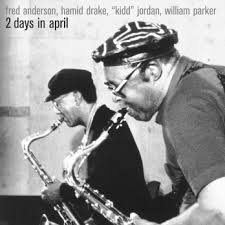
Fred Anderson was born in Monroe, Louisiana on March 22, 1929. When he was ten, his parents separated, and he moved to Evanston, Illinois, where he initially lived with his mother and aunt in a one-room apartment. When Anderson was a teenager, a friend introduced him to the music of Charlie Parker, and he soon decided he wanted to play saxophone, purchasing his first instrument for $45. He listened to Lester Young, Johnny Hodges, Dexter Gordon, Gene Ammons, and Illinois Jacquet, all of whom would influence his playing. He also heard Young and Parker in concert on multiple occasions.
Unlike many musicians at the time, Anderson did not play with dance bands or school ensembles, and instead focused on practicing, taking private lessons, and studying music theory at the Roy Knapp Conservatory in Chicago, Illinois all the while supporting his family by working as a waiter. He also began making an effort to develop a personal sound on his instrument, with the goal of combining Ammons’ big sound with Parker’s speed.
At around this time, he began to develop a series of exercises which he incorporated into his daily practice routine, and which eventually became a book titled Exercises for the Creative Musician.
In the early 1960s, Anderson began listening to and studying the music of Ornette Coleman, and immediately related Coleman’s playing to that of Charlie Parker. Influenced by Coleman, he formed a piano-less band with trumpeter Bill Brimfield, bassist Bill Fletcher, and drummer Vernon Thomas, playing a mixture of bebop standards and Anderson originals. During the decade he would go on to play weekly jam sessions, joined the AACM (Association for the Advancement of Creative Musicians) and remained in the States when many of his AACM colleagues left for Europe seeking better opportuities.
In the Seventies he formed the Fred Anderson Sextet, with trombonist George E. Lewis, reedist Douglas Ewart, bassist Felix Blackmon, drummer Hamid Drake, and vocalist Iqua Colson. By 1977 he and Brimfield visited Europe, where they recorded Accents with the Austrian trio Neighbours, then returned and opened a venue in Chicago that he named the Birdhouse, after Charlie Parker. Unfortunately, Anderson encountered resistance and harassment from officials and people in the neighborhood, who were suspicious of his motives, and he ended up closing the club a year later.
The following decade saw Fred taking over ownership of a bar in Chicago called the Velvet Lounge, and transformed it into a center for the city’s jazz and experimental music scenes, hosting Sunday jam sessions and numerous concerts. The club expanded and relocated in the summer of 2006.
Though he remained an active performer, Anderson rarely recorded for about a decade beginning in the early Eighties. In 1990, however, he received the first Jazz Masters Fellowship from Arts Midwest, and by the mid-1990s, he resumed a more active recording schedule, both as a solo artist, and in collaboration with younger performers. He would go on to perform as a soloist with 30 piece orchestras, mentor young musicians, and his Velvet Lounge has international fame.
Tenor saxophonist Fred Anderson, rooted in the swing, hard bop and free jazz idioms, who continued to record and tour throughout the 2000s and was scheduled to perform the day he died, transitioned on June 24, 2010.
More Posts: bandleader,history,instrumental,jazz,music,saxophone

Daily Dose Of Jazz…
Michael John David Westbrook was born March 21, 1936 in High Wycombe, Buckinghamshire, England and grew up in Torquay. After a spell in accountancy and his National Service he went to art school and studied painting and where he began his first bands in 1958, soon joined by such musicians as John Surman, Lou Gare and Keith Rowe.
Moving to London, England in 1962, Westbrook led numerous bands, large and small, and played regularly at the Old Place and the Little Theatre Club at Garrick Yard, St Martin’s Lane. Together with Chris McGregor’s Brotherhood of Breath, Westbrook shared the role of house-band at Ronnie Scott’s Jazz Club.
Becoming a key figure in the development of British jazz, Mike produced several big-band records for the Deram label, with the newly formed Mike Westbrook Concert Band, which varied in size from 10 to 26 musicians. His music was given exposure on BBC Radio. The British Arts Council awarded him a bursary to develop ‘Metropolis’ for an enlarged Concert Band, and the jazz suite was further broadcast on BBC Radio Three.
The 1970s saw a wide range of different projects beyond his orchestra work including but not limited to carnival processions, jazz-rock, avant-rock. At 80 years old, Westbrook, as part of the celebrations, recorded his first solo piano album for 40 years, titled PARIS.
Pianist, composer, and writer of orchestrated jazz pieces Mike Westbrook, who was awarded the OBE (Most Excellent Order of the British Empire), and recorded his latest album London Bridge Live in Zurich 1990 in 2022, continues to expand his musical horizons.
More Posts: bandleader,composer,history,instrumental,jazz,music,piano

Daily Dose Of Jazz…
James R. Coe was born in Tompkinsville, Kentucky on March 20, 1921 and moved to Indianapolis, Indiana with his family as a child. He first played in a band with Erroll “Groundhog” Grandy, who mentored J. J. Johnson and Wes Montgomery.
From 1938 to 1940, Coe performed with Buddy Bryant’s band and by the age of 20, was already touring with the Jay McShann band, which included Charlie Parker, Al Hibbler, Walter Brown, Bernard Anderson, Gene Ramey and Doc West.
In the 1950s Jimmy recorded for King Records as a member of Tiny Bradshaw’s band, then made a session with his own combo, though the company oddly insisted on billing him as Jimmy Cole. 1953 saw States recording his Gay Cats of Rhythm. By the late 1950s, he led the house band for the small Indianapolis-based label Note Records. Some of the material was licensed to Checker, which had better distribution.
Coe backed performers Wes Montgomery, Slide Hampton, David Baker, Freddie Hubbard, Carl Perkins, Larry Ridley, Leroy Vinnegar, as well as Aretha Franklin, Roy Hamilton, Gladys Knight & the Pips. and doo-wop performers, The Students.
Saxophonist Jimmy Coe transitioned in Indianapolis on February 26, 2004 at the age of 82.
More Posts: bandleader,history,instrumental,jazz,music,saxophone

Daily Dose Of Jazz
Keith John Smith was born on March 19, 1940 in Isleworth, Middlesex, England. Originally intent on pursuing studies in engineering, he began playing trumpet at the age of 15. Soon after he began playing in local amateur ensembles, including Norrie Cox’s band and the New Teao Brass Band, the latter including Chris Barber and Ken Colyer.
His first professional gig came in 1960 as a member of Mickey Ashman’s Ragtime Jazz Band. In 1962, he started the Climax Jazz Band and began recording. In 1964, Smith visited New Orleans for the first time, where he played with George Lewis. Intending to move to the U.S. permanently, he worked briefly in New Orleans, Louisiana before spending time in California and New York. In 1966, he organized an all-star band to tour Canada and Europe, which included Pops Foster, Jimmy Archey, and Alvin Alcorn.
Moving to Denmark in 1972 he remained there until 1975, playing with Papa Bue in his Viking Jazz Band. Afterwards he returned to England, where he founded a new band, Hefty Jazz. This group lasted over a decade, toured internationally and over the years featured George Chisholm, Mick Pyne, Peanuts Hucko, Nat Pierce, Johnny Mince, and Barrett Deems. Concurrently, he was named leader of the Louis Armstrong All-Stars in 1981, and in 1984 served as producer for Stardust Road, a televised film made as a tribute to Hoagy Carmichael. Late in his life he lived in Germany, still active as a performer.
Trumpeter Keith Smith, principally active on the trad jazz and Dixieland revival scenes, transitioned on January 4, 2008 in London, England from a heart attack at the age of 67.
More Posts: bandleader,history,instrumental,jazz,music,trumpet
Daily Dose Of Jazz…
Alfred Wesley Hall was born on March 18, 1915 and grew up in Philadelphia, Pennsylvania. He played cello and tuba early in life before settling on bass at the age of 17. Moving to New York in 1936, Al played at different times through and into the Forties with Billy Hicks, Skeets Tolbert, and Teddy Wilson in both big band and small ensemble format.
Following time with Ellis Larkins and Mary Lou Williams, Hall took a job as a staff musician at CBS, working in Paul Baron’s orchestra on the Mildred Bailey Show. He also worked in Broadway theater pit orchestras for the next several decades. In 1946, he founded his own label, Wax Records, which was bought by Atlantic Records in 1949. He led five numbers on his own label in the mid Forties and four on Columbia Records Europe in 1959.
Hall had an extended partnership with Erroll Garner, playing with him intermittently from 1945 to 1963. He also played later in life with Benny Goodman in 1966, Hazel Scott, Tiny Grimes, and Alberta Hunter from 1977 to 1978, and Doc Cheatham. He recorded with Helen Merrill, Paul Quinichette, Duke Ellington, Harold Ashby, Eddie Condon, Della Reese, Teddy Wilson and numerous others.
Double bassist Al Hall, who recorded thirty albums as a sideman but none as a leader, transitioned on January 18, 1988.
More Posts: bass,history,instrumental,jazz,music