

Daily Dose Of Jazz…
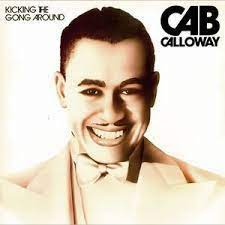
Cabell Calloway III was born on December 25, 1907 in Rochester, New York, on December 25, 1907 to two college graduates, his mother a teacher and church organist, and his father who worked as a lawyer and in real estate. The family moved to Baltimore, Maryland, in 1919 but soon after, his father died and his mother remarried.
Growing up in West Baltimore’s Druid Hill neighborhood Cab often skipped school to earn money by selling newspapers, shining shoes, and cooling down horses at the Pimlico racetrack where he developed an interest in racing and gambling on horse races. He ended up in Downingtown Industrial and Agricultural School, a Pennsylvania reform school run by his mother’s uncle.
Returning to Baltimore he resumed hustling, worked as a caterer while he improved his studies in school, and his mentors included drummer Chick Webb and pianist Johnny Jones. After graduating high school Calloway joined his older sister Blanche on tour for the popular black musical revue Plantation Days. He spent most of his nights in Chicago, Illinois clubs performing as a singer, drummer, master of ceremonies and as an understudy for singer Adelaide Hall. There he met and performed with Louis Armstrong, who taught him to sing in the scat style.
He established himself as a vocalist singing Ain’t Misbehavin’ by Fats Waller. The Thirties saw Cab’s orchestra permanently at the Cotton Club in Harlem, performed twice a week for radio broadcasts on NBC, and appeared on radio programs with Walter Winchell and Bing Crosby. He was the first Black American to have a nationally syndicated radio show and during the depths of the Great Depression he was earning $50,000 a year at 23 years old.
During the decade he recorded his most famous song, Minnie the Moocher, and became the first single record by a Black American to sell a million copies. He performed the song along with St. James Infirmary Blues and The Old Man of the Mountain, in Betty Boop cartoons of the same name.
His success with Minnie the Moocher and his relationship to the chorus earned him the nickname, The Hi De Ho Man. He performed a gliding backstep dance move called The Buzz, which some observers have described as the precursor to Michael Jackson’s moonwalk. He would go on to be featured in several films, and made his first Hollywood feature film appearance opposite Al Jolson in The Singing Kid in 1936.
His band included Ben Webster, Illinois Jacquet, Milt Hinton, Danny Barker, Doc Cheatham, Ed Swayze, Cozy Cole, Eddie Barefield, and Dizzy Gillespie. He entertained troops during World War II, hosted a weekly radio quiz show called The Cab Calloway Quizzicale and recorded songs full of social commentary. He appeared in the film Stormy Weather, one of the first mainstream Hollywood films with a black cast. Then he played the prominent role of Sportin’ Life in a stage production of Porgy and Bess. He continued to perform in movies and on stage throughout his career.
He published an autobiography and Cab Calloway’s Cat-ologue: A “Hepster’s” Dictionary, the first dictionary published by a Black American. It became the official jive language reference book of the New York Public Library.
Suffering a stroke at his home, vocalist, bandleader and actor Cab Calloway transitioned from pneumonia on November 18, 1994, at the age of 86, at a nursing home in Hockessin, Delaware.

More Posts: actor,bandleader,history,instrumental,jazz,music,vocal
Requisites
Maggie’s Back In Town ~ Howard McGhee | By Eddie Carter
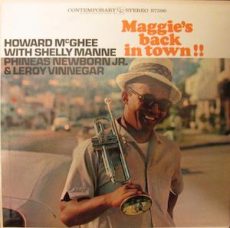
Howard McGhee opens this morning’s discussion with a superb 1961 album, Maggie’s Back In Town (Contemporary Records M3596/S7596). He was one of the earliest jazz musicians to begin playing bebop and became a leading trumpet player during the Forties. Howard was also an excellent arranger and composer who performed with some of the elite musicians during that era. Drug problems derailed his career during the fifties, but he returned in 1960 and recorded two impressive albums for Lester Koenig’s label. A first-class trio joins him on this studio session: Phineas Newborn Jr. on piano, Leroy Vinnegar on bass, and Shelly Manne on drums. My copy is the 1975 US Stereo reissue.
Side One opens with a Howard McGhee original, Demon Chase. The quartet swings easily into the melody; then, Howard gets to the song’s core first. Phineas follows happily along in the second reading. McGhee returns on muted horn with a solo that’s sheer heaven. Leroy closes things out ahead of the finale. Willow Weep For Me by Ann Ronell is one of the most beautiful and recorded song’s from The Great American Songbook. Newborn makes the introduction segueing into McGhee’s muted slow-tempo theme and mellow opening statement. Phineas demonstrates tenderness and intimacy next, and then Howard takes the song out thoughtfully with the mute removed.
Softly, As In a Morning Sunrise by Sigmund Romberg and Oscar Hammerstein II is taken at a brisk clip, with the leader’s mute building the melody effectively. Howard delivers the song’s only solo with joyful vitality fueled by the trio’s exceptional support ahead of the closing chorus and climax. Sunset Eyes by Teddy Edwards ends the first side. The rhythm section sets the scene for McGhee’s easygoing melody. The tempo moves upward for a fascinating interpretation by the leader. Newborn also puts together a well-constructed offering preceding the closing chorus and gentle fadeout.
Side Two starts with Maggie’s Back In Town, by Teddy Edwards. The title refers to Howard’s nickname and his return to the jazz scene after battling drug addiction. The quartet’s bluesy theme gets things underway, followed by Howard’s warm welcome in the first solo. Newborn’s second statement is as delicious as a good meal. McGhee returns for a short reading, and then Vinnegar takes a relaxing walk. Manne shares the closing statement with Howard ahead of the ending theme. Summertime by George and Ira Gershwin and DuBose Heyward starts at mid-tempo, with the leader back on a muted trumpet. McGhee’s solo is as enjoyable as a day at the seaside until the close.
Brownie Speaks by Clifford Brown takes off with the foursome’s vigorous uptempo workout. Howard generates plenty of heat in the first solo. Phineas takes a scintillating statement next. Leroy follows with a short, robust comment, and the leader’s finale flows vibrantly toward the climax. Lester Koenig produced Maggie’s Back In Town, and Roy DuNann was the recording engineer. It’s a great-sounding reissue with an outstanding soundstage that brings the quartet to your listening room with stunning fidelity. If you’re in the mood for a hard-bop album with great tunes and tight musicianship, I invite you to check out Maggie’s Back In Town by Howard McGhee on your next record shopping trip. It’s an excellent introduction to his music and a terrific album that’s sure to give you many hours of listening pleasure!
~ Together Again! (Contemporary Records M3588/S7588) – Source: Discogs.com ~ Softly, As In A Morning Sunrise, Summertime, Willow Weep For Me – Source: JazzStandards.com © 2023 by Edward Thomas Carter

More Posts: choice,classic,collectible,collector,history,instrumental,jazz,music,trumpet

Daily Dose Of Jazz…
David Louis Bartholomew was born Davis Bartholomew on December 24, 1918 in Edgard, Louisiana and initially learned to play the tuba, then took up the trumpet with lessons from Peter Davis, who also tutored Louis Armstrong. Around 1933 he moved with his parents to New Orleans, Louisiana where he played in local jazz and brass bands, including Papa Celestin’s. He played in Fats Pichon’s band on a Mississippi riverboat and took charge of his band in 1941. After a stint in Jimmie Lunceford’s band he joined the US Army during World War II and developed writing and arranging skills as a member of the 196th Army Ground Forces Band.
At the end of the war he returned to New Orleans and towards the end of 1945 he started leading his own dance band, Dave Bartholomew and the Dew Droppers, named after a now-defunct local hotel and nightclub, the Dew Drop Inn. Their popularity was a model for early rock ‘n’ roll bands the world over. In 1947, they were invited by club owner Don Robey to perform in Houston, Texas, where Bartholomew met Lew Chudd, the founder of Imperial Records.
His band made their first recordings for De Luxe Records in 1947 and their first hit was Country Boy, reached No. 14 in the national Billboard R&B chart in early 1950. Prominent members of the band, besides Bartholomew on trumpet and occasional vocals, were the saxophonists Alvin Tyler, Herb Hardesty, and Clarence Hall, the bass player Frank Fields, the guitarist Ernest McLean, the pianist Salvador Doucette, and the drummer Earl Palmer. They were later joined by the saxophonist Lee Allen.
Two years after their first meeting in Houston, Texas he was asked by Lew Chudd to become Imperial’s A&R man in New Orleans. Dave went on to produce singer Jewel King, and a young pianist Fats Domino, who went on to have great success with their collaboration. He went on to work at several labels including his own Broadmoor Records.
The 1970s and 1980s had Bartholomew leading a traditional Dixieland jazz band in New Orleans, releasing an album, Dave Bartholomew’s New Orleans Jazz Band in 1981. He produced numerous hit songs and was inducted into the Songwriters Hall of Fame, the Rock and Roll Hall of Fame, and the Louisiana Music Hall of Fame.
Trumpeter, bandleader, composer, arranger and record producer Dave Bartholomew, who was prominent in the New Orleans music scene and active in rhythm and blues, big band, swing music, rock and roll, New Orleans jazz, and Dixieland, transitioned from a heart attack in Metarie, Louisiana on June 23, 2019.
More Posts: aranger,bandleader,composer,history,instrumental,jazz,music,record producer,trumpet
Daily Dose Of Jazz…
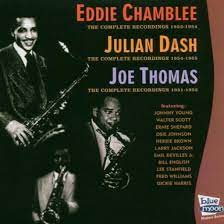
Joe Thomas was born in Muskogee, Oklahoma on December 23, 1908 and was the brother of Walter “Foots” Thomas. He first went to New York City with Jelly Roll Morton in 1929.
During the 1930s he worked with Blanche Calloway and other bands. The early Forties saw him working with jazz musician Dave Martin. He gave up playing to become a vocal coach and songwriter and later an A&R executive.
Alto saxophonist and songwriter Joe Thomas transitioned on April 15, 1997.
More Posts: history,instrumental,jazz,music,saxophone

Daily Dose Of Jazz…
Leonard “Red” Balaban was born in Chicago, Illinois on December 22, 1929 to Barney Balaban, former president of Paramount Pictures. By the Fifties he was residing in the Florida panhandle, working as a farmer and playing in regional ensembles. He moved to New York City in the mid-1960s and held a regular gig at the Dixieland jazz club Your Father’s Mustache.
He worked extensively as a sideman, for musicians such as Wild Bill Davison, Eddie Condon, Gene Krupa, Dick Wellstood, and Kenny Davern. He opened the third incarnation of Eddie Condon’s Jazz club on W. 54th Street after arranging permission for using Eddie’s name from Condon’s widow. He co-led the house band with Ed Polcer from 1975, with whom he later shared ownership of the club. Other musicians in this outfit included Vic Dickenson, Warren Vache, and Connie Kay. The club closed in the mid-1980s.
Tubist, sousaphonist, gui Red Balaban, who also played banjo, stand-up bass, slide trombone, ukulele and rhythm guitar, transitioned on December 29, 2013 at his lakefront home in West Haven, Connecticut.
More Posts: history,instrumental,jazz,music,sousaphone,tuba