

Daily Dose Of Jazz…
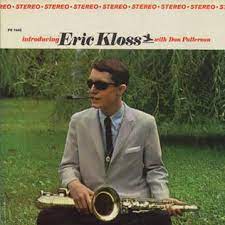
Eric Kloss was born April 3, 1949 in Greenville, Pennsylvania near Pittsburgh, and attended the Western Pennsylvania School for the Blind, which was run by his father. When he was 10, he started on saxophone, and two years later he was playing in night clubs with professional musicians such as Bobby Negri, Charles Bell, and Sonny Stitt. At 16, he recorded his debut album, Introducing Eric Kloss on the Prestige label in 1965, with Don Patterson and Pat Martino.
On his third album, Grits & Gravy, he recorded with musicians over twice his age: Jaki Byard, Richard Davis, and Alan Dawson. He continued recording and performing while a student at Duquesne University. A fan of Elvis Presley and The Ventures, he was attracted to the growth of jazz fusion in the 1960s and ’70s, and eventually played with fusion musicians Chick Corea, Dave Holland, and Jack DeJohnette. He also collaborated with Richie Cole and Gil Goldstein, and did sessions with Cedar Walton, Jimmy Owens, Kenny Barron, Jack DeJohnette, Booker Ervin, Barry Miles, and Terry Silverlight.
By the 1980s, Kloss was teaching at Rutgers University, then Duquesne and Carnegie Mellon. He and his wife, a vocalist, collaborated in a group called Quiet Fire. Saxophonist Eric Kloss has performed and recorded rarely since the Eighties due to health problems.
More Posts: bandleader,history,instrumental,jazz,music,saxophone
Daily Dose Of Jazz…
Salvatore Nistico was born on April 2, 1940 in Syracuse, New York. He started playing alto saxophone, switching to tenor in 1956, and briefly played baritone saxophone. From 1959 to 1961, he played with the Jazz Brothers band, with Chuck Mangione and Gap Mangione.
Nistico played in the 1962–65 Woody Herman group, considered one of his best bands, with Bill Chase, Jake Hanna, Nat Pierce, and Phil Wilson. In 1965, he joined Count Basie but returned on many occasions to play with Herman. Around that time he was also a member of Dusko Goykovich’s sextet with other musicians associated with the Herd, such as Carl Fontana, Nat Pierce, and Michael Moore.
He also played with Nat Adderley, Don Ellis, Buddy Rich, and Stan Tracey. Moving to Europe in his latter years he worked with mostly European musicians as Joe Haider, Isla Eckinger, Billy Brooks, Fritz Pauer. He went on to record with the Larry Porter/ Allan Praskin Band and Three Generations Of Tenor Saxophone with Johnny Griffin, Roman Schwaller, Paul Grabowsky, Roberto DiGioia, Thomas Stabenow, Joris Dudli and Mario Gonzi. The first live performance from 1985 was released under the band’s name on JHM Records Switzerland.
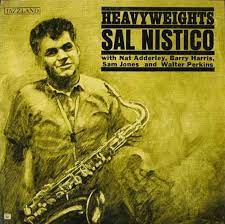
Nistico’s solo work is a contrast to his big band work, with his solo work more oriented towards bebop, as heard on the Heavyweights recording on Riverside Records. Tenor saxophonist Sal Nistico, who was associated for many years with Woody Herman’s Herd, passed away on March 3, 1991, in Berne, Switzerland.
More Posts: bandleader,history,instrumental,jazz,music,saxophone
The Quarantined Jazz Voyager
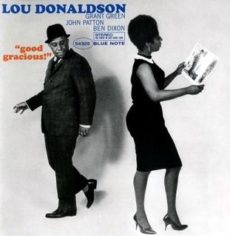
Fourteen months and the end of social distancing and mask wearing is not in sight, and remains the fare for the times as does my continual joy of listening to music. So going into my music room I’ve selected for this week’s enjoyment from the shelves the album Good Gracious!. The studio album was recorded on January 24, 1963 at the Van Gelder Studios in Englewood Cliffs, New Jersy and released on the Blue Note label by saxophonist Lou Donaldson. The album was produced by Alfred Lion and released in the early part of June 1964.
If you’re a fan of Donaldson’s you will notice that his tone is richer and fuller than it is on many of his early-’60s records. He connects with the laid-back R&B grooves and soul-jazz vamps and it remains one of his best soul-jazz sessions.
Track List | 41:59
All compositions by Lou Donaldson except where noted- Bad John ~ 8:18
- The Holy Ghost ~ 8:38
- Cherry (Don Redman) ~ 5:17
- Caracas ~ 7:19
- Good Gracious ~ 6:52
- Don’t Worry ‘Bout Me (Rube Bloom, Ted Koehler) ~ 5:35
- Lou Donaldson – alto saxophone
- Grant Green – guitar
- Big John Patton – organ
- Ben Dixon – drums

More Posts: adventure,album,club,genius,jazz,museum,music,preserving,restaurant,saxophone,travel
Daily Dose Of Jazz…
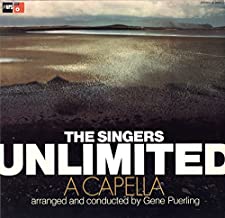
Eugene Thomas Puerling was born on March 31, 1929 in Milwaukee, Wisconsin. He created and led the vocal groups The Hi-Lo’s and The Singers Unlimited. He won a Grammy Award for Best Vocal Arrangement for Two or More Voices in 1982 for his arrangement of A Nightingale Sang in Berkeley Square as performed by The Manhattan Transfer. A Latin song he arranged for Singers Unlimited, “One More Time, Chuck Corea,” inspired by Chuck Mangione and Chick Corea, has been adapted and used by marching bands, drum and bugle corps and jazz ensembles.
His vocal arrangements and chord structures were classic and instantly recognizable. In addition to the afore-mentioned he contributed to Rosemary Clooney’s TV show. His vocal arranging ability and his ability to arrange musical backing by Frank Comstock’s band and several others were widely regarded. Puerling’s innovative use of vocal harmony influenced many groups and musicians, including Take 6, The King’s Singers, The Free Design, Brian Wilson, The Manhattan Transfer, Chanticleer, and the band Glad, the latter three also commissioned him to create original arrangements for them.
Vocalist and vocal arranger Gene Puerling, whose vocal arrangements collection is being housed at The University of North Texas College of Music and Music Library, passed away on March 25, 2008.
Three Wishes
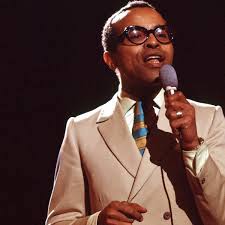
Jon Hendricks told Nica what his three wishes would be when she inquired:
- “Knowledge of God.”
- “Art.”
- “Love.”
*Excerpt from Three Wishes: An Intimate Look at Jazz Greats ~ Compiled and Photographed by Pannonica de Koenigswarter

More Posts: baroness,history,instrumental,jazz,music,pannonica,three,vocal,wishes