
Requisites
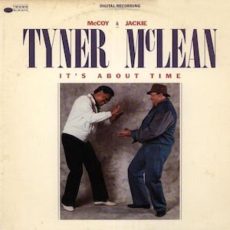
It’s About Time ~ McCoy Tyner and Jackie McLean | By Eddie Carter
This morning’s discussion brings two jazz giants together for their only collaborative album. It’s About Time (Blue Note BT 85102) is a 1985 release by pianist McCoy Tyner and alto saxophonist Jackie McLean (tracks: A1 to A3, B1) that rekindles a sixties Hard-Bop or Post-Bop date and is one of the best kept secrets in both musician’s discographies. The supporting cast is a stellar one, Jon Faddis (tracks: A1, B1) on trumpet, Ron Carter (tracks: A1, B1, B2) on acoustic bass, Marcus Miller (tracks: A2, A3, B3) on electric bass, Al Foster on drums, and Steve Thornton (tracks: A2, A3, B3) on percussion. My copy used in this report is the 1985 US Stereo Full Digital Recording.
Side One opens with the first of five tunes from Tyner’s pen, Spur of The Moment begins with a lively opening chorus in unison. Jon opens the opening solo with tremendous fire and spirit, followed by Jackie who produces some commanding choruses on the second performance. McCoy cooks confidently on the finale with inexhaustible energy into the climax. You Taught My Heart To Sing is a beautiful ballad that’s a showcase for McLean who gives the melody and first solo a warm and moving treatment. Tyner is up next with a delicately gentle reading shadowed by Miller, Foster, and Thornton who anchor both soloists with gorgeous groundwork preceding McLean’s return for the reprise and Tyner’s quiet ending.
It’s About Time begins with a tropical flavor in its blood on a delightfully, feisty midtempo theme led by Jackie who also leads the solos this time with an effective groove, then McCoy follows with a perfectly crafted closing statement. Marcus and Steve provide the spicy compliment that keeps our fingers popping and toes tapping into the group’s soft fadeout. Side Two opens with Hip Toe, a mid~tempo swinger that starts with the front-line and Tyner cruising comfortably into the infectious opening chorus. McLean is up first and comes out swinging on a peppy reading. Faddis answers him with a sharp, zesty statement that builds to a satisfying conclusion. Tyner provides the exclamation point on an extremely happy closing solo before the theme’s return and disappearance.
No Flowers Please by Ron Carter is a trio performance of tranquil beauty that the bassist introduces thoughtfully. McCoy takes the first solo and paints an intimate portrait. Ron closes with a polite, considerate reading executed with fingertip delicacy leading to a tender climax. Travelin’ invites us to take a mid~tempo trip without leaving the comfort of our sweet spot. Miller is the highlight here and demonstrates some stellar bass playing on the opening solo after Tyner’s opening chorus propelled by the rhythm section and Thornton’s percussion. Tyner makes a very personal statement on the closing reading with a grand delivery that brings us safely home after this six-song journey into a gentle culmination.
It’s About Time was produced by Jeffrey Weber and was digitally recorded by Ron Saint German. The sound quality is superb with an outstanding soundstage and excellent stereo separation matching the exceptional interaction between the musicians. The music also flows smoothly and is reminiscent of a classic Blue Note recording of the late fifties or early sixties. If you’re a fan of McCoy Tyner and Jackie McLean, I invite you to audition It’s About Time at your earliest opportunity. It’s an album of wonderful jazz music deserving further investigation for a spot in your library!
© 2021 by Edward Thomas Carter
More Posts: choice,classic,collectible,collector,history,instrumental,jazz,music,piano,saxophone
Daily Dose Of Jazz…
Abbey “Chinee Bébé” Foster was born on January 9, 1902 in New Orleans, Louisiana. A self-taught jazz drummer, he played in Storyville with William Ridgley’s Tuxedo Orchestra, and with Buddie Petit in the Eagle Band.
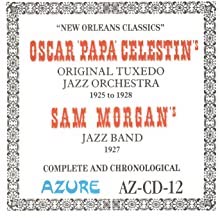
He recorded with Celestin’s Original Tuxedo Jazz Orchestra in 1927. After years of retirement, he made a comeback with Punch Miller’s Band at Preservation Hall in 1961.
On September 12, 1962 drummer Abbey Foster transitioned in his hometown.
More Posts: drums,history,instrumental,jazz,music
Daily Dose Of Jazz…
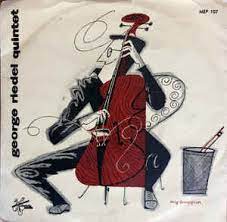
Georg Riedel was born January 8, 1934 in Karlovy Vary, Czechoslovakia, and in 1938, when he was four years old, the family fled to Sweden following the German annexation of the Sudetenland. He attended school in Stockholm, Sweden and at the Adolf Fredrik’s Music School.
The best known recording featuring Riedel is probably Jan Johansson’s Jazz på svenska (Jazz in Swedish), a minimalist-jazz compilation of folk songs recorded between 1962–1963. He recorded with other leading Swedish musicians including trumpeter Jan Allan and Arne Domnérus.
As a composer, George worked almost exclusively writing music for Astrid Lindgren movies, including the main theme from the Emil i Lönneberga (Emil of Maple Hills) movies. He also composed the music for several films by Arne Mattsson in the 1960s as well as for film adaptations of novels by Stig Dagerman.
Double bassist and composer George Riedel, played on Jazz at the Pawnshop in 1977, at 87 continues his involvement with jazz.
Bestow upon an inquiring mind a dose of a Karlovy Vary double bassist to motivate the perusal of the genius of jazz musicians worldwide whose gifts contribute to the canon…
More Posts: bandleader,bass,composer,history,instrumental,jazz,music
Daily Dose Of Jazz…
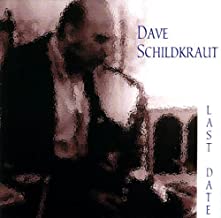
Dave Schildkraut was born on January 7, 1925 in New York, New York and started playing professionally in 1941, first with Louis Prima. He followed this five year residency with Buddy Rich and Anita O’Day through the end of the decade and into the Fifties.
He moved on to hone his craft further by working with Stan Kenton, Pete Rugolo, Oscar Pettiford, Miles Davis, George Handy, Tony Aless, Ralph Burns, Tito Puente, Johnny Richards, and Kenton again in 1959. During the 1960s, Dave freelanced around New York City, appearing regularly with Eddie Bert at the West End Cafe. Later in his life he went into semi-retirement.
His playing was fluid and brilliant in pure bebop style but Schildkraut only recorded one album as a leader, in 1979. However, the album wasn’t released until 2000 by Endgame Records as Last Date. As a sideman he recorded sixteen albums.
Alto saxophonist Dave Schildkraut, whose style mimicked Charlie Parker but later showed influences of John Coltrane, Warne Marsh and Lee Konitz, transitioned on January 1, 1998 in Darien, Connecticut.
More Posts: bandleader,history,instrumental,jazz,music,saxophone
Daily Dose Of Jazz…
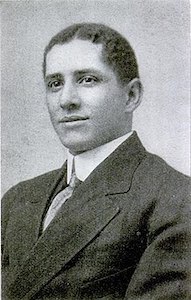
Harry Herbert Pace came into this world on January 6, 1884 in Covington, Georgia. No information is available about his parents but his grandfather was a slave related to his master who ultimately freed him. The young lad however completed elementary school at the age of twelve.
Enrolled at Atlanta University, Pace found work as a printer’s devil or an apprentice mixing tubs of ink and fetching type to pay his way through school. However, after learning that pay equity was higher for whites employees than black employees he left and began working odd jobs on campus instead. While at school he met W. E. B. Du Bois, who was one of his professors, and he went on to graduate valedictorian of his class in 1903, at 19.
A move to Memphis, Tennesse saw Harry going into the printing business with Du Bois. Then two years later they put together the short-lived magazine The Moon Illustrated Weekly. By 1912 he was collaborating and writing songs with W. C. Handy, who took a liking to him. They founded the Pace and Handy Music Company, which brought him to New York City. Around 1920, the company began working with composers William Grant Still and Fletcher Henderson.
A visionary who saw that the growing popularity of the phonograph would shift the music business as it reached a wider audience wanted to expand beyond selling sheet music for parlour playing. Handy had no interest in changing the business, so Pace resigned.
While living in 1921 Harlem, New York he established Black Swan Records after singer Elizabeth Taylor Greenfield, who was called the Black Swan. Their offices were in Times Square and he set up a recording studio in the basement of his brownstone. He brought in Henderson as recording manager and Still as arranger. The label’s first hit was a recording of Down Home Blues and Oh, Daddy, sung by Ethel Waters. Even with outstanding artists the label failed, went into bankruptcy and was sold to Paramount Records in 1923.
In 1925, Pace founded the Northeastern Life Insurance Company in Newark, New Jersey, which became the largest African-American-owned business in the North during the 1930s. Moving to Chicago, Illinois he attended the Chicago-Kent College of Law, receiving his degree in 1933. Around this time, he began passing for White and opened a law firm in downtown Chicago in 1942. His progeny would not discover his African ancestry until well after his death.
Music publisher, record label owner and life insurance executive Harry Pace, who is featured on the documentary series Profiles of African-American Success and in the miniseries The Vanishing of Harry Pace on Radiolab. transitioned on July 19, 1943, in Chicago.
More Posts: history,instrumental,jazz,music,music publisher,record label owner