

Daily Dose Of Jazz…
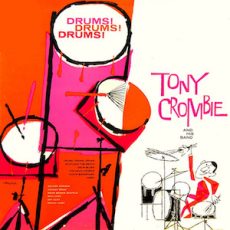
Tony Crombie was born Anthony John Kronenberg on August 27, 1925 in London, England’s East End Jewish community. A self-taught musician, he began playing the drums at the age of fourteen. He was one of a group of young men from the East End of London who ultimately formed the co-operative Club Eleven bringing modern jazz to Britain. He went to New York with his friend Ronnie Scott in 1947, witnessing the playing of Charlie Parker and Dizzy Gillespie, he and like-minded musicians such as Johnny Dankworth, and Scott and Denis Rose, brought be-bop to the UK. This group of musicians were the ones called upon if and when modern jazz gigs were available.
In 1948, Crombie toured Britain and Europe with Duke Ellington, who had been unable to bring his own musicians with him, except for Ray Nance and Kay Davis. Picking up a rhythm section in London, he chose Crombie on the recommendation of Lena Horne, with whom Crombie had worked when she appeared at the Palladium.
By 1956 Tony temporarily left jazz to set up a rock and roll band he called The Rockets, modeling themselves after Bill Haley’s Comets and Freddie Bell & the Bellboys. They released several singles for Decca and Columbia. He is credited with introducing rock and roll music to Iceland, performing there in 1957.
The next year the Rockets had become a jazz group with Scott and Tubby Hayes. During the following year, Crombie started Jazz Inc. with pianist Stan Tracey. During the Sixties he scored for television and film and established a residency at a hotel in Monte Carlo. He toured the UK with Conway Twitty, Freddy Cannon, Johnny Preston, and Wee Willie Harris.
In the early 1960s, Crombie’s friend, Victor Feldman, passed one of his compositions to Miles Davis, who recorded the piece on his album Seven Steps to Heaven. The song, “So Near, So Far”, has been recorded by players including Joe Henderson, who named a tribute album to Miles Davis using the title.
Over the next thirty years, Crombie worked with many American jazz musicians, including Ben Webster, Coleman Hawkins, Illinois Jacquet, Joe Pass, Mark Murphy and Eddie “Lockjaw” Davis.
After breaking his arm in a fall in the mid-1990s he stopped playing the drums, but continued composing until his death. Drummer, pianist, vibraphonist, bandleader and composer Tony Crombie, was regarded as one of the finest English jazz drummers and bandleaders, transitioned on October 18, 1999, aged 74.

More Posts: composer,drums,history,instrumental,jazz,music,piano,vibraphone
Daily Dose Of Jazz…
Sonny Lee was born Thomas Ball Lee on August 26, 1904 in Huntsville, Texas. While a student at Texas State Teachers’ College in the early 1920s he played with Peck Kelley, then moved to St. Louis, Missouri where he worked with the Scranton Sirens, Frankie Trumbauer, Gene Rodemich, Vincent Lopez, and Paul Specht.
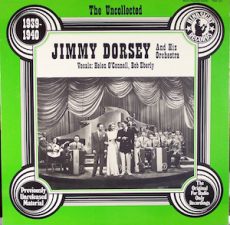
By 1932 he had joined the Isham Jones Orchestra, remaining with Jones until 1936. Concomitantly he played with Benny Goodman in 1934-35. After this stint he went to work with Artie Shaw, Charlie Barnet, Woody Herman, and Bunny Berigan. In 1938 he joined the Jimmy Dorsey Orchestra, where he played until 1946.
Trombonist Sonny Lee, who is credited on nearly 200 recording sessions between 1925 and 1946, transitioned on May 17, 1975 in Amarillo, Texas.
More Posts: history,instrumental,jazz,music,trombone
GEORGE V. JOHNSON JR.
Tribute To Charlie Parker | AH~LEU~CHA
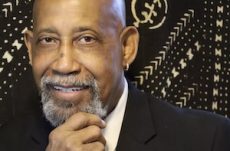
Native Washingtonian, jazz vocalist-songwriter, and recording artist George V. Johnson Jr. will perform (alongside his bandmates) excerpts from the “jazzical” Jazz Iz Really Classical Music, a.k.a. Ah-Leu-Cha, a spirited tribute to Charlie Parker featuring Johnson’s original lyrics.
Deemed “Next in Line” by Eddie Jefferson, the father of the art of jazz vocalese, Johnson continues the legacy of writing lyrics to improvised solos and telling stories we love and appreciate. The performance will be an unforgettable evening celebrating the music of Charlie Parker.
Imagine listening to a seasoned jazz musician rip into a bebop solo so sizzling and smooth it makes your senses tingle. Close your eyes and play along. Try and picture the sweat bouncing off the performer like the notes that leap through the air. See if you can hear the mesmerizing melodies go up and down, bringing you through joy and sadness, taking your emotions on a sensory experience unlike any other. Now picture that musician and his beloved instrument: his voice.
Band members Donvonte McCoy (trumpet), Elijah Easton (tenor saxophone), Allyn Johnson (piano), Herman Burney (bass), and Dana-j Hawkins (drums) are seasoned visionaries who’ve performed across the globe. Join us for a memorable performance.
More Posts: adventure,festival,genius,jazz,music,preserving,travel,vocal

CHARLIE PARKER JAZZ FESTIVAL
Featuring: The Cookers | Ndudzo Makhathini Trio | Endea Owens & The Cookout | Akua Allrich & The Tribe | DJ Sets by Uptown Vinyl Supreme
As part of the Charlie Parker Jazz Festival, the Cookers headline a group of innovative artists that embody a sense of community. Most of this super septet—comprising Billy Harper, Cecil McBee, George Cables, Eddie Henderson, Billy Hart, David Weiss, and Donald Harrison—are veterans of the heady mid-’60s when hard bops gave way to the next wave of jazz, and have been pushing the limits of the sound ever since. Endea Owens and the Cookout is led by the titular house bassist for The Late Show with Stephen Colbert. Hailing from Detroit, Juilliard graduate Owens has found a home in Harlem, where she hosted community cookouts during the COVID-19 pandemic, playing music with her band of fellow virtuosos and handing out hundreds of free meals. Nduduzo Makhathini has become a rising star of South African jazz in both art and academia; the award-winning pianist, improviser, healer, and scholar brings his latest trio to perform selections from The Spirit Of Ntu, his 2022 album for Blue Note Africa. Rounding out the bill is Akua Allrich and The Tribe, led by the jazz and pan-African vocalist with deep musical roots in the blues, soul, and R&B. Allrich and her group the Tribe have drawn accolades for their annual events honoring the defining female voices of Black music, but are also known to craft soul-stirring originals.
Plus, see “We’re Outside”, an exhibition of 10 local artists, curated by Fable Jones Studio, August, 26th, 3-7pm on the west lawn of Marcus Garvey Park (123rd & Mt Morris Park West side) hosted by Heath Gallery and MMPCIA.
More Posts: adventure,festival,genius,jazz,museum,music,preserving,travel

AKUA ALLRICH
Charlie Parker Jazz Festival 2023
Jazz vocalist and DC-native Akua Allrich has proven herself to be a musician of extraordinary talent and crowd-moving passion. With finesse and charisma, this vocalist, composer and teacher, has successfully etched out a place for her unique musical expression, electrifying audiences in and around the nation’s capital with sold-out performances.
With the launch of her independently produced albums, A Peace of Mine in 2010, Uniquely Standard, Akua Allrich Live! in 2012, and her latest release Soul Singer, the young artist’s music and concerts created a significant buzz with critics and music-lovers alike. Said Franz Matzner of All About Jazz, “Akua Allrich’s music flows with a free, natural energy as engaging as her equally ingenuous personality.” Her appeal soon reached across US borders and attained international attention. In early 2011, Allrich signed a distribution deal with Japanese record label AGATE/Inpartmaint Inc. Her debut CD, A Peace of Mine, was released in Japan during their “Golden Week” of May 2011. Music lovers and tastemakers from around the world expressed their appreciation and excitement for this new music.
Allrich’s style is fluid and ever evolving. Her musical roots run deeply into blues, soul and rhythm and blues, with a clear grounding in jazz and pan-African music. She sings in many languages including Portuguese, French, Spanish, English, Xhosa, and Twi. Given her ability to capture the essence of a broad range of musical genres, Allrich is often likened to legendary artists such as Oscar Brown, Jr., Miriam Makeba and Nina Simone. She has developed popular tribute programs involving the latter two women and other great African American women of jazz.
Akua Allrich was educated at Howard University, where she obtained her BM in jazz vocals and a master’s degree in social work. She was taught, coached and mentored by talented musicians such as world-renowned singer Kehembe V. Eichelberger, singer/drummer Grady Tate, and pianist Charles Covington.
Joining her is The Tribe: Kris Funn ~ bass, Samuel Prather ~ keys, Tyler Leak ~ drums
More Posts: adventure,festival,genius,jazz,music,preserving,travel,vocal