

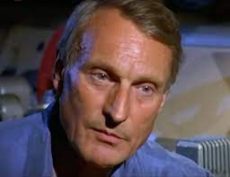
Three Wishes
Francis Paudras replied to the query of three wishes by the Baroness with:
- “To ‘ave ze Beatles naked on ze stage on all fours, cut zeir ‘air, and zen close zem up, and force zem to listen to ze works of Monk, twenty-four hours on twenty-four!”
- “Zat ze world of music take conscience of ze importance, ze true place of Bud Powell in music, not just jazz.”
- “I would like for jazz coming ze ambassador for peace in ze world.”
*Excerpt from Three Wishes: An Intimate Look at Jazz Greats ~ Compiled and Photographed by Pannonica de Koenigswarter

More Posts: baroness,history,instrumental,jazz,music,pannonica,piano,three,wishes,writer
Daily Dose Of Jazz…
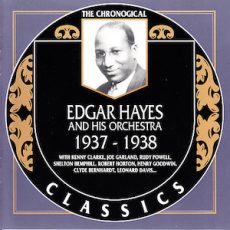
Edgar Junius Hayes was born on May 23, 1902 in Lexington, Kentucky and attended Wilberforce University, graduating with a degree in music. In 1922 he toured with Fess Williams, and formed his own group in 1924, the Blue Grass Buddies, in Ohio. The following year he played with Lois Deppe. Later in the decade he led the groups Eight Black Pirates and the Symphonic Harmonists.
For five years from 1931 to 1936 Hayes played and arranged for the Mills Blue Rhythm Band. Hayes again led his own orchestra from 1937 to 1941 and Kenny Clarke was among his sidemen. His most popular recording was a version of the song Stardust and the original recording of In the Mood which was later covered by Glenn Miller; both songs were recorded in 1938.
Moving to California in 1942 and led a quartet there for most of the decade. Following this he played solo, continuing to perform live into the 1970s. He recorded under his own name several times between 1937 and 1960.
Pianist and bandleader Edgar Hayes transitioned in San Bernardino, California on June 28, 1979.

More Posts: bandleader,history,instrumental,jazz,music,piano
Daily Dose Of Jazz…
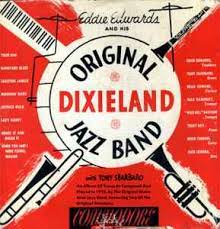
Edwin Branford “Eddie” Edwards was born on May 22, 1891 in New Orleans, Louisiana and started on violin at age 10 and five years later he picked up the trombone. In 1916, he was chosen to go to Chicago, Illinois by Alcide Nunez to play trombone with Johnny Stein’s Jazz Band. With a few changes of personnel, this band became the Original Dixieland Jass Band, which made the first jazz records in 1917. He played on one of the first commercially released jazz recordings, Livery Stable Blues, later released as Barnyard Blues.
Leaving the band after being drafted into the United States Army, he served from July 1918 to March 1919. After being discharged, Eddie led his own band and worked in Jimmy Durante’s band before returning to the Original Dixieland Jass Band. After that band broke up, he again led a band in New York City for most of the 1920s until retiring from music in the early Thirties. He then ran a newspaper stand and worked as a sports coach.
Coming out of retirement he returned to music in 1936 when Nick LaRocca reformed the Original Dixieland Jazz Band, playing with them until 1938. He played in other bands with Larry Shields, Tony Sbarbaro, and J. Russell Robinson in New York City into the 1940s. He continued playing professionally intermittently until shortly before his death.
His composition Sensation Rag or Sensation was performed at the 1938 Benny Goodman jazz concert at Carnegie Hall and was included on the album The Famous 1938 Carnegie Hall Jazz Concert. Darktown Strutters’ Ball, composed by Shelton Brooks, a Black man, was recorded by the Original Dixieland Jass Band and inducted into the Grammy Hall of Fame in 2006.
Trombonist Eddie Edwards, who played both violin and trombone, and who also played minor-league baseball and worked as an electrician, transitioned on April 9, 1963 in his hometown at the age of 71.
More Posts: bandleader,history,instrumental,jazz,music,trombone,violin
Requisites
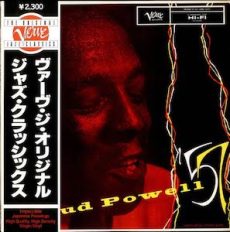
Bud Powell ‘57 ~ Bud Powell | By Eddie Carter
I wanted to hear something soothing after dinner a few nights ago, so I chose one of my favorite records by pianist Bud Powell. This morning’s album from the library comprised three sessions and was initially released as Jazz Original in 1955 and reissued two years later as Bud Powell ’57 (Norgran Records MG N-1098). He’s leading two trios in a program of nine standards. Percy Heath (tracks: A1 to A3), Lloyd Trotman (A4, B2 to B5) on bass, Max Roach (tracks: A1 to A3), and Art Blakey (A4, B2 to B5) on drums. My copy is the 1981 Verve Original Jazz Classics Japanese Mono audiophile reissue (UMV 2571) by Polygram Records.
Deep Night, by Charles E. Henderson and Rudy Vallée, opens the album and is introduced by Bud, then Percy and Max join him to complete the melody. Powell is the song’s only soloist and gives a briskly efficient interpretation complimented by the rhythm section’s compelling understructure leading to the climax. Next, the trio takes on That Old Black Magic by Harold Arlen and Johnny Mercer. It made its debut in the 1942 film Star Spangled Rhythm. The trio opens the song with a deceptively simple melody before Bud makes a tremendous statement toward the ensemble’s exit.
‘Round Midnight by Thelonious Monk, Cootie Williams, and Bernie Hanighen is one of the most recorded compositions in jazz. Powell opens with a hauntingly beautiful introduction which grows into the trio’s gorgeous melody. Bud has the spotlight and demonstrates delicacy over Percy and Max’s subtle accompaniment ahead of a pretty ending. Thou Swell by Richard Rodgers and Lorenz Hart comes from the 1927 musical, A Connecticut Yankee. The trio picks up their pace to a medium tempo, and Powell leads Trotman and Blakey in the melody. The pianist feeds off their energy and does an excellent job freshening up this old chestnut with a bright performance.
Side Two starts with Like Someone in Love by Jimmy Van Heusen and Johnny Burke, a solo performance by Bud that premiered in the 1944 film Belle of The Yukon. Powell has the showcase alone here, and right from the song’s entrance, he brings out its warmth of lyricism, tenderness, and sincerity in one of the album’s prettiest performances. Someone To Watch Over Me by George and Ira Gershwin is from the 1926 musical, Oh, Kay! Initially known as a torch song, the group’s interpretation is performed flawlessly, with Powell showing the utmost respect during the melody and in his solo. Trotman and Blakey anchor him politely, preceding the closing chorus.
The tempo moves upward again for Lover Come Back To Me by Sigmund Romberg and Oscar Hammerstein II. It appeared first in the 1928 musical, The New Moon, and it’s a catchy tune beginning with the threesome’s lively opening chorus. Bud opens the song’s only solo at a brisk gallop, complemented by Lloyd and Art leading to the trio’s finale. Tenderly by Walter Gross and Jack Lawrence is an enchanting song about finding love. Powell’s piano makes the introduction which grows into a delicately gentle theme; then Bud reminisces nostalgically in an excellent interpretation preceding the ending.
The album ends with How High The Moon by Morgan Lewis and Nancy Hamilton. It’s an infectious tune with a driving beat that takes off after Bud’s introduction. The pianist swings to Lloyd and Art’s zesty foundation into the theme’s reprise and climax. Norman Granz supervised the initial album, and it’s unknown who was the recording engineer. However, the reissue’s sound quality is excellent, with a stellar soundstage that brings the musicians into your listening room with incredible clarity. The record is pressed on virgin vinyl and silent until the music starts. If you’re in the mood for a relaxing album to enjoy after a long day or week, I offer for your consideration Bud Powell ’57. It’s an endlessly satisfying trio album that I’m sure you’ll enjoy!
~ Jazz Original (Norgran Records MG N-1017) – Source: Discogs.com ~ How High The Moon, Like Someone In Love, Lover Come Back To Me, ‘Round Midnight, Someone To Watch Over Me, Tenderly, That Old Black Magic, Thou Swell – Source: JazzStandards.com ~ Deep Night – Source: Wikipedia.org © 2023 by Edward Thomas Carter

More Posts: choice,classic,collectible,collector,history,instrumental,jazz,music,piano
Daily Dose Of Jazz…
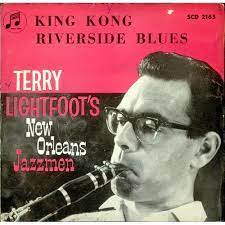
Terence Lightfoot was born on May 21, 1935 in Potters Bar, Middlesex, England. He started his musical career as a vocalist during early school life, singing popular songs with a small amateur variety group. In 1949, he came to jazz while at Enfield Grammar School in Enfield Town, London, England. He changed from playing the trumpet to clarinet to meet the needs of the traditional Dixieland jazz band of his friends. After leaving school, he formed his first jazz band, the Wood Green Stompers.
In 1955 he formed the band Terry Lightfoot’s New Orleans Jazzmen. In the Sixties they had three minor hits in the UK Singles Chart in 1961 and 1962, True Love, King Kong and Tavern in the Town. The group made regular Sunday night appearances at the Wood Green Jazz Club.
Clarinetist Terence Lightfoot transitioned from prostate cancer in Milton Keynes General Hospital on March 15, 2013 at the age of 77.
More Posts: bandleader,clarinet,history,instrumental,jazz,music