

Daily Dose Of Jazz…
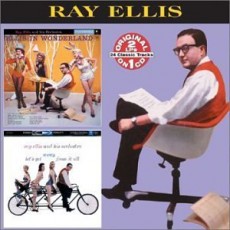
Ray Ellis, born July 28, 1923 in Philadelphia, Pennsylvania became a well-known record producer, arranger and conductor. In the 1950s and 60s he produced easy-listening sessions for RCA Victor, MGM an Columbia, recorded such well known works as a leader “Let’s Get Away From It All” and “Ellis In Wonderland”.
Ray arranged such works as “A Certain Smile” for Johnny Mathis, “Broken Hearted Melody” for Sarah Vaughan and “Standing On The Corner” for the Four Lads, but his best known jazz orchestration is Billie Holiday’s “Lady In Satin”. He would collaborate with Lena Horne, Emmy Lou Harris, Barbra Streisand, Harold Land, The Drifters, Connie Francis and others
Ellis’ work encompassed all areas of music, from records to film, commercials, and television. His television theme music credits include NBC News At Sunrise with Connie Chung, The Today Show and the original Spider-Man cartoon series.
From 1968 to 1982 Ellis along with Norman Prescott composed and arranged nearly all of the background music for cartoon studio Filmation, composed and conducted the music for Fantastic Voyage, The Hardy Boys, Flash Gordon, The Archie Show and Sabrina The Teenage Witch. He was responsible for such game show themes such as Sale of the Century, Scrabble and Scattergories among others.
Ray Ellis’ prolific career ended with his death from complications from melanoma on October 27, 2008 in Encino, California.
More Posts: arranger,conductor,record producer
Daily Dose Of Jazz…
Joel Harrison was born on July 27, 1957 in Washington D.C. In the Sixties he became enamored with the inventive guitarists such as Jimi Hendrix and John McLaughlin. By his twenties, after graduating from Bard College, he hitchhiked across America exploring the rich diversity contained between its coasts.
Joel’s musical style encompasses a melding of jazz, classical, country, rock and world influences as the composer, arranger, songwriter, vocalist and bandleader stretches from concert hall to jazz club and the occasional dive bar. Finding inspiration from music too often barred from admission into the jazz consciousness, he continues his exploration into the reinterpretations of Miles Davis, Charles Ives, Walt Whitman, Jack Kerouac and Hank Williams.
He is a Guggenheim Fellow, a two-time winner of the Jazz Composer’s Alliance Composition Competition, 1st Place at the Percussive Arts Society worldwide competition, and has received grants from Chamber Music America, Meet the Composer, the Flagler Cary Trust, NYSCA, and the Jerome Foundation.
With a string of albums under his belt in a variety of genres, guitarist Joel Harrison has played and recorded with an impressive list of collaborators that includes Christian Howes, Donny McCaslin, Nels Cline, David Binney, Norah Jones, Dave Liebman, Uri Caine, Jamey Haddad, and Dewey Redman. He continues to compose, record, perform and tour.
More Posts: guitar
Requisites
Sphere On Tour ~ Sphere | By Eddie Carter
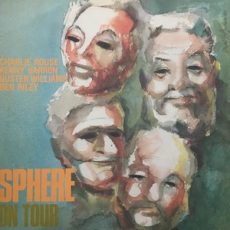
This morning’s album from the library is a 1985 live recording by the bop quartet Sphere. Sphere on Tour (Red Record VPA 191) was the first of two live dates in their small discography and one of two records they recorded for the Italian label. Sphere took the pianist’s middle name and was originally formed to honor Thelonious Monk’s legacy after his death. The quartet quickly broadened its focus by recording albums that also featured its own original compositions. The group consists of two former members of Monk’s group, tenor saxophonist Charlie Rouse and drummer Ben Riley, and is anchored by pianist Kenny Barron and bassist Buster Williams. The copy I own is the 1986 Italian stereo release.
Dual Force by Buster Williams opens the set with the foursome’s lively melody setting the tone. Kenny gets things started with a spirited lead solo, then Charlie wails enthusiastically in a lengthy performance. Buster takes a short, scintillating statement leading to the theme’s restatement and an upbeat finish. Beautiful Friendship by Donald Kahn and Stanley Styne slows the pace when the rhythm section’s pretty introduction moves to an upbeat theme when Charlie enters. Kenny is up first to give a charming solo, then Charlie cooks at an easy groove next. Buster evokes a sense of intimacy in a short statement, and Ben has the last word before the theme returns and the song ends softly.
Scratch by Kenny Barron begins with the foursome’s offbeat introduction and melody. Charlie’s opening statement pushes his solo to the outer limits of musical boundaries. Kenny follows with a bit of quirky fun, then Buster takes an interesting walk, preceding the quirky theme reprise and abrupt stop. Tayamisha by Buster Williams starts Side Two at midtempo with the bassist’s introduction to the opening ensemble. Charlie leads the way with a smoothly flowing interpretation. Kenny comes in next for a delightful display of evident pleasure, then Buster takes us home in a short walk of consummate ease ahead of the quartet’s theme restatement and ending.
Up next is Spiral by Kenny Barron. Kenny brings the song to life, segueing into the quartet’s melody. Charlie sets the tone in the first solo with warmth, deep conviction and melodic beauty. Kenny follows with an exquisite, elegant statement, then Buster communicates his heart before the foursome regroups for the theme’s return. To conclude the album, the quartet dresses up one of Thelonious Monk’s most popular tunes, Well, You Needn’t, mistakenly listed as “Will, You Needn’t,” with a spirited introduction by Riley and the rhythm section, ahead of the ensemble melody. Charlie is off to the races with an intense drive. Kenny builds upon his solo with a steady attack, then Buster takes a short, swift walk leading back to the ending theme, band introductions and a pleasant goodnight to the audience.
Sphere on Tour was produced by Red Records co-founders Alberto Alberti and Sergio Veschi. Gianni Grassilli was the recording engineer, and the album’s sound quality is superb, with a soundstage that transports the listener to the audience as the musicians perform. The original group, consisting of Rouse, Barron, Williams, and Riley, recorded six albums from 1982 to 1988. They disbanded briefly after Rouse’s death, then made one final album with Gary Bartz in 1997. If you’re in the mood for live bop from a fabulous quartet who effortlessly blend innovation and tradition, I invite you to check out Sphere on Tour on your next record shopping trip. It’s a terrific introduction to their music collectively and might become a welcome addition to your jazz library!
~ A Beautiful Friendship, Well, You Needn’t – Source: Wikipedia.org
© 2026 by Edward Thomas Carter

More Posts: bass,choice,classic,collectible,collector,drums,history,instrumental,jazz,music,piano,saxophone
Daily Dose Of Jazz…
Charli Persip was born Charles Lawrence Persip on July 26, 1929 in Morristown, New Jersey. The drummer became known as Charlie but in the 1980s dropped the “e” to become Charli.
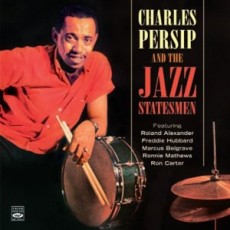
He played with Tadd Dameron in 1953, then toured and recorded with Dizzy Gillespie’s big and small bands between 1953 and 1958 before joining with Harry “Sweets” Edison quintet. He followed this stint with the Harry James Orchestra before forming his own group, the Jazz Statesmen, with Roland Alexander, Freddie Hubbard and Ron Carter in 1960.
During this period Persip also recorded with Lee Morgan, Dinah Washington, Melba Liston, Kenny Dorham, Zoot Sims, Red Garland, Gil Evans, Don Ellis, Eric Dolphy, Rahsaan Roland Kirk and Gene Ammons among others.
Charli would go on to record on the legendary “Eternal Triangle”, with Sonny Rollins and Sonny Stitt on “Sonny Side Up” and from 1960 to 1973 toured as a drummer and conductor with Billy Eckstine. As an educator has given drum and music instruction for Jazzmobile, Inc. in New York since 1974 and is currently an Associate Professor at the New School for Jazz and Contemporary Music.
In the mid 1980s Persip led Superband that evolved into Suppersound, his jazz big band. Supersound’s first album recorded for Stash titled Charli Persip and Superband was followed by Superband 11, No Dummies Allowed and Intrinsic Evolution. Drummer Charli Persip recorded 27 albums as a leader and a sideman and continued to record and perform until he died on August 23, 2020, at Mount Sinai Morningside in New York City at the age of 91.
More Posts: drums
Daily Dose Of Jazz…
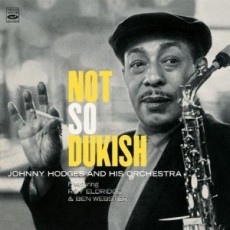
Johnny Hodges was born John Keith Hodges on July 25, 1906 in Cambridge, Massachusetts but soon after the family moved to Boston. Growing up with baritone saxophonist Harry Carney and saxophonists Charlie Holmes and Howard E. Johnson, he started out on drums and piano and was mostly self-taught. He became good enough to play the piano at dances in private homes. By the time he was a teenager, he took up the soprano saxophone and around this time he picked up the nickname “Rabbit”, either for his ability to outrun truant officers or his nibbling on lettuce and tomato sandwiches.
When Hodges was 14 he saw Sidney Bechet, introduced himself, played a tune, received encouragement to continue to play and grew a name for himself in the Boston area till he moved to New York in 1924, able to play both the alto and soprano saxophone.
Hodges started playing with Lloyd Scott, Sidney Bechet, Lucky Roberts and Chick Webb. In 1928 he joined the Ellington orchestra and became one of the identifying voices on both alto and soprano sax. Leaving Duke in 1951 to lead his own band, he returned four years later shortly before Ellington’s 1956 performance at the Newport Jazz Festival. Ellington would write pieces like “Confab with Rab”, “Jeep’s Blues”, “Sultry Sunset”, “Hodge Podge” and “Prelude To A Kiss” among many others that featured Hodge.
Johnny’s pure tone and economy of melody on both the blues and ballads won him admiration from musicians of all eras and styles, from Ben Webster to John Coltrane, who both played with him when he had his own orchestra in the 1950s, to Lawrence Welk, who featured him in an album of standards.
Alto saxophonist Johnny Hodges’ last recordings are featured on the New Orleans Suite album and his final performances were at the Imperial Room in Toronto, less than a week before his death from a heart attack on May 11, 1970. He is considered one of the definitive alto saxophones players of swing in the Big Band Era and of mainstream jazz.
More Posts: saxophone