

Daily Dose Of Jazz…
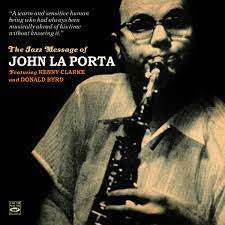
John Daniel LaPorta was born on April 13, 1920 in Philadelphia, Pennsylvania and started playing clarinet at the age of nine. He studied at the Mastbaum School in Philadelphia, alongside classmate Buddy DeFranco. As a teenager he played in local bands with Charlie Ventura and Bill Harris, and studied classically with Joseph Gigliotti of the Philadelphia Orchestra and Leon Russianoff at the Manhattan School of Music.
1942 saw him as a member of the Bob Chester big band for two years, then spent the following two years with the Woody Herman Orchestra. Beginning in 1947, he studied with Lennie Tristano, and with Teo Macero and Charles Mingus he was a member of the Jazz Composers Workshop, trying to combine jazz with classical music. Classically, he worked with Boston Pops, Leonard Bernstein, Leopold Stokowski, and Igor Stravinsky. In jazz he worked with Kenny Clarke, Miles Davis, Dizzy Gillespie, Charlie Parker, Buddy Rich, and Lester Young.
In 1956, La Porta played the first jazz concert in Venezuela at Caracas National Theater, where a selection of the repertoire performed was released under the title South American Brothers by Fantasy Records, becoming the first jazz recording in Venezuela.
As an educator he taught at Parkway Music School, then at public schools on Long Island, followed by the Manhattan School of Music and the Berklee College of Music. With guitarist Jack Petersen, he pioneered the use of Greek modes for teaching chord-scales.
In the 1990s, he retired to Sarasota, Florida, where he performed at the Sarasota Jazz Club and as a guest with the Fred Williams Trio. His autobiography is titled Playing It by Ear. Clarinetist and composer John LaPorta transitioned from complications of a stroke on May 12, 2004 in Sarasota.
More Posts: bandleader,clarinet,composer,history,instrumental,jazz,music
Three Wishes
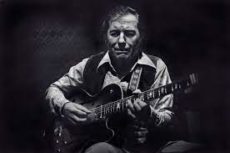
When asked what his three wishes would be, Chuck Wayne answered with:
-
-
“The funny part is, I really… you know, frankly? I can’t think of any! Because frankly, I like things the way they are. I really don’t want to be rich, I love my wife, I have wonderful children, and I have a certain amount of security, which is substantial enough for me. I really don’t care for anything else. Between music and my wife and kids’ love, life is pretty good as it is. There are so few other things that count. Would a million dollars help me play a good chorus? Or give me more to the one I love?”
-

More Posts: guitar,history,instrumental,jazz,music,pannonica,three,wishes

Daily Dose Of Jazz…
Esther Miller was born on April 12, 1968 and raised in the east coastal motor city of Port Elizabeth, South Africa. It is here that she sang in church and school choirs and raided the family Nat King Cole albums for early inspiration.
Leaving Port Elizabeth to study medicine at Cape Town University, she soon gave in to the lure of jazz. Esther started her professional career as the vocalist with Gerry Spencer’s Jazz Cyclone, one of the leading bands on the South African jazz circuit at the time.
During this early apprenticeship Miller worked with some excellent players on both sides of the pond, Herb Ellis, Alan Skidmore, Johnny Fourie, Errol and Alvin Dyers, Winston Mankunku and Ezra Ngkukana, to name but a few.
Esther has honed her technique with classical singing lessons and delved into jazz history, gleaning inspiration from Sarah Vaughan, Billie Holiday, Shirley Horn, Blossom Dearie, Frank Sinatra, and of course, Nat King Cole.
She performed in South African jazz festivals, concert halls and jazz clubs before settling in the United Kingdom for 10 years. There she performed and recorded with some excellent musicians including Steve Melling, Steve Waterman, Zoltan Dekany, Karen Sharp, among others.
Possessing an outstanding technique and sensitive interpretation, with a half dozen albums under her belt, vocalist Esther Miller has moved to Denmark where she continues to add to her repertoire as she explores the Scandinavian jazz scene.
More Posts: bandleader,history,instrumental,jazz,music,vocal

Daily Dose Of Jazz…
Jimmy Lewis was born April 11, 1918 in Nashville, Tennessee learned to play the bass and though little is known about his early years, he began working professionally with the Count Basie Orchestra and sextet in the 1950s. He went on to perform with Duke Ellington, Cootie Williams, Billie Holiday and Ivory Joe Hunter.
Moving to bass guitar during his time with King Curtis, Jimmy freelanced profusely, recording on over four dozen jazz, soul and R&B albums. He was a sideman and sessionplayer with Solomon Burke, Billy Butler, Al Casey, David Clayton-Thomas, Sam Cooke, Lou Donaldson, Byrdie Green, Grant Green, Tiny Grimes, John P. Hammond, Richard “Groove” Holmes, Alberta Hunter, Willis Jackson, Boogaloo Joe Jones, Charles Kynard, Johnny Lytle, Freddie McCoy, Galt MacDermot, Modern Jazz Quartet, Idris Muhammad, Mark Murphy, Houston Person, Sonny Phillips, Wilson Pickett, Otis Redding, Dave Pike, Arthur Prysock, Horace Silver, Johnny “Hammond” Smith, Buddy Terry, Charles Williams.
Continuing to perform and record up until the Eighties, double bassist Jimmy Lewis, who provided the basslines for the Broadway musical Hair, transitioned in New York City in 2000.
Requisites
Full House ~ Wes Montgomery | By Eddie Carter
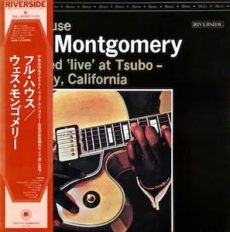
In a game of poker, a full house is a five-card hand containing three-of-a-kind and a pair of another. The three-of-a-kind in this morning’s discussion to begin April is a brilliant trio that at the time was Miles Davis’ rhythm section but also a spectacular group in their own right. The pair is a little giant who was diminutive only in height but possessed a robust sound and an extraordinary guitarist who’d taken the jazz world by storm with his playing. Full House (Riverside RLP 434/RS 9434) is a 1962 live date by Wes Montgomery performed with a world-class quartet, Johnny Griffin on tenor sax, Wynton Kelly on piano, Paul Chambers on bass, and Jimmy Cobb on drums. My copy used in this report is the 1974 Victor Musical Industries Japanese Stereo reissue (Riverside SMJ-6069).
The opener, Full House is an original by Wes welcoming everyone inside the club with the quintet’s festive theme. The leader cooks on the first solo with an infectiously happy groove. Johnny comes in next, swinging strongly on the second reading. We’re then treated to a rollicking finale by Wynton punctuated by the rhythm section’s groundwork leading to the climax. I’ve Grown Accustomed To Her Face by Frederick Loewe and Alan Jay Lerner made its debut in the musical, My Fair Lady (1956). This is a trio tune with Wes supported only by Paul and Jimmy. The guitarist approaches the melody and song’s only solo with an intimate beauty and graceful lyricism that’s gorgeously rendered culminating in a tender finale receiving appreciative applause from the crowd.
Blue ‘N’ Boogie by Dizzy Gillespie and Frank Paparelli begins with the ensemble’s vigorous melody. Montgomery begins in good spirits with a lively opening statement, then Kelly shows a masterful hand on the keys. Griffin thrills the listener with utter delight on the next interpretation. Cobb shares an energetic exchange with Wes, Johnny, and Wynton before taking the spotlight himself leading to the ensemble’s reprise and exit. Cariba, the guitarist’s second tune opens Side Two with a positively tropical flavor in the quintet’s theme. Paul lays down some bluesy bass lines on the first solo. Wynton opens the second presentation with exceptionally smooth execution. Griff delivers a good deal of happy excitement in the third reading. Wes adds a pleasant punctuation with a light-hearted, friendly finale.
Come Rain or Come Shine by Harold Arlen and Johnny Mercer premiered in the Broadway musical, St. Louis Woman (1946). Montgomery and the trio pick up the tempo on the introduction and theme. Johnny kicks things off with some exciting blowing. Wes propels the second solo with tasteful playing, and Wynton closes with an eminently enjoyable interpretation before the song’s conclusion. This delightful set concludes with an uptempo cooker by Wes, S.O.S. The ensemble soars collectively in the opening chorus, then Griffin delivers the first solo with a fiery passion. Wes follows with an equally assertive second statement. Wynton adds a bit of effervescent energy to the third reading. Jimmy provides the final fireworks in a conversation with Griff and Wes into the group’s finish.
A few months after the quintet recorded Full House, Tsubo closed, later reopening as The Jabberwock, offering its patrons folk music. It remained open a few more years until the doors closed for good in 1967. This album was produced by Orrin Keepnews and Wally Heider was the recording engineer. Victor Musical Industries has done a fantastic job with the mastering because this reissue sounds incredible with an outstanding soundstage placing the listener in the club with exceptional clarity. If you’re a fan of Wes Montgomery, Johnny Griffin, or Wynton Kelly, I offer for your consideration on your next vinyl expedition, Full House. The music throughout is excellent and there’s superb playing from all hands, making this a perfect title for any jazz library!
~ Come Rain or Come Shine – Source: JazzStandards.com
~ Blue ‘N’ Boogie, I’ve Grown Accustomed To Her Face, The Jabberwock – Source: Wikipedia.org © 2022 by Edward Thomas Carter

More Posts: choice,classic,collectible,collector,guitar,history,instrumental,jazz,music