

Daily Dose Of Jazz…
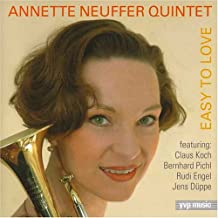
Annette Neuffer was born on January 15, 1966 in Munich, Germany. She didn’t start playing the trumpet until he was 18. Three years later she began studying music at the Graz University of Music , majoring in jazz trumpet . Another two yearsand she moved to the Stuttgart University of Music and Performing Arts, where she completed her diploma under Claus Stötter in 1996.
As a trumpeter she has worked with the Sarah Morrow Allstars in Paris, Benny Golson, Hal Singer, Mike Carr, Benny Waters, Jimmy Woode, and Horst Jankowski. In 1994 Annette was invited by the Sunday Night Orchestra as a singer for a project with Al Porcino. In 1995 she brought Porcino into his own big band, of which she was a singer for eleven years.
Since 2001 she has released four albums with her own quintet. She is an active composer and lyricist. She performed with the Bobby Burgess Big Band Explosion, Alexander’s Swingtime Band and Pete York. Vocalist, trumpeter, composer and lyricist Annette Neuffer continues to compose, perform and record.
More Posts: bandleader,history,instrumental,jazz,music,trumpet,vocal
Daily Dose Of Jazz…
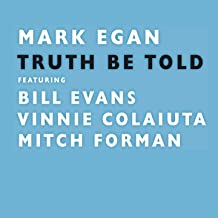
Mark Egan was born on January 14, 1951 in Brockton, Massachusetts and was influenced by his father, studying trumpet at age 10. Playing the trumpet throughout high school, he began playing the bass when he was fifteen. While attending the University of Miami’s Frost School of Music, initially a trumpet student, he studied with Jerry Coker. He switched from trumpet to bass part way through the program. His teachers included Jaco Pastorius, Dave Holland, and Andy LaVerne. While in Miami he became friends and performed with Ira Sullivan, Pat Metheny, Danny Gottlieb, Clifford Carter.
After graduate school, in 1975 Egan went on tour with Eumir Deodato and the Pointer Sisters and recorded with David Sanborn. Two years later, working as a studio musician in New York City, he met Joe Beck and Steve Khan. He then joined the Pat Metheny Group until 1981, before starting the jazz fusion band Elements with the Group’s drummer, Danny Gottlieb. They were joined by saxophonist Bill Evans and keyboardist Clifford Carter. They recorded and toured through the 1990s. During the 1980s and Nineties, he was a member of the Gil Evans Orchestra.
He founded his own record label, Wavetone Records and has made three music videos: Om Yoga & Meditation, Music on the Edge, and Bass Workshop. He has appeared on the soundtracks of movies including Two Moon Junction, The Object of My Affection, You’ve Got Mail, The Color of Money, Rollover, Quick Change, Blown Away, and A Chorus Line. He recorded an album, Urge, with trumpeter Forrest Buchtel, Jr., featuring, among other things, the theme from CNN Headline News.
Egan has toured and recorded with jazz artists including Stan Getz, Gil Evans, John McLaughlin, Larry Coryell, Pat Martino, Pat Metheny, Michael Franks, Jim Hall, Bill Evans, Lew Soloff, Paul Shaffer, rock and pop musicians and The Pointer Sisters, Sting, Arcadia, Roger Daltrey, Joan Osborne, Marianne Faithfull, Carly Simon, Art Garfunkel, Judy Collins, Sophie B. Hawkins, Bryan Ferry, Joe Beck, as well as Brazilians Airto Moreira, Flora Purim, and Toninho Horta.
Bassist and trumpeter Mark Egan continues to perform and record.
More Posts: bandleader,bass,history,instrumental,jazz,music,trumpet
Daily Dose Of Jazz…
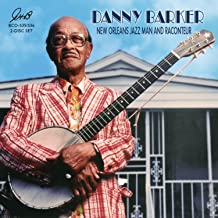
Daniel Moses Barker was born on January 13, 1909 in New Orleans, Louisiana to a family of musicians, the grandson of bandleader Isidore Barbarin and nephew of drummers Paul Barbarin and Louis Barbarin. He took up the clarinet and drums before switching to a ukulele that his aunt got him, and then to banjo. One of Barker’s earliest teachers in New Orleans was fellow banjoist Emanuel Sayles, with whom he would record.
Barker began his career as a musician in his youth with his streetband, the Boozan Kings, and toured Mississippi with Little Brother Montgomery. 1930 saw him moving to New York City where he switched to the guitar. Through the decade he played with Fess Williams, Billy Fowler and the White Brothers, Buddy Harris, Albert Nicholas, Lucky Millinder, and Benny Carter in 1938. During his time in New York, he frequently played with West Indian musicians, who often mistook him for one of them due to his Creole style of playing.
From 1939 to 1946 he frequently recorded with Cab Calloway, and started his own group featuring his wife Blue Lu Barker after leaving Calloway. In 1945 he recorded with pianist Sir Charles Thompson, and saxophonists Dexter Gordon and Charlie Parker. In 1947 he was back with Lucky Millinder and Bunk Johnson. He returned to working with Al Nicholas in 1948 and in 1949 rejoined efforts with his wife in a group.
During the 1950s Danny was primarily a freelance musician, but did work with his uncle Paul Barbarin from 1954 to 1955. In the mid-1950s he went to California to record again with Albert Nicholas; performed at the 1960 Newport Jazz Festival with Eubie Blake. In 1963 he was working with Cliff Jackson, and then in 1964 appeared at the World Fair leading his own group. Sometime in the early 1960s he formed a group he called Cinderella. The following year he returned to New Orleans and took up a position as assistant to the curator of the New Orleans Jazz Museum.
In 1970 he founded and led a church-sponsored brass band for young people ~ the Fairview Baptist Church Marching Band. The Fairview band launched the careers of a number of professional musicians who went on to perform in brass band and mainstream jazz contexts, including Leroy Jones, Wynton Marsalis, Branford Marsalis, Kirk Joseph, Nicholas Payton, Shannon Powell, Lucien Barbarin, Dr. Michael White and others. In later years the band became known as the Dirty Dozen Brass Band.
He played regularly at many New Orleans venues from the late 1960s through the early 1990s, in addition to touring. Beyond overcoming the obstacles of segregation, banjoist Danny Barker, who also sang and played guitar and ukulele, authored two books and was an amateur landscape artist; and who suffered from diabetes throughout most of his adult life, passed away from cancer in New Orleans on March 13, 1994 at age 85.
More Posts: bandleader,banjo,guitar,history,instrumental,jazz,music,ukulele,vocal

Daily Dose Of Jazz…
Harry Roy was born Harry Lipman on January 12, 1900 in Stamford Hill, London, England, and began to study clarinet and alto saxophone at the age of 16. He and his brother Sidney formed a band which they called the Darnswells, with Harry on saxophone and clarinet and Sidney on piano. During the 1920s they performed in several prestigious venues such as the Alhambra and the London Coliseum, under names such as the Original Lyrical Five and the Original Crichton Lyricals. They spent three years at the Café de Paris, and toured South Africa, Australia, and Germany.
By the early 1930s, Harry was fronting the band under his own name, and broadcasting from the Café Anglais and the Mayfair Hotel. In 1935 he married Elizabeth Brooke, daughter of the white Rajah of Sarawak, with whom he appeared in two musical films, Rhythm Racketeer and Everything Is Rhythm.
During World War II, he toured with his band, Harry Roy’s Tiger Ragamuffins. He was at the Embassy Club in 1942, and a little later, toured the Middle East, entertaining troops. In 1948, Roy traveled to the United States but was refused a work permit, so returning to Britain, he reformed his band and scored a hit with his recording of Leicester Square Rag.
By the early 1950s the big band era had come to an end and his band split up, sending him drifting in and out of the music scene. That decade he ran his own restaurant, the Diners’ Club until it was destroyed by fire. By 1969 Harry returned to music, led a quartet in London’s Lyric Theatre’s show Oh Clarence and his own Dixieland Jazz Band residency during the summer at Sherry’s Dixieland Showbar in Brighton, but by then he was in failing health. Clarinetist and dance band leader Harry Roy passed away in London on February 1, 1971.
More Posts: bandleader,clarinet,history,instrumental,jazz,music
Daily Dose Of Jazz…
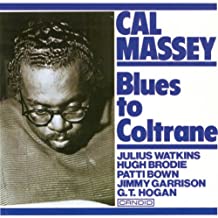
Calvin “Cal” Massey was born in Philadelphia, Pennsylvania on January 11, 1928 and studied trumpet under Freddie Webster. Following his studies, he played in the big bands of Jay McShann, Jimmy Heath, and Billie Holiday.
In the late 1950s Cal headed an ensemble with Jimmy Garrison, McCoy Tyner, and Tootie Heath. Occasionally John Coltrane and Donald Byrd would play with Massey’s group and in the 1950s he gradually receded from active performance and concentrated on composition.
His works were recorded by Coltrane, Tyner, Freddie Hubbard, Jackie McLean, Lee Morgan, Philly Joe Jones, Horace Tapscott and Archie Shepp. Massey played and toured with Shepp from 1969 until 1972 and also performed in The Romas Orchestra with Romulus Franceschini.
Massey’s political standpoint was radical and his work was strongly connected with the Civil Rights Movement of the 1960s and ’70s. The Black Panther Party was an inspiration for The Black Liberation Movement Suite which he created with Franceschini and was performed three times at Black Panther benefit concerts. His ideology resulted in him getting whitelisted from major recording companies and only one album was recorded under his name.
Trumpeter and composer Cal Massey passed away from a heart attack on October 25, 1972 at the age of 44 in New York City, New York.