

Daily Dose Of Jazz…
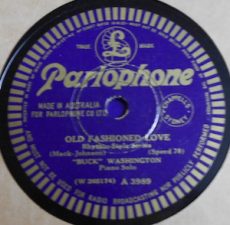
Ford Lee “Buck” Washington was born October 16, 1903 in Louisville, Kentucky. He and John W. Sublett, known by his stage name Bubbles, first began working together in the 1910s, while in his teens. Their duo was known as Buck and Bubbles.
Bubbles was primarily a tap dancer while Washington sang and played stride piano and sang. They were so popular that the duo moved to Manhattan, New York City in 1919 and by the late 1920s they were on Broadway. They played together in the Columbia Theater, the Palace, performing with Eddie Cantor, Al Jolson, and Danny Kaye. They were in the Ziegfeld Follies of 1931.
They became the first black artists to perform at Radio City Music Hall. They toured Europe in the 1930s and appeared on television and in films, including Calling All Stars in 1937 and Cabin in the Sky in 1942. They performed live in the first scheduled high definition television program on November 2, 1936 at Alexandra Palace in London, England for the BBC. In 1927, when Buck and Bubbles were performing at the Sunset Café, Buck developed a working relationship and friendship with Louis Armstrong.
As a pianist, Washington also recorded sessions in the 1930s with jazz musicians including Armstrong, Bessie Smith, Benny Goodman and Coleman Hawkins. He also played trumpet, though he only made home recordings on the instrument. He continued working with Bubbles until 1953, and then for a couple of years worked with Timmie Rogers and Jonah Jones.
Pianist, singer and vaudeville performer Buck Washington, with partner Bubbles were the first black artists to appear on television anywhere in the world, transitioned on January 31, 1955 in New York City.

More Posts: history,instrumental,jazz,music,piano,trumpet,vocal
Daily Dose Of Jazz…
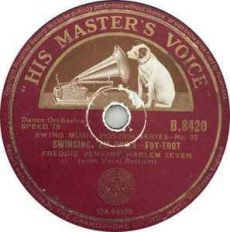
Freddie Jenkins was born on October 10, 1906 in New York City, New York and played in the Jenkins Orphanage Band when young before he attended Wilberforce University. Following this he played with Edgar Hayes and Horace Henderson between 1924 and 1928.
He then took a position in Duke Ellington’s Orchestra in 1928 where he soloed in the 1930 film Check and Double Check, during a performance of the song Old Man Blues. He remained with the Ellington Orchestra until 1935, when lung problems forced him to quit.
Recovered, he formed his own group in 1935, recording one session as a leader. His sidemen included Ward Pinkett, Albert Nicholas and Bernard Addison. After this he played with Luis Russell in 1936. Rejoining Ellington in 1937 he played with him for a year, then for a short time thereafter played with Hayes Alvis.
After 1938, his lung ailment returned and he retired again from performance. In his later years he worked as a songwriter, disc jockey, and in music press. He became a deputy sheriff in Fort Worth, Texas.
Trumpeter Freddie Jenkins transitioned in 1978.
Bestow upon an inquiring mind a dose of a New York City trumpeter to motivate the perusal of the genius of jazz musicians worldwide whose gifts contribute to the canon…
Freddie Jenkins: 1906~1978 | Trumpet
More Posts: bandleader,history,instrumental,jazz,music,trumpet
Daily Dose Of Jazz…
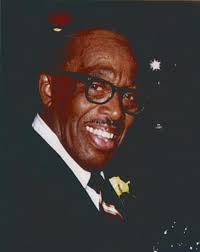
Myron Pierman “Mynie” Sutton was born October 9, 1903 in Niagara Falls, Canada. He worked in dance ensembles in Buffalo, New York and Cleveland, Ohio between 1924 and 1931. Returning to Canada in 1931 he founded the Canadian Ambassadors in Aylmer, Quebec. This was one of very few black jazz bands based out of Canada in the 1930s.
The group operated out of Montreal, Canada from 1933, playing at Connie’s Inn, the Hollywood Club, and Cafe Montmartre. Additionally they toured Quebec and Ontario. Pianists in the ensemble included Lou Hooper and Buster Harding.
By 1941 the Ambassadors had disbanded and Sutton returned to his birthplace of Niagara Falls, where he played locally for decades. He made no commercial recordings. A collection of materials devoted to Sutton is held at the Concordia University library in Montreal.
Alto saxophonist and bandleader Mynie Sutton transitioned on June 17, 1982 in Niagara Falls.
More Posts: bandleader,history,instrumental,jazz,music,saxophone
Daily Dose Of Jazz…
Alton “Slim” Moore was born October 7, 1908 in Selma, Alabama and began on baritone horn before settling on trombone by age 17. He played with local bandleaders and territory bands in his youth, such as Georgia Barlowe, Eddie Lemon, Gonzelle White, and Gene Coy.
Moving to New York City early in the Thirties he played with Jack Butler, Charlie Skeete, and Bobby Neal. Frequently switching ensembles in New York, in 1938 he did a short tour of Cuba with the Leon Gross Orchestra. Toward the end of the decade Moore moved up to play in more high-profile bands such as those of Fats Waller, Coleman Hawkins, Hot Lips Page, and Charlie Johnson. In the 1940s he played with Ella Fitzgerald, Benny Carter, Dizzy Gillespie and Louis Armstrong.
By the 1950s Slim had reduced his outings to part-time playing, after an extended stay in the band of Stafford “Pazuza” Simon. He would go on to play with Fletcher Henderson in 1957, and in the 1960s played in the Prince Hall Symphonic Band in New York as well as other big band revival outfits.
Trombonist Slim Moore, who also played and recorded on euphonium and did some scat singing, transitioned in 1978 in New York City.
More Posts: euphonium,history,instrumental,jazz,music,trombone
Daily Dose Of Jazz…
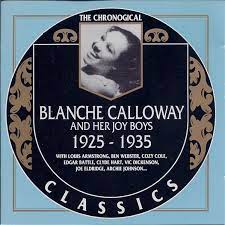
Edgar “Puddinghead” Battle was born on October 3, 1907 into a musical family in Atlanta, Georgia. In 1921 while a student at Morris Brown University he started playing trumpet and formed his own band, the Dixie Serenaders. A few years later the group changed their name to Dixie Ramblers.
Battle played with Eddie Heywood Sr., and toured with the 101 Ranch Boys traveling show. During the 1920s he worked with Gene Coy, Andy Kirk, Blanche Calloway, Ira Coffey, and Willie Bryant. A move to New York City in the early Thirties saw him doing short stints with Benny Carter and Sam Wooding before joining George White’s ensemble on Broadway.
Over time, he began doing more work as a studio musician and arranger, writing charts for Cab Calloway, Paul Whiteman, Fats Waller, Earl Hines, Rudy Vallee, and Count Basie. During World War II, Edgar held a position as an electrician in a shipyard, while simultaneously running a big band with Shirley Clay.
In the 1950s, he founded Cosmopolitan Records and continued to play in big bands part-time through the 1960s. Among his numerous jazz compositions are the pieces Topsy, co-composed with Eddie Durham and Doggin’ Around with Herschel Evans.
Trumpeter, trombonist, saxophonist and pianist Edgar “Puddinghead” Battle, who was also a composer and arranger, transitioned in New York City on February 6, 1977, at the age of 69.
More Posts: bandleader,history,instrumental,jazz,music,piano,saxophone,trombone,trumpet